When The Fast and the Furious hit theaters in 2001, it ignited a global obsession with tuner culture. Overnight, cars like the Nissan Skyline GT‑R R34, Toyota Supra Mk4, and Mitsubishi Eclipse became icons of street performance.
Back then, car modding looked simple: bolt on a turbo, install a body kit, maybe wire up a nitrous system, and hit the streets. But two decades later, enthusiasts often debate whether modifying cars has actually become easier or harder.
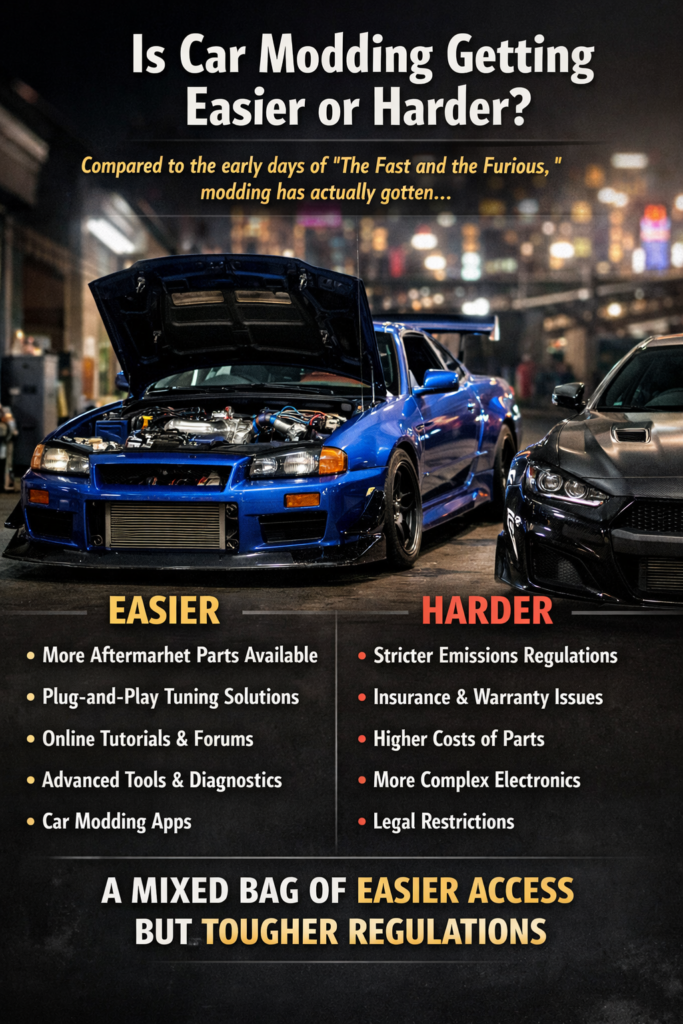
The honest answer: technically easier, but practically harder.
The tools, information, and parts available today are better than ever. Yet modern regulations, electronics, and costs have created new barriers that didn’t exist in the early 2000s.
Let’s break down why.
Why Car Modding Is Easier Today
1. Unlimited Knowledge Online
In the early 2000s, knowledge was scarce. Most enthusiasts relied on:
- Car magazines
- Local tuners
- Small forums
Today, you have:
- YouTube tutorials
- Massive global forums
- Discord communities
- ECU tuning guides
- full step-by-step builds documented online
A beginner today can learn in a few hours what once took years of trial and error.
2. Plug-and-Play Performance Parts
Back in the Fast and Furious era, many modifications required custom fabrication.
Today:
- ECU tunes can be flashed with a laptop
- Bolt-on turbo kits exist for many cars
- Pre-made wiring harnesses are common
- Performance parts are designed to fit perfectly
Even complex systems like standalone ECUs (Haltech, Motec, etc.) have much more user-friendly software compared to early tuning tools.
3. Global Aftermarket Industry
The aftermarket industry has exploded.
You can now buy:
- Coilovers shipped worldwide
- Engine swap kits
- Complete turbo systems
- Custom ECUs
- Widebody kits
In 2001, enthusiasts often had to import parts slowly or fabricate them locally.
Today, Amazon-level logistics exist for performance parts.
4. Better Diagnostic Tools
Modern tools allow enthusiasts to diagnose problems quickly.
Examples include:
- OBD scanners
- ECU datalogging
- wideband AFR monitoring
- knock detection
In the early 2000s, diagnosing an engine issue could mean hours of guesswork.
Now you can literally watch your engine’s data live on a laptop.
Why Car Modding Is Harder Today
Despite those advantages, many enthusiasts feel modding has actually become more difficult overall.
Here’s why.
1. Modern Cars Are Much More Complex
Cars in the early 2000s were relatively simple.
Today’s vehicles contain:
- dozens of ECUs
- complex CANBUS networks
- encrypted software
- integrated sensors controlling everything
Modifying one system can trigger errors across the entire vehicle.
Even changing something simple like an exhaust can cause:
- check engine lights
- limp mode
- emissions faults.
2. Emissions Regulations Are Much Stricter
Government regulations worldwide have become far more aggressive.
Many regions now ban:
- catalytic converter removal
- certain ECU tunes
- non-approved exhaust systems
In some places, even mild performance mods can fail inspections.
This was far less enforced in the early 2000s.
3. Insurance and Legal Risks
Insurance companies today often penalize modified vehicles.
Problems include:
- higher premiums
- denied claims
- inspection failures
- police crackdowns on modified cars
Street racing culture that once thrived in the early 2000s now faces much stronger enforcement.
4. Cars Are More Disposable
Many modern vehicles are harder to modify because they are built around:
- sealed electronics
- proprietary software
- non-serviceable components
Manufacturers increasingly design cars for lease cycles, not long-term modification.
5. Rising Costs
Ironically, modding has become far more expensive.
Examples:
Early 2000s:
- turbo kit: ~$2000
- coilovers: ~$800
- ECU: ~$1000
Modern performance builds can easily exceed $10k–$20k for similar upgrades.
And the base cars themselves are also more expensive.
The Real Truth: Modding Has Shifted
The reality is not that modding is dying — it’s evolving.
In the early 2000s, modding was:
- mechanical
- garage-built
- experimental
Today, it is increasingly:
- software-driven
- data-based
- highly engineered.
Tuning now often involves laptops and firmware, not just wrenches.
The Golden Age of Modding May Have Been 2000–2015
Many enthusiasts argue the true golden age of car modification occurred between:
2000 and 2015.
That period had:
- simpler cars
- huge aftermarket growth
- rising internet communities
- fewer restrictions.
It was the perfect storm for tuner culture.
Final Verdict
Technically:
Car modding is easier than ever.
Practically:
It’s harder than it used to be.
Technology has empowered enthusiasts with incredible tools, but regulations, complexity, and cost have made the hobby more restrictive.
Ironically, the cars from the era of The Fast and the Furious are now becoming the most desirable platforms to modify, precisely because they were built before the modern wave of software control and regulation.