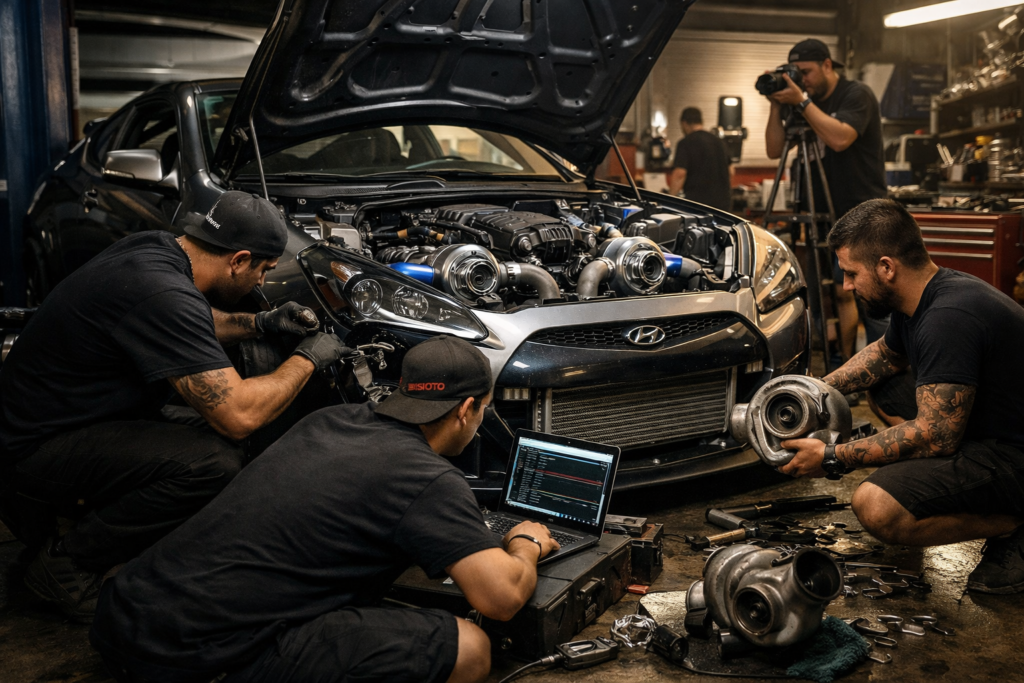
For years, the global tuning scene revolved around a few dominant cultures. Japanese tuner cars defined the 1990s. European performance builds rose through the 2000s. But in the last decade, a new movement has been quietly gaining momentum.
Korean tuning culture—once almost nonexistent—is now becoming one of the fastest-growing enthusiast scenes in the automotive world.
From humble beginnings with budget coupes to modern track-ready performance machines, the rise of Korean tuner culture is one of the most interesting developments in modern car enthusiasm.
The Early Years: When Korean Cars Were Underdogs
In the late 1990s and early 2000s, Korean manufacturers like Hyundai Motor Company and Kia were not known for performance.
Their reputation was built mostly around:
- affordable commuter cars
- reliability improvements
- value for money
For car enthusiasts, Korean vehicles were rarely considered tuning platforms.
However, a few models began attracting attention from modders looking for something different. Cars like the Hyundai Tiburon started appearing at local car meets with:
- body kits
- aftermarket wheels
- custom exhaust systems
At the time, these builds were often inspired by Japanese tuner culture. Enthusiasts were experimenting, adapting the style and spirit of JDM builds to Korean platforms.
It was the very beginning of KDM culture.
The Genesis Coupe Era
Everything changed in 2008.
That year Hyundai released the Hyundai Genesis Coupe, a rear-wheel-drive sports coupe designed specifically with performance in mind.
For the first time, Korean car enthusiasts had a platform that checked many of the same boxes that made Japanese tuner cars so popular:
- rear-wheel drive
- turbocharged engine options
- strong aftermarket potential
The Genesis Coupe quickly became the backbone of Korean tuning culture.
Enthusiasts began pushing the platform with:
- turbo upgrades
- ECU tuning
- widebody builds
- drift setups
Suddenly, Korean cars were appearing at track events, drift competitions, and tuner shows around the world.
The Rise of Hyundai N
While the Genesis Coupe helped legitimize Korean performance cars, the real turning point came in the late 2010s.
Hyundai launched its dedicated performance division: Hyundai N.
Led by former BMW M engineer Albert Biermann, the goal was simple:
Build cars that enthusiasts actually wanted to drive.
The results were immediate.
Cars like the Hyundai Veloster N and Hyundai Elantra N quickly gained international praise for their:
- track-ready suspension
- aggressive driving dynamics
- driver-focused engineering
For tuners, these cars offered something extremely valuable: a modern performance platform that was still affordable.
The aftermarket scene began expanding rapidly.
The Growth of the KDM Community
As more performance-oriented Korean cars appeared on the market, a new enthusiast identity began forming: KDM (Korean Domestic Market) culture.
Much like JDM culture before it, KDM began to develop its own style.
Typical Korean tuner builds often emphasize:
Aggressive aesthetics
- widebody kits
- bold colors
- aerodynamic modifications
Performance upgrades
- ECU tuning
- larger turbos
- upgraded intercoolers
Track and street presence
- stance builds
- track builds
- show builds
Car meets dedicated specifically to Korean vehicles have started appearing in cities across North America, Europe, and Asia.
Communities and groups centered around Korean performance cars are growing every year.
The Electric Performance Revolution
One of the most interesting aspects of Korean tuning culture is that it is evolving during a major transition in the automotive world.
While traditional tuner culture has always focused on combustion engines, Korean manufacturers are pushing heavily into high-performance electric vehicles.
Cars like the Hyundai Ioniq 5 N and Kia EV6 GT are redefining what performance cars can look like in the electric era.
This opens the door to an entirely new form of tuning:
- software tuning
- cooling upgrades
- suspension performance setups
- aerodynamic modifications
The future of Korean tuning culture may blend traditional car modification with digital performance engineering.
A New Chapter in Car Culture
Today, Korean cars are no longer seen as outsiders in the enthusiast world.
They are becoming serious performance machines capable of competing with established sports car brands.
More importantly, a new generation of enthusiasts is embracing them not just for their performance—but for what they represent.
Just like the early days of JDM culture, Korean tuning culture is driven by:
- creativity
- experimentation
- community
And if the momentum continues, the next decade could see Korean cars become one of the defining forces in the global tuner scene.
The evolution of Korean tuning culture is only just beginning.