
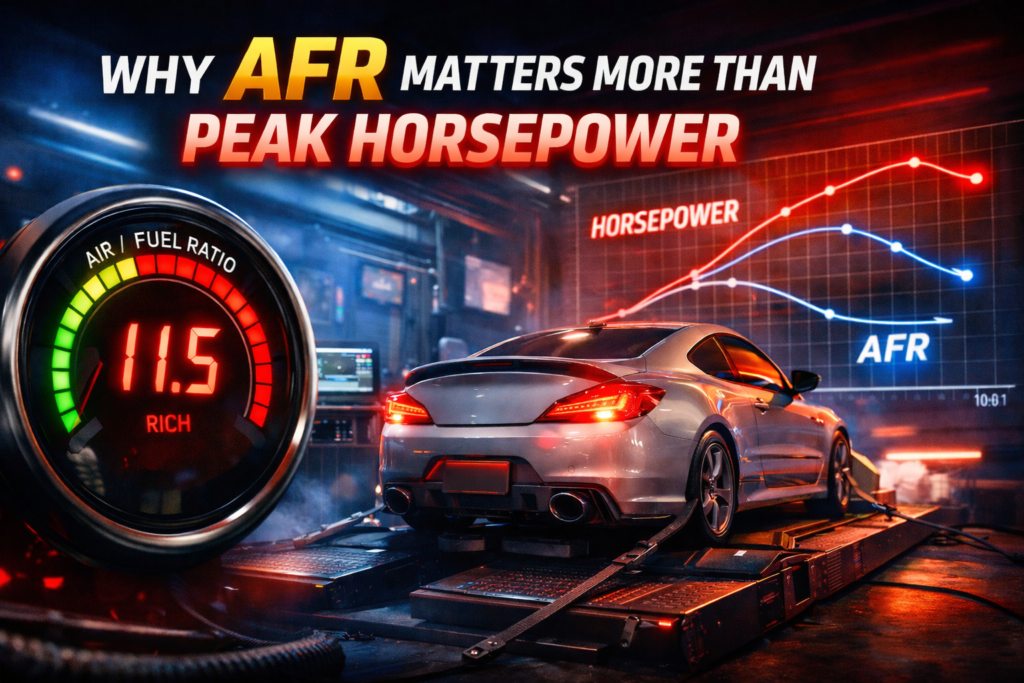
Why AFR Matters More Than Peak Horsepower
The overlooked metric that determines whether your engine thrives—or fails.
In the world of performance tuning, peak horsepower often steals the spotlight. Dyno charts, racing bragging rights, and marketing materials all celebrate the highest number achieved at full throttle. Yet seasoned tuners and engineers know that a different metric holds far greater importance: Air-Fuel Ratio (AFR). While horsepower may win races on paper, AFR determines whether your engine survives long enough to compete.
What Is AFR?


Air-Fuel Ratio refers to the proportion of air to fuel entering an engine’s combustion chamber. It is typically expressed as a numerical ratio.
- 14.7:1 – Stoichiometric ratio for gasoline; ideal for efficiency and emissions.
- 12.5–13.0:1 – Common target for naturally aspirated performance under load.
- 11.0–12.0:1 – Typical for turbocharged or high-performance engines under boost.
- Above 15.0:1 – Lean mixtures, which may improve fuel economy but increase risk under load.
Maintaining the correct AFR ensures optimal combustion, power delivery, and engine longevity.
The Obsession with Peak Horsepower


Peak horsepower represents the maximum output an engine can achieve at a specific RPM. It’s an impressive figure, but it tells only part of the story.
Why enthusiasts chase peak horsepower:
- Marketing Appeal: Big numbers attract attention.
- Dyno Competitions: Higher peaks mean bragging rights.
- Benchmarking: Easy to compare across builds.
- Psychological Satisfaction: It feels like tangible progress.
However, peak horsepower does not reveal whether an engine is running safely or efficiently across its powerband.
Why AFR Matters More Than Peak Horsepower
1. Engine Safety and Longevity
An incorrect AFR can quickly destroy an engine:
- Lean Conditions: Cause overheating, detonation, and potential piston damage.
- Rich Conditions: Lead to carbon buildup, fouled spark plugs, and reduced efficiency.
A safe AFR ensures your engine lasts beyond a few dyno pulls.
2. Real-World Performance Over Dyno Glory
Peak horsepower is measured at a single RPM. AFR, on the other hand, influences performance across the entire rev range. A properly tuned AFR provides:
- Smooth acceleration
- Consistent throttle response
- Reliable power delivery
This translates to faster lap times and better drivability.
3. Critical for Forced Induction Builds
Turbocharged and supercharged engines rely heavily on precise AFR tuning.
- Too Lean: Catastrophic failure under boost.
- Properly Tuned: Maximum safe power and reliability.
For performance builds—such as turbocharged Korean platforms like the Hyundai Tiburon or Genesis Coupe—AFR tuning is the difference between a reliable daily driver and a blown engine.
4. Fuel Efficiency and Emissions
Correct AFR optimizes combustion, resulting in:
- Improved fuel economy
- Reduced emissions
- Cleaner engine operation
Even performance enthusiasts benefit from efficient daily driving.
5. Consistency Beats Peak Numbers
A well-tuned AFR ensures repeatable results across varying conditions:
- Temperature fluctuations
- Altitude changes
- Different fuel qualities
Consistency builds trust in your vehicle—whether commuting or racing.
Ideal AFR Targets
| Driving Condition | Naturally Aspirated | Turbocharged |
|---|---|---|
| Idle | 14.5–15.0:1 | 14.5–15.0:1 |
| Cruising | 14.7–15.5:1 | 14.7–15.5:1 |
| Moderate Acceleration | 13.0–13.5:1 | 12.5–13.0:1 |
| Wide Open Throttle | 12.5–13.0:1 | 11.0–12.0:1 |
Note: Exact values vary depending on engine design, fuel type, and tuning strategy.
Real-World Example: The Daily-Driven Performance Car
Imagine two identical cars:
- Car A: Produces 400 horsepower but runs dangerously lean.
- Car B: Produces 370 horsepower with a perfectly tuned AFR.
While Car A may boast superior dyno numbers, Car B delivers:
- Reliable performance
- Better drivability
- Longer engine life
In reality, Car B is the superior machine.
The Role of Modern Engine Management Systems
Today’s ECUs and tuning software—such as Haltech, AEM, and standalone engine management systems—allow tuners to monitor and refine AFR with precision. Wideband oxygen sensors provide real-time data, ensuring optimal performance and safety under all conditions.
Conclusion: Power Is Nothing Without Balance
Peak horsepower may win headlines, but AFR wins longevity, reliability, and real-world performance. A well-balanced engine with an optimized air-fuel mixture will always outperform—and outlast—one tuned solely for maximum output.
In performance tuning, horsepower impresses—but AFR protects, refines, and perfects.