
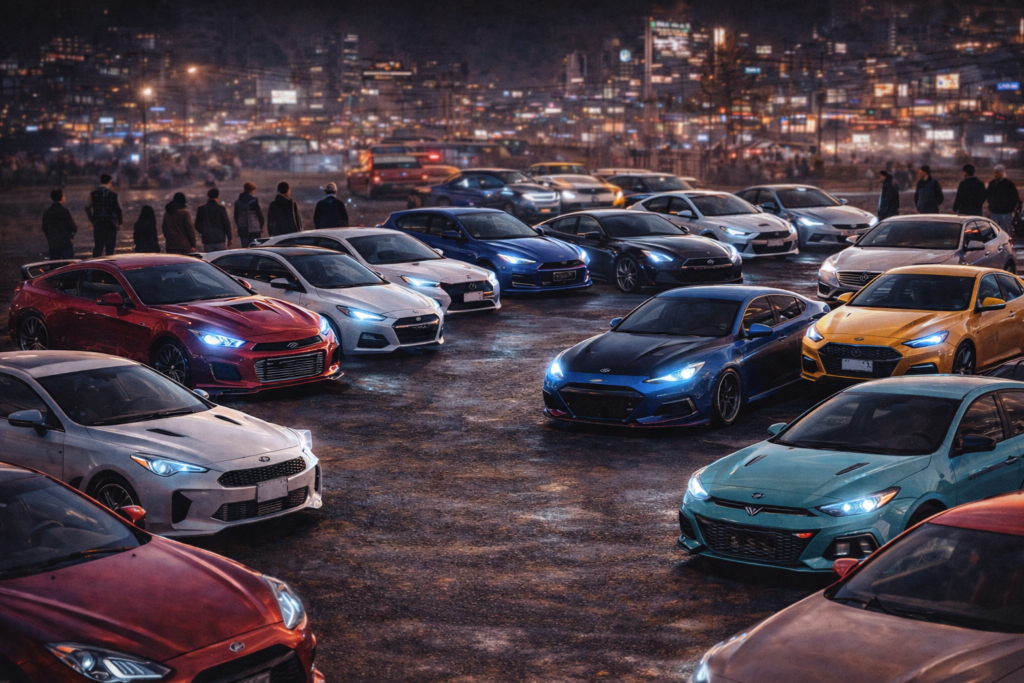
Why Korean Car Meets Feel Different
Less ego, more experimentation—and a culture still being built in real time
Editor’s Note
If you’ve been to enough car meets, you start to notice something:
Not all scenes feel the same.
Walk into a traditional JDM or Euro meet and there’s often an established energy:
- hierarchy
- expectations
- unspoken rules
But step into a Korean car meet—whether it’s in Seoul or Toronto—and the vibe feels different.
Less rigid.
More open.
Almost… unfinished.
And that’s exactly what makes it powerful.
🧠 1. A Culture That Isn’t Fully Defined Yet
JDM and Euro scenes have decades of history behind them.
That comes with:
- strong identity
- established “right” ways to build
- clear social hierarchy
Korean car culture?
Still forming.
There’s no fixed blueprint for:
- what a “proper” build looks like
- what mods are “correct”
- what defines status
👉 Which means:
You’re not stepping into a system—you’re helping build one.
🔧 2. More Builders, Fewer Buyers
At many traditional meets, you’ll see:
- high-end cars
- lightly modified platforms
- status-driven builds
At Korean car meets, it’s different.
You see:
- DIY solutions
- experimental setups
- evolving builds
Why?
Because Korean platforms often require:
👉 more creativity
👉 more problem-solving
Which attracts:
👉 builders, not just owners
⚖️ 3. Less Hierarchy (For Now)
In established scenes, there’s often a silent ranking system:
- who has the best car
- who gets attention
- who matters
Korean car meets feel flatter.
You’ll often find:
- people actually talking across groups
- less intimidation for newcomers
- less “prove yourself first” energy
It’s not that hierarchy doesn’t exist—
👉 it’s just not fully formed yet.
🌍 4. Global Influence Without a Fixed Identity
Korean car culture pulls from everywhere:
- JDM styling
- Euro performance
- American power builds
But it hasn’t locked into one identity.
That creates:
👉 hybrid builds
👉 mixed styles
👉 new interpretations
You might see:
- a track-focused Elantra N
- a stance-focused Genesis Coupe
- a DIY turbo Tiburon
All in the same meet.
And all equally valid.
🧪 5. Experimentation Is Still Encouraged
In older scenes, deviation can get judged.
In Korean car meets?
Experimentation is expected.
Because:
- aftermarket support is still growing
- there’s no “standard formula”
- people are figuring things out in real time
That leads to:
👉 more innovation
👉 more unique builds
👉 more trial and error
🔥 6. The Underdog Bond
There’s a shared understanding in Korean car meets:
👉 “We know how people see these cars.”
That creates a different kind of connection.
Instead of competing for status, there’s often:
- mutual respect
- shared experience
- quiet confidence
You’re not just showing up with a car.
You’re showing up with a perspective.
🧠 7. Ego vs Identity
Traditional meets can sometimes lean toward:
- flexing
- comparison
- status signaling
Korean meets tend to lean more toward:
- identity
- creativity
- individuality
Not always—but more often.
Because when you choose a Korean platform, you’re already:
👉 stepping outside the mainstream
🌱 8. You Can Feel the Growth
One of the most unique things about Korean car meets is:
👉 they feel like they’re evolving
You can literally see:
- builds improving over time
- people learning from each other
- the scene getting stronger
It doesn’t feel static.
It feels alive.
⚠️ The Trade-Off (Let’s Be Honest)
That openness comes with downsides:
- inconsistent turnout
- varying build quality
- less recognition from outside scenes
But those are symptoms of:
👉 a culture still in development
🚀 Why This Is Actually the Best Phase
Every major car scene goes through this stage:
- undefined
- experimental
- growing
- established
Korean car culture is right between:
👉 stage 2 and 3
And that’s the most interesting phase.
Because:
👉 nothing is locked in yet
🏁 Final Thoughts
Korean car meets feel different because they are.
They’re not built on decades of expectation.
They’re built on:
- curiosity
- experimentation
- early adopters
And while other scenes might feel more polished…
Korean car culture feels more real.
🔥 Closing Line
Some scenes are inherited.
Others are created.
Korean car culture is still being created.