
From “cheap commuter” to one of the fastest-rising performance platforms in the world
Editor’s Note
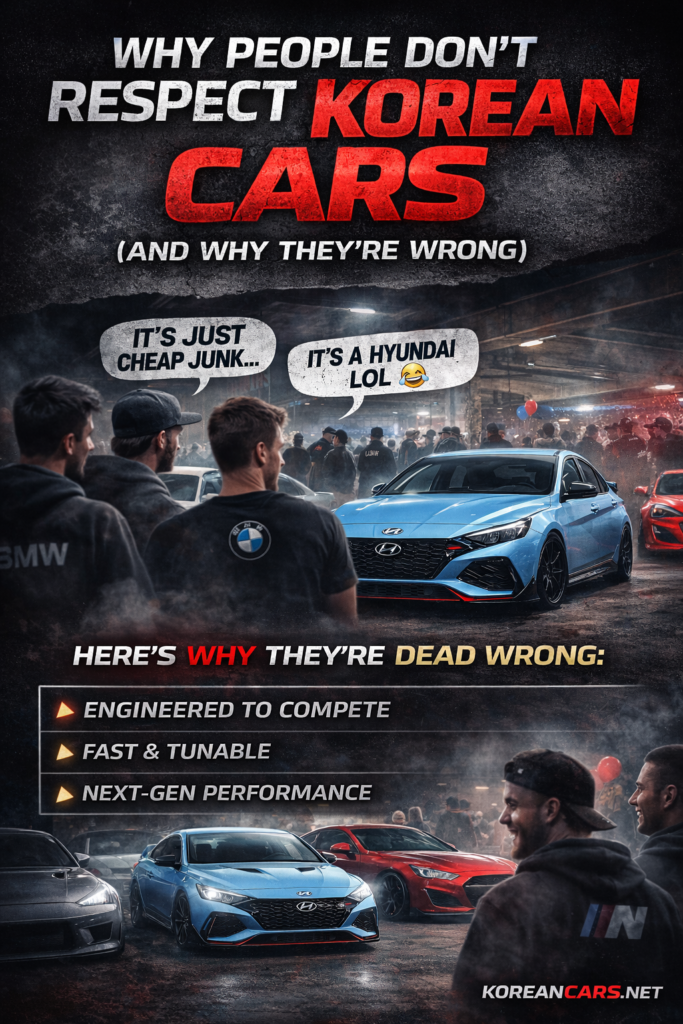
Walk into almost any traditional car meet and you’ll still feel it.
That subtle reaction when you pull up in a Hyundai or Kia.
The raised eyebrow. The half-smirk. The unspoken assumption:
“It’s just a Hyundai.”
But here’s the reality:
That perception is outdated.
And the people holding onto it?
They’re missing one of the biggest shifts happening in car culture right now.
🧠 1. The Reputation Lag Problem
Korean cars suffer from something most brands can’t escape:
Their past.
In the late 90s and early 2000s, brands like Hyundai Motor Company and Kia were known for:
- budget pricing
- basic design
- minimal performance
Back then, the criticism was fair.
But the problem is:
People stopped updating their opinions.
Meanwhile, Hyundai didn’t just improve—it completely reinvented itself.
🔄 2. The Industry Changed—People Didn’t
Over the last decade, Korean manufacturers quietly:
- hired top engineers from Germany
- invested heavily in R&D
- focused on performance divisions
The biggest move?
Bringing in Albert Biermann to lead performance development.
That’s not a small detail.
That’s like taking the DNA of BMW M… and putting it into a Hyundai.
Cars like the Hyundai Elantra N and Hyundai Veloster N didn’t happen by accident.
They were engineered to compete.
And they do.
🏁 3. Badge Snobbery Is Still Real
Let’s be honest.
A lot of car culture isn’t about performance.
It’s about status.
Driving a BMW, Audi, or Mercedes still carries a certain image.
Driving a Hyundai?
Not so much—yet.
That creates a bias where people judge cars based on:
- brand perception
- price tag
- social status
Instead of:
- handling
- performance
- driving experience
And that’s where Korean cars get unfairly dismissed.
⚖️ 4. Performance vs Perception
Here’s where things break down.
Put a Hyundai Elantra N next to a German performance sedan on a track, and something interesting happens:
It doesn’t just keep up.
It competes.
In some cases—it wins.
Why?
Because Hyundai focused on:
- lightweight performance
- driver engagement
- track capability
While many competitors shifted toward:
- luxury
- tech
- refinement
Different priorities. Different results.
🔧 5. The Aftermarket Myth
Another reason Korean cars aren’t respected:
“There’s no aftermarket.”
That used to be true.
Not anymore.
Today, platforms like:
- Hyundai Genesis Coupe
- Hyundai Elantra N
- Kia Stinger GT
…have growing support for:
- turbo upgrades
- ECU tuning
- suspension setups
- full builds
And because the scene is still young, there’s something even more valuable:
👉 Room to innovate
🌍 6. Being Early Looks Like Being Wrong
Here’s a pattern you see in every car culture shift:
- Early adopters get ignored
- Then criticized
- Then copied
Japanese cars went through this.
So did European tuning.
Now?
It’s happening with Korean cars.
Right now, owning and building a Hyundai performance car feels like being early.
And being early always looks like being wrong—until it isn’t.
🧪 7. The DIY Advantage
Korean platforms are benefiting from something unique:
They’re growing during the DIY era.
With tools like:
- ECU tuning software
- online communities
- 3D printing
Builders aren’t waiting for aftermarket companies.
They’re creating their own solutions.
That leads to:
- faster innovation
- unique builds
- stronger grassroots culture
And that’s how real car scenes are built.
🚀 8. The Next Generation Doesn’t Care About Badges
Younger enthusiasts are starting to shift priorities.
They care more about:
- performance per dollar
- uniqueness
- driving experience
Less about:
- brand legacy
- old reputations
- status symbols
That’s a huge advantage for Korean cars.
Because they deliver exactly what this new generation values.
🏁 Final Thoughts
People don’t respect Korean cars for one simple reason:
They’re still judging them based on what they used to be.
Not what they are now.
But the reality is:
- they’re fast
- they’re capable
- they’re evolving rapidly
And most importantly—
They represent the next wave of car culture.
🔥 Closing Line
The same people laughing at Korean cars today…
Will be the ones trying to build them tomorrow.