0
0
 0
0
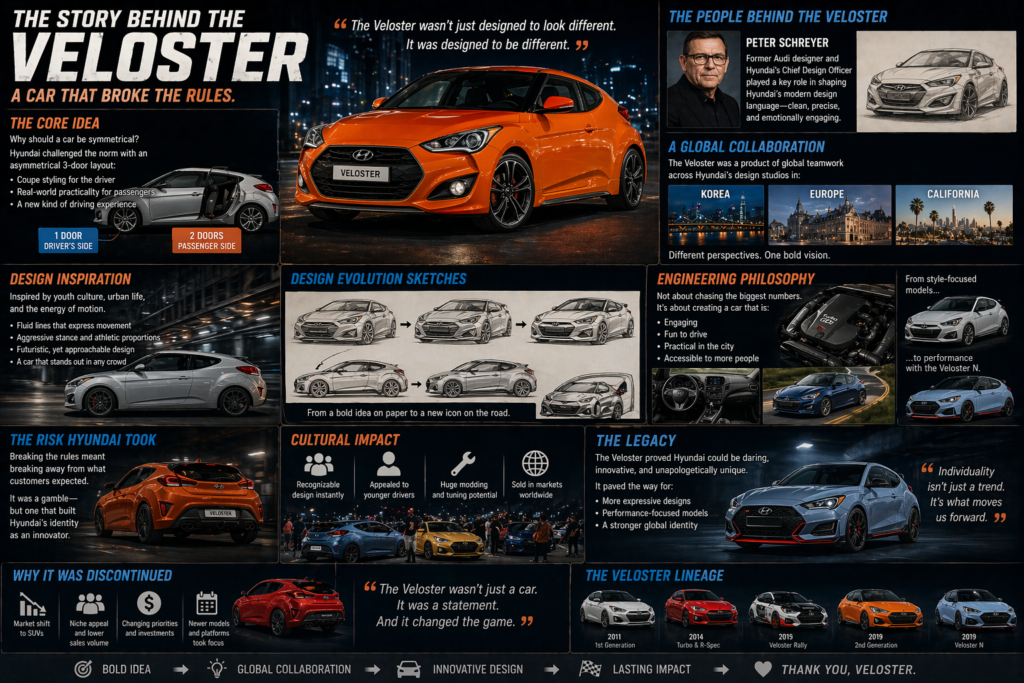
If the Hyundai Genesis Coupe was Korea’s attempt to prove it could build a traditional sports coupe, the Veloster was something completely different:
👉 A car that ignored the rules entirely.
The Hyundai Veloster wasn’t about copying existing formulas—it was about creating a new one. And behind that bold move was a mix of global designers, unconventional thinking, and a willingness to take risks that most automakers avoid.
🧠 The Core Idea: “Why Should a Car Be Symmetrical?”


The Veloster’s defining feature is obvious:
👉 One door on the driver’s side
👉 Two doors on the passenger side
This wasn’t a gimmick added later—it was the starting point.
The Problem Hyundai Wanted to Solve:
- Coupes look sporty, but aren’t practical
- Hatchbacks are practical, but not exciting
The Solution:
👉 Combine both
- Driver gets the coupe experience
- Passengers get real access
This idea alone made the Veloster one of the most unique cars ever produced.
👥 The People Behind the Veloster
Peter Schreyer — Design Leadership Influence


While not the sole designer, Peter Schreyer (former Audi designer turned Hyundai design chief) played a huge role in shaping Hyundai’s modern design identity.
His philosophy:
- Clean lines
- Strong identity
- European-influenced precision
👉 The Veloster reflects this—but with a twist of rebellion.
Global Hyundai Design Teams (Korea + Europe + California)


The Veloster wasn’t designed in one place.
It was a global collaboration:
- Korea (engineering + identity)
- Europe (design refinement)
- California (youthful, lifestyle-driven input)
Why This Matters:
The Veloster was aimed at:
- Younger buyers
- Urban environments
- Style-conscious drivers
👉 It needed a global perspective
🎨 Design Inspiration: Youth, Motion, and Urban Energy


The Veloster wasn’t trying to look like a traditional sports car.
Key Design Themes:
- Motion even when standing still
- Aggressive front fascia
- Compact, athletic proportions
- Futuristic hatchback silhouette
It was inspired by:
- Urban lifestyles
- Compact European hot hatches
- Youth culture and individuality
👉 It was designed to feel alive and different
⚙️ Engineering Philosophy: Fun Over Perfection


The Veloster wasn’t built to dominate specs.
It was built to:
- Be engaging
- Feel playful
- Offer something different
Early Versions:
- Focused on style + affordability
Later Evolution:
- Hyundai Veloster N introduced real performance
- Tuned by Hyundai’s growing performance division
👉 It evolved from quirky to serious hot hatch contender
🔥 The Risk Hyundai Took


Let’s be clear:
👉 The Veloster was a gamble.
Most companies would never:
- Break symmetry
- Create a new category
- Risk confusing customers
But Hyundai did.
And that risk paid off by:
- Building brand identity
- Attracting new buyers
- Standing out in a crowded market
🌍 Cultural Impact
The Veloster became:
- A recognizable design instantly
- A favorite for younger drivers
- A platform for creative builds
In the KDM scene, it represents:
👉 Individuality over conformity
🧠 Why It Was Discontinued
Despite its uniqueness, the Veloster eventually ended production.
Reasons include:
- Market shift toward SUVs
- Niche appeal
- Changing priorities
But like the Genesis Coupe…
👉 Its impact outlived its production run
🏁 The Real Legacy


The Veloster proved something important:
👉 Hyundai didn’t have to follow the rules to succeed
It paved the way for:
- More expressive designs
- Performance-focused models
- A stronger global identity
Conclusion
The Hyundai Veloster wasn’t just a car—it was a statement.
Built by:
- Global designers
- Forward-thinking leadership
- A willingness to take risks
It showed that Korean cars could be:
- Fun
- Different
- Unapologetically unique
And in a world of increasingly similar vehicles…
👉 That might be its greatest achievement.