0
 0
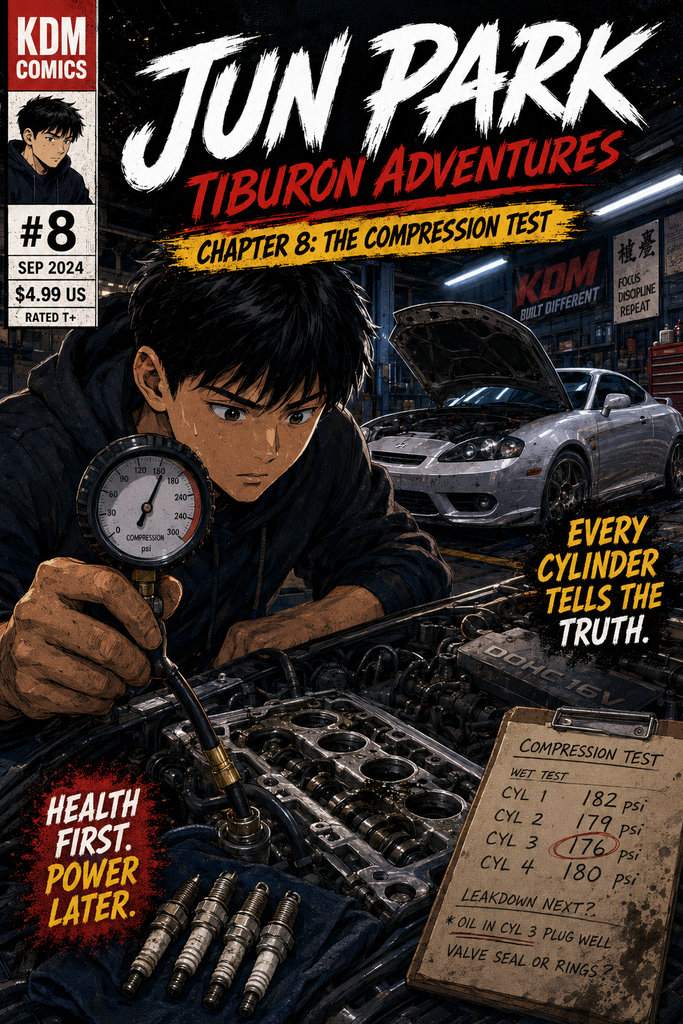
Jun Park had learned that a smooth-running engine could still hide questions.
The Tiburon’s misfire was gone.
Its idle was steady.
Its acceleration felt clean again.
But every time Jun opened the hood, his eyes returned to the same place—the faint oil residue near the spark-plug well.
Daniel had cleaned it.
Jun had checked it twice since then.
It had not returned.
Not yet.
Still, two words followed him everywhere.
Compression test.
Minho had recommended one after the dyno session.
Daniel had repeated it after the misfire.
And now Jun could not stop imagining what the numbers might reveal.
He searched online late into the night.
Some people treated compression testing like a simple health check.
Others described it like a mechanical judgment day.
Jun found photographs of gauges showing perfectly even cylinders.
Then photographs of one cylinder sitting far below the others.
Burned valves.
Worn piston rings.
Failed head gaskets.
Cracked pistons.
The internet had once again provided every possible disaster except peace of mind.
Jun closed the laptop.
Then opened it again.
“Symptoms of low compression Hyundai Tiburon.”
The next morning, Jun called Daniel.
“Are you busy Saturday?”
“Yes.”
Jun waited.
Daniel sighed.
“But I know you’re going to ask about the compression test.”
“I was.”
“Bring the car at ten.”
Jun arrived at 9:32.
Daniel was still raising the garage door.
“You’re early.”
“I didn’t sleep properly.”
“That seems healthy.”
Jun parked the Tiburon inside.
The engine sounded normal.
Perfectly normal.
Almost suspiciously normal.
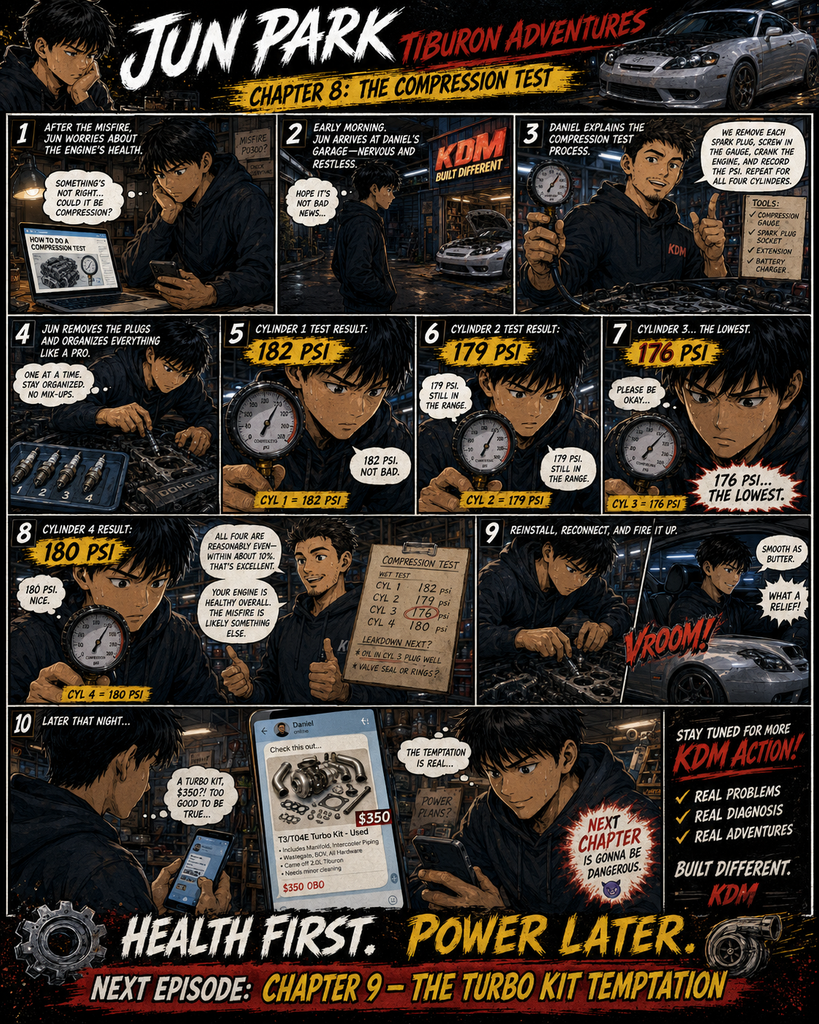
Daniel placed a compression gauge on the workbench.
It was smaller than Jun expected.
A round dial.
A flexible hose.
A threaded fitting.
Jun picked it up carefully.
“This tells us whether the engine is healthy?”
“It gives us one important piece of information.”
“So it doesn’t tell us everything?”
“Nothing tells us everything.”
Jun placed it back down.
“Cars are inconvenient.”
“That is why we like them.”
Daniel explained the process.
The engine should be warm.
The battery needed enough charge to crank consistently.
The ignition and fuel systems would be disabled so the engine could turn without starting.
All spark plugs would be removed.
Then each cylinder would be tested under the same conditions.
“What number do we want?” Jun asked.
Daniel shook his head.
“Before you obsess over one number, understand the comparison.”
“The cylinders should be close to each other.”
“Exactly.”
“How close?”
“Close enough that one cylinder isn’t clearly weaker than the rest. The exact acceptable difference depends on the engine and the test conditions.”
Jun frowned.
“So there isn’t one magical number.”
“There rarely is.”
“That makes the internet very misleading.”
“The internet did not ask you to treat every number like a prophecy.”
They warmed the engine, then shut it down.
Jun removed the ignition components carefully.
He arranged them in order, just as Daniel had taught him during the misfire repair.
Cylinder one.
Cylinder two.
Cylinder three.
Cylinder four.
The new spark plugs still looked clean.
Jun inspected the third plug twice.
No unusual darkening.
No fresh oil.
That helped.
A little.
Daniel threaded the compression tester into cylinder one.
“Get in.”
Jun sat behind the wheel.
“Throttle open while cranking?”
Daniel nodded.
“And count the compression strokes. We want the same procedure every time.”
Jun turned the key.
The starter engaged.
The engine rotated without firing.
The gauge needle jumped.
Again.
Again.
Again.
Daniel raised a hand.
“Stop.”
Jun released the key.
Daniel studied the gauge.
Jun stepped out immediately.
“Well?”
Daniel wrote the result on a piece of cardboard.
Cylinder 1: 182 psi
Jun stared at the number.
“Is that good?”
“It’s one cylinder.”
“So?”
“So we test the others.”
Cylinder two came next.
Jun cranked the engine again.
The needle climbed.
Daniel watched.
Jun watched Daniel.
Daniel wrote another number.
Cylinder 2: 179 psi
Jun compared them.
“Three lower.”
“Yes.”
“Is that bad?”
“No.”
“You answered too quickly again.”
Daniel moved to the next cylinder.
Cylinder three.
The cylinder that had misfired.
The cylinder with the oil in the plug well.
The cylinder Jun had been thinking about for days.
Daniel threaded in the gauge.
Jun returned to the driver’s seat.
His hand rested on the key.
“What if it’s low?”
“Then we learn something.”
“What if it’s very low?”
“Then we learn something important.”
Jun looked through the windshield.
Daniel stood beside the open hood, waiting.
Jun turned the key.
The starter spun.
The needle jumped.
Jun counted.
One.
Two.
Three.
Four.
Daniel raised his hand.
“Stop.”
Jun stepped out slowly.
Daniel looked at the gauge.
He did not speak.
Jun’s stomach tightened.
“What?”
Daniel wrote the result.
Cylinder 3: 176 psi
Jun stared.
“That’s lower.”
“Yes.”
“How much lower?”
“Six below the highest cylinder so far.”
“Is that bad?”
Daniel looked at him.
“No.”
“Are you sure?”
“That difference is not alarming.”
“But it’s the lowest.”
“We still have another cylinder.”
Jun looked toward the fourth plug hole.
For some reason, cylinder four now felt like the final judge.
They repeated the process.
The engine cranked.
The gauge climbed.
Daniel recorded the result.
Cylinder 4: 180 psi
Jun stood over the cardboard.
Four numbers.
Close.
But not identical.
He pointed at cylinder three.
“That one is weaker.”
Daniel leaned against the car.
“It is slightly lower.”
“So there is a problem.”
“There is a difference.”
“Which means a problem.”
“Not necessarily.”
Jun crossed his arms.
“Then why test anything if every answer is ‘not necessarily’?”
Daniel laughed.
“Because diagnosis is interpretation, not panic.”
Daniel explained that the results were reasonably even.
Cylinder three was the lowest, but not dramatically so.
The engine did not show the kind of large imbalance that would immediately suggest a serious sealing failure.
The consistency mattered.
The engine’s behaviour mattered.
The lack of smoke mattered.
The clean pull under load mattered.
The compression readings supported what the car had already been showing.
The engine was not new.
But it appeared healthy.
Jun looked at the cardboard again.
“So I can turbo it.”
Daniel’s expression changed immediately.
“That is not what I said.”
“But the compression is good.”
“The compression is encouraging.”
“So—”
“So now we have one more reason not to rush.”
Jun sighed.
“That feels backward.”
“A healthy engine is worth protecting.”
Jun picked up the cylinder-three spark plug.
“What about the oil?”
“The oil was around the plug, not necessarily inside the combustion chamber.”
“So the upper seal is still the likely problem.”
“Yes.”
“And we should replace it.”
“Yes.”
“Before adding power.”
Daniel nodded.
“Now you’re learning.”
Jun placed the plug down.
“I was hoping the lesson would be ‘install turbo.’”
“That lesson comes from people selling turbos.”
Daniel suggested one more test.
A small amount of oil could be added to the lower cylinder before repeating a compression check.
If the reading rose significantly, worn piston rings might be contributing.
If it stayed nearly the same, the difference could relate more to the valves or simply normal variation.
Jun immediately looked worried.
“Are we doing that?”
“Not today.”
“Why not?”
“Because these results do not justify chasing a minor difference until we create a problem.”
Jun paused.
“You’re telling me not to investigate?”
“I’m telling you not to confuse investigation with obsession.”
They reinstalled the spark plugs.
Jun tightened them carefully with a torque wrench.
Daniel watched without interfering.
The ignition components returned to their proper positions.
Every connector clicked into place.
Before closing the hood, Jun checked the entire area again.
No loose tools.
No disconnected wiring.
No oil in the plug wells.
The engine started immediately.
Jun watched the tachometer.
The idle settled into its familiar rhythm.
Steady.
Calm.
Alive.
He rested his hand on the steering wheel.
The numbers had not changed the way the engine sounded.
They had changed the way Jun heard it.
Daniel handed him the cardboard.
“Keep this.”
Jun looked at the handwritten results.
“For comparison later?”
“Exactly. A baseline is most useful when you repeat the test under similar conditions.”
Jun folded the cardboard carefully.
His glove compartment now contained a dyno sheet and compression results.
The Tiburon was slowly developing a medical record.
Before leaving, Jun noticed another car outside the garage.
A modified coupe sat with its hood open.
Large turbo.
Polished piping.
Bright fittings.
The owner stood beside it, talking loudly about power figures.
Jun could not help looking.
The turbocharger seemed enormous.
“Imagine that on the Tiburon,” Jun said.
Daniel followed his gaze.
“Imagine the fuel system.”
Jun nodded.
“The injectors.”
“The pump.”
“The tuning.”
“The clutch.”
“The cooling.”
“The maintenance.”
“The possibility that every weak component introduces itself at once.”
Jun looked back at the turbo.
It seemed slightly less glamorous.
Still glamorous.
Just more complicated.
At the weekend meet, Jun showed the compression numbers to Minho.
The tuner studied them quietly.
Jun waited for the verdict.
Minho handed the cardboard back.
“Reasonable.”
“That’s it?”
“What were you hoping for?”
“I don’t know. Maybe ‘excellent.’”
“It is an old engine with even readings. Reasonable is good.”
Jun nodded.
“So what comes next?”
Minho looked toward the Tiburon.
“Fix the oil leak.”
“And then?”
“Service the cooling system.”
“And then?”
“Check the fuel system.”
“And then turbo?”
Minho shrugged.
“Then decide whether the car you enjoy needs to become the car you imagine.”
That question stayed with Jun.
He had always pictured modifications as a straight road.
Intake.
Suspension.
Wheels.
Power.
More power.
Finished.
But the road was not straight.
Every improvement created new questions.
Every number added context.
Every repair protected the work already done.
The build was becoming less like a shopping list and more like a relationship.
The car communicated.
Jun learned to listen.
Later that night, a group gathered around a heavily modified hatchback.
Its owner revved the engine repeatedly.
The exhaust cracked through the parking lot.
People cheered.
Jun watched from beside his Tiburon.
For a moment, he wanted that attention.
The noise.
The power.
The instant recognition.
Then the hatchback’s idle dropped.
It stumbled.
A warning light appeared.
The cheering stopped.
The owner revved it again.
The engine sounded worse.
Minho, standing nearby, shook his head.
“Turn it off.”
Jun looked at his own car.
Quiet.
Healthy.
Modest.
Ready to drive home.
For the first time, those qualities felt powerful.
A younger enthusiast approached.
“Is your Tiburon turbo?”
“Not yet.”
“You going to do it?”
Jun considered the question.
In the past, he would have answered immediately.
Absolutely.
Soon.
Big plans.
This time, he looked at the car before responding.
“Maybe.”
The younger driver seemed surprised.
“I thought that was the goal.”
Jun smiled.
“The goal is to build it properly.”
On the drive home, the city reflected across the Tiburon’s hood.
Jun accelerated through an open section of road.
The engine pulled cleanly.
No misfire.
No hesitation.
No warning lights.
The car was not fast.
But it was honest.
Every one of its cylinders was working.
Every modification had been chosen.
Every lesson had been earned.
Jun parked beneath his apartment and opened the glove compartment.
He placed the compression results beside the dyno sheet.
Two baselines.
One for power.
One for health.
The next stage of the build would need both.
His phone vibrated.
A message from Daniel.
Found something you may want to see.
A photograph followed.
A used turbo kit.
Piping.
Manifold.
Intercooler.
Wastegate.
Everything laid out across a garage floor.
Beneath the picture was a price.
It was low.
Suspiciously low.
Jun stared at it.
Then another message appeared.
Do not message the seller yet.
Jun smiled.
He had already opened the listing.
End of Chapter 8
Next: Chapter 9 – The Turbo Kit Temptation