0
0
 0
0
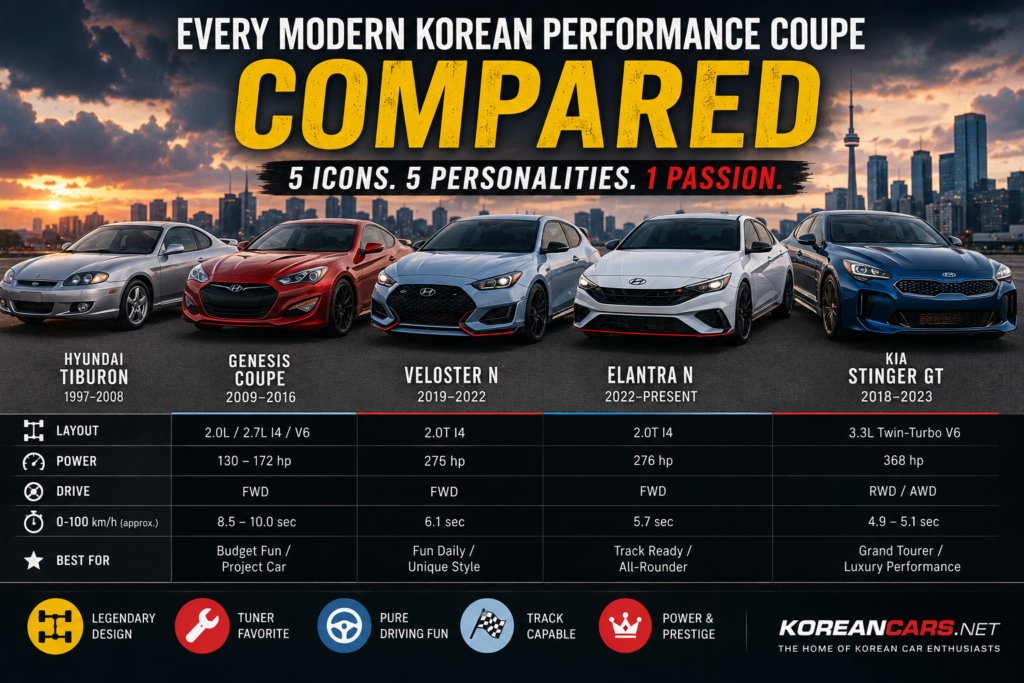
Over the last three decades, South Korea has transformed from building affordable economy cars into producing genuine performance machines that compete with some of the biggest names in the automotive world.
From the affordable Hyundai Tiburon to the rear-wheel-drive Genesis Coupe, and from the unconventional Veloster N to the track-focused Elantra N and luxurious Kia Stinger GT, Korean manufacturers have continually redefined what enthusiasts should expect.
But which one is actually the best?
The answer depends entirely on what kind of driver you are.
Let’s compare them all.
The Contenders
Hyundai Tiburon (1997–2008)
Layout: Front-engine, Front-Wheel Drive
Power: 130–172 hp (factory)
Transmission: Manual or Automatic
The Tiburon was Hyundai’s first true attempt at building an affordable sports coupe for the global market.
While it never challenged the outright performance of Japanese icons like the Toyota Celica or Mitsubishi Eclipse, it offered aggressive styling, solid reliability, and excellent value for money.
Strengths
- Beautiful styling that has aged surprisingly well
- Affordable to buy and maintain
- Large aftermarket community
- Excellent first project car
- Lightweight compared to modern vehicles
Weaknesses
- Limited factory power
- Front-wheel drive
- Aging platform
- Finding clean examples is becoming difficult
Best For
Budget enthusiasts looking for an affordable, stylish project car.
Hyundai Genesis Coupe (2009–2016)
Layout: Front-engine, Rear-Wheel Drive
Power: 210–348 hp
Transmission: Manual or Automatic
If the Tiburon was Hyundai proving they could build a sports coupe, the Genesis Coupe was Hyundai proving they could build a real sports car.
Rear-wheel drive changed everything.
Available with both turbocharged four-cylinder and naturally aspirated V6 engines, the Genesis Coupe became Korea’s answer to cars like the Nissan 350Z, Infiniti G37 Coupe, and Ford Mustang.
Strengths
- Rear-wheel drive
- Strong aftermarket support
- Excellent drifting platform
- Powerful V6 option
- Balanced chassis
Weaknesses
- Interior quality shows its age
- Fuel economy isn’t exceptional
- Early models have some refinement issues
Best For
Drivers wanting an affordable rear-wheel-drive performance car.
Hyundai Veloster N (2019–2022)
Layout: Front-engine, Front-Wheel Drive
Power: 275 hp
Transmission: Manual or DCT
The Veloster N surprised nearly everyone.
Rather than simply making another sporty hatchback, Hyundai developed a genuinely exciting driver’s car that earned praise from journalists around the world.
It became famous for:
- Crackling exhaust
- Incredible steering feel
- Sharp handling
- Huge personality
Its unusual three-door design only added to its charm.
Strengths
- Fantastic handling
- Outstanding factory exhaust
- Playful personality
- Excellent daily driver
Weaknesses
- Polarizing styling
- Limited rear access
- Smaller cargo space
Best For
Drivers who prioritize fun over outright horsepower.
Hyundai Elantra N (2022–Present)
Layout: Front-engine, Front-Wheel Drive
Power: 276 hp
Transmission: Manual or DCT
The Elantra N represents Hyundai’s current performance philosophy.
Built with significant input from Hyundai’s N division, it offers remarkable track capability while remaining practical enough for everyday use.
Many reviewers have compared it favorably against much more expensive sports sedans.
Strengths
- Incredible chassis
- Excellent value
- Track-ready from the factory
- Practical four-door layout
- Modern technology
Weaknesses
- Front-wheel drive limits ultimate balance
- Styling remains controversial to some buyers
Best For
Drivers wanting one car that can handle commuting, road trips, and track days.
Kia Stinger GT (2018–2023)
Layout: Front-engine, Rear-Wheel Drive or AWD
Power: Up to 368 hp
Transmission: 8-speed Automatic
The Stinger GT took a different approach.
Instead of chasing lightweight sports car dynamics, Kia built a high-speed grand touring machine capable of crossing entire countries in comfort while still delivering impressive performance.
Powered by a twin-turbocharged V6, the Stinger GT combines luxury, practicality, and speed in one package.
Strengths
- Outstanding highway performance
- Comfortable interior
- Twin-turbo V6
- Premium features
- Available all-wheel drive
Weaknesses
- Larger and heavier
- Automatic only
- More expensive to maintain
Best For
Drivers seeking luxury performance without sacrificing practicality.
Performance Comparison
| Vehicle | Drive | Power | Personality |
|---|---|---|---|
| Tiburon | FWD | 130–172 hp | Affordable classic |
| Genesis Coupe | RWD | 210–348 hp | Pure sports coupe |
| Veloster N | FWD | 275 hp | Hot hatch with attitude |
| Elantra N | FWD | 276 hp | Precision performance sedan |
| Stinger GT | RWD/AWD | 368 hp | Grand touring powerhouse |
Which Handles Best?
Winner: Elantra N
Modern suspension geometry, an electronic limited-slip differential, adaptive dampers, and extensive chassis development make the Elantra N arguably Hyundai’s best-handling production performance car to date.
Which Is the Most Fun?
This category is highly subjective.
Many enthusiasts would argue:
- Tiburon for nostalgia.
- Genesis Coupe for rear-wheel-drive excitement.
- Veloster N for raw personality.
- Elantra N for precision.
- Stinger GT for effortless speed.
Each delivers fun in a different way.
Which Sounds Best?
- Naturally Aspirated: Genesis Coupe 3.8 V6
- Turbo Four-Cylinder: Veloster N
- Turbo V6: Stinger GT
The Veloster N’s factory exhaust remains one of the most entertaining exhaust notes Hyundai has ever produced.
Best Daily Driver
Winner: Kia Stinger GT
The combination of comfort, refinement, cargo space, modern technology, and effortless power makes the Stinger GT the easiest car to live with every day.
The Elantra N finishes a close second thanks to its practicality and lower operating costs.
Best Project Car
Winner: Hyundai Tiburon
The Tiburon remains one of the most affordable ways to enter the Korean performance scene.
Parts remain relatively inexpensive, the cars are mechanically straightforward, and owners continue to build everything from clean OEM restorations to turbocharged track cars.
Best Drift Platform
Winner: Genesis Coupe
Rear-wheel drive, balanced proportions, and a large aftermarket have made the Genesis Coupe a favorite among drifting enthusiasts worldwide.
Best Value Today
This depends on your budget.
- Under $10,000: Tiburon
- $10,000–20,000: Genesis Coupe
- $20,000–35,000: Veloster N
- $30,000–45,000: Elantra N
- $30,000–50,000: Stinger GT
Each occupies a different segment, making value relative to what you’re looking for.
The Evolution of Korean Performance
Viewed together, these cars tell the story of how Korean manufacturers matured.
The Tiburon proved Hyundai could build an attractive sports coupe.
The Genesis Coupe demonstrated Korea could compete with established rear-wheel-drive performance cars.
The Veloster N showed Hyundai could create a genuinely exciting driver’s car.
The Elantra N established the N division as a serious performance brand capable of challenging the best sport compacts in the world.
The Stinger GT proved Kia could produce a refined, high-performance grand tourer worthy of comparison with established European competitors.
Each model built upon the lessons of its predecessor, pushing Korean performance further than many enthusiasts thought possible.
Final Verdict
There is no single “best” Korean performance car—only the one that best matches your goals.
If you dream of building a unique project on a budget, the Tiburon still offers tremendous character. If rear-wheel-drive thrills are your priority, the Genesis Coupe remains a standout. Drivers who crave playful handling will appreciate the Veloster N, while those seeking a modern all-rounder will be hard-pressed to beat the Elantra N. And if you want effortless speed wrapped in luxury and practicality, the Stinger GT delivers an experience unlike anything else Korea has produced.
Together, these five vehicles showcase just how far Korean performance engineering has come. From humble beginnings to world-class driver’s cars, they have earned a respected place in automotive enthusiast culture—and their legacy is still being written.