0
 0
For most of Hyundai Motor Company’s history, there was an assumption that hardly needed to be stated.
The person ultimately running Hyundai would be Korean.
That made sense.
Hyundai was not merely another multinational automobile corporation headquartered in Seoul. Its history was deeply intertwined with South Korea’s industrialization, the Chung family’s enormous business empire and a corporate culture developed over nearly six decades inside one of Korea’s most important chaebols.
Then Hyundai did something unprecedented.
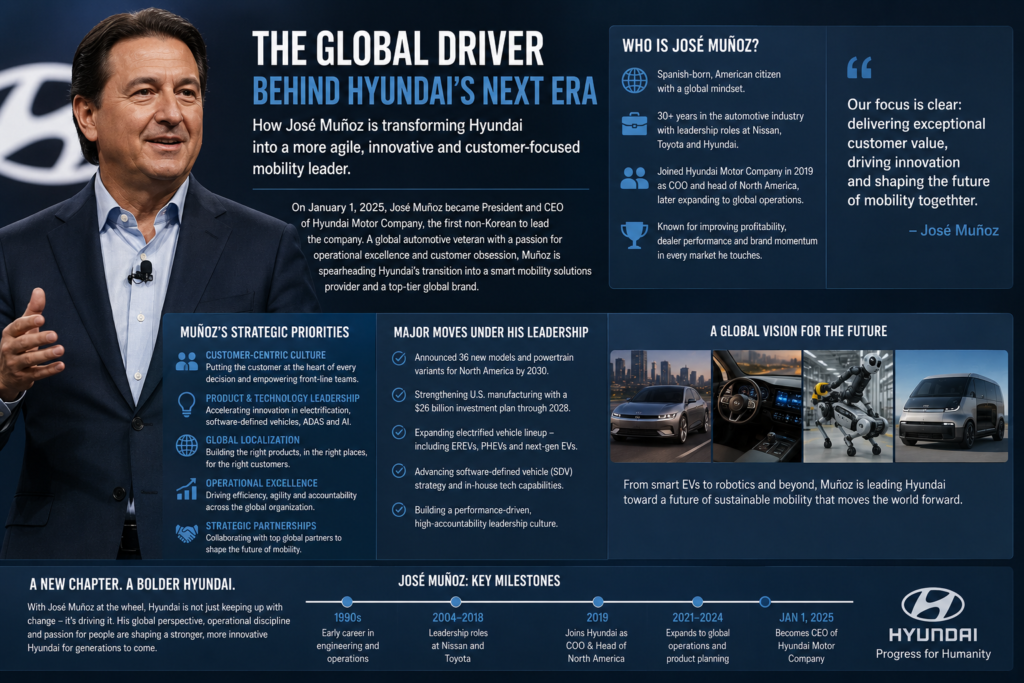
On January 1, 2025, José Muñoz became President and CEO of Hyundai Motor Company.
The Spanish-born, American citizen became the first non-Korean CEO in Hyundai Motor Company’s history. Executive Chair Euisun Chung subsequently described the appointment as a deliberate expression of Hyundai Motor Group’s commitment to innovation and to promoting leaders according to ability rather than nationality, gender, seniority or background.
That makes Muñoz historically important before examining a single car introduced during his tenure.
But his significance goes deeper than nationality.
Hyundai appears to be using Muñoz to solve a new problem.
The Hyundai of Chung Ju-yung’s era had to learn how to build cars.
The Hyundai of Mong-Koo Chung’s era had to learn how to build them at world-class quality.
The Hyundai increasingly shaped by Euisun Chung has had to learn how to become a technology and mobility company.
Muñoz’s challenge is different again:
How does a Korean industrial giant become truly global internally, rather than merely selling Korean-developed products around the world?
That transformation is already becoming visible.
First, It Is Important to Understand Who Actually Runs What
José Muñoz is CEO of Hyundai Motor Company.
That is not identical to being chairman of the entire Hyundai Motor Group.
Hyundai Motor Group remains under Executive Chair Euisun Chung, whose responsibilities extend across the wider industrial group containing Hyundai Motor, Kia, Genesis-related operations, Hyundai Mobis, Hyundai Steel, Hyundai Rotem, Hyundai Engineering & Construction and numerous technology and industrial affiliates.
When Muñoz became Hyundai Motor Company’s CEO, his predecessor Jaehoon Chang moved upward to become Vice Chair of Hyundai Motor Group’s automotive division.
So the leadership structure is not:
Muñoz replaces the Chung family.
It is more accurately:
The Chung-led Group has entrusted the global operation of Hyundai Motor Company to a non-Korean professional manager.
That distinction makes the appointment even more interesting.
Euisun Chung did not lose control of Hyundai.
He deliberately widened the group of people capable of exercising major authority inside it.
Muñoz Arrived Through America
Muñoz did not suddenly appear in Seoul in 2025.
Hyundai had effectively been testing him for the job for years.
He joined Hyundai in 2019 as President and Global Chief Operating Officer while simultaneously leading Hyundai and Genesis in North America. His responsibilities were later expanded to include major global markets, including Europe, India, the Middle East, Africa and Asia Pacific, along with global sales, service and product planning.
Before Hyundai, Muñoz spent approximately 15 years at Nissan, eventually becoming Chief Performance Officer and holding senior responsibility for North America and China. Earlier in his career he had also worked at Toyota Motor Europe. He holds a doctorate in nuclear engineering as well as an executive MBA.
But his Hyundai credentials were built particularly strongly in North America.
Hyundai credits Muñoz with creating a more profitability-focused sales structure, improving dealer performance and contributing to record sales, market-share growth and financial performance for Hyundai and Genesis in the region.
By 2025, Hyundai was selling roughly one million vehicles annually in the United States—around 39 percent more than when Muñoz joined Hyundai in 2019, according to reporting by The Wall Street Journal.
That track record helps explain why Hyundai promoted a sales-and-operations executive rather than a traditional Korean manufacturing insider.
The problems facing Hyundai in the late 2020s are increasingly global-market problems.
Tariffs.
Regional regulations.
Chinese competition.
EV demand uncertainty.
Dealer relationships.
Software.
Localization.
Supply-chain resilience.
Political risk.
Those are exactly the environments in which Muñoz built his career.
His Appointment Is Itself a Cultural Change
The symbolism should not be underestimated.
Large Korean chaebols historically developed strongly hierarchical cultures, with enormous respect for seniority, internal career progression and centralized Korean decision making.
Appointing a foreigner to Hyundai Motor Company’s highest operational position sends a different message.
Euisun Chung explicitly linked Muñoz’s promotion to the idea that capable people should be allowed to lead regardless of nationality or background.
Muñoz has subsequently emphasized more direct communication, cross-functional cooperation and organizational agility. During Hyundai’s 2025 global Leaders Talk, he encouraged open communication among employees and argued that adaptability and coordination across departments would be critical as the automotive industry changed.
More recent reporting suggests he wants to push this substantially further. The Wall Street Journal reported in 2026 that Muñoz was concerned Hyundai could move too slowly and wanted to reduce some of the effects of hierarchical corporate culture while making the organization more transparent and agile.
For Hyundai, that could eventually matter as much as any individual product decision.
Artificial intelligence and software companies operate differently from traditional automobile manufacturers.
Software requires rapid iteration.
Regional teams need authority to react to local competitors.
Engineers need to communicate across departmental boundaries.
Bad news has to travel upward quickly rather than being softened as it passes through management layers.
A company attempting to compete with Tesla, Chinese EV manufacturers and Silicon Valley software organizations cannot operate exactly like a 1980s manufacturing chaebol.
Muñoz appears to understand that.
Hyundai Is Becoming More Local Instead of Simply More Global
One of the strongest themes under Muñoz is localization.
For decades, becoming a global automaker generally meant building vehicles in one country and selling them everywhere else.
Hyundai has already moved far beyond that model through factories and research operations around the world.
Muñoz is pushing the concept further.
The emerging philosophy is:
Develop the right Hyundai for each major region.
Not merely:
Sell the same Hyundai everywhere.
At Hyundai’s 2025 CEO Investor Day, the company announced regional vehicles including the IONIQ 3 for Europe, a locally designed EV for India and China-specific electric products including the Elexio.
In March 2026 Hyundai announced plans for 36 model and powertrain variants in North America by 2030, up from roughly 25 at the time. The company simultaneously targeted a substantial recovery in China, aiming for annual sales of approximately 500,000 vehicles there over the medium term.
China is particularly important because Hyundai cannot approach it simply as another export market.
Chinese manufacturers have become extraordinarily strong in EVs, software, batteries and consumer electronics integration.
Hyundai’s response increasingly involves partnerships and local development rather than expecting a Korean-developed vehicle to succeed merely because the Hyundai badge is established internationally.
This may become one of Muñoz’s defining changes.
The next generation of Hyundai may be globally Korean but increasingly regionally engineered.
America Has Become Central to Hyundai Strategy
No market better illustrates Muñoz’s influence than the United States.
North America is now Hyundai Motor Company’s most profitable region, and Hyundai has said it plans to introduce 36 model and powertrain variants there by 2030.
Muñoz’s attachment to the market is hardly subtle.
After Hyundai confirmed development of a true mid-size pickup for North America, he described the United States as becoming increasingly important and jokingly summarized his priorities as:
“U-S-A.”
The product strategy follows that thinking.
Hyundai plans to enter categories in which it historically had little or no presence.
One of the most important is a genuine body-on-frame mid-size pickup truck, planned for North America before the end of the decade.
That is strategically very different from the Santa Cruz.
The Santa Cruz is essentially a crossover-based lifestyle pickup.
A body-on-frame truck places Hyundai directly into one of the most culturally American vehicle categories in existence.
Toyota Tacoma.
Ford Ranger.
Chevrolet Colorado.
Nissan Frontier.
Hyundai apparently intends to enter their territory.
That is localization at its most aggressive.
Hyundai Is Also Becoming More American Industrially
The change is not limited to vehicle design.
Hyundai Motor Group is investing massively in American production.
The Group has committed approximately $26 billion in U.S. investment from 2025 through 2028, including increased vehicle-production capacity, parts and logistics operations, a steel facility and investments related to autonomous driving, robotics and AI.
Hyundai’s Georgia Metaplant, which began vehicle production before Muñoz formally became CEO but was heavily associated with his North American leadership period, is central to the strategy. Hyundai had already committed $12.6 billion to its Georgia vehicle and battery manufacturing ecosystem when announcing Muñoz’s promotion.
The company now wants approximately 80 percent of the vehicles it sells in the United States to be manufactured locally by 2030, according to reporting on Hyundai’s current strategy.
That helps Hyundai for several reasons.
It reduces shipping.
It shortens supply chains.
It improves political legitimacy as an American employer.
It creates greater eligibility for incentives when available.
And increasingly importantly, it reduces exposure to tariffs.
Muñoz’s Hyundai is therefore becoming less dependent on the traditional idea of:
Made in Korea → exported to America.
Instead:
Designed through a global organization → increasingly manufactured where the customer lives.
This Does Not Mean Hyundai Is Leaving Korea
Localization abroad might sound threatening to Hyundai’s Korean identity.
The actual investment numbers suggest the opposite.
Hyundai Motor Group has announced KRW 125 trillion of investment in South Korea from 2026 through 2030, its largest five-year domestic investment commitment to date. Of that amount, KRW 50.5 trillion is directed toward future businesses including autonomous driving, robotics, electrification, software-defined vehicles and hydrogen.
That reveals the emerging division of responsibility.
Korea remains Hyundai’s technological and corporate centre.
But large overseas markets increasingly receive their own manufacturing and product-development ecosystems.
This is a much more mature form of globalization than simply operating export subsidiaries.
Muñoz Is Not Betting Everything on Battery EVs
Another major difference in the current Hyundai strategy is powertrain flexibility.
A few years ago, much of the automobile industry spoke as though the transition from gasoline vehicles to battery EVs would occur in one relatively straight line.
Reality became more complicated.
EV growth differed dramatically between markets.
Charging infrastructure developed unevenly.
Government incentives changed.
Consumers showed stronger-than-expected demand for hybrids.
Hyundai responded by broadening rather than abandoning electrification.
At the 2025 CEO Investor Day under Muñoz, Hyundai retained a target of 3.3 million electrified vehicles by 2030, representing approximately 60 percent of projected global sales—but significantly expanded the number of technologies included within that strategy.
Hyundai plans more than 18 hybrid models by 2030.
Genesis will receive hybrids.
Battery EV development continues.
And Hyundai plans its first extended-range electric vehicles, or EREVs, from 2027, targeting more than 600 miles of total driving range.
This is classic Muñoz-style flexibility.
Instead of attempting to force every customer into the same technological answer, Hyundai intends to sell the propulsion system appropriate for the market.
Gasoline where necessary.
Hybrid where customers want efficiency without charging dependence.
Battery electric where infrastructure makes sense.
EREV where customers want EV driving with very long range.
Hydrogen where Hyundai believes fuel cells have an advantage.
That is a less ideologically pure electrification strategy.
It may also be more commercially resilient.
The Hybrid Expansion Is Especially Significant
For Korean-car enthusiasts, the hybrid push deserves particular attention.
Hyundai and Kia already possess substantial hybrid-engineering capability, but hybrids are shifting from being specialized efficiency products toward becoming ordinary powertrains across large portions of the lineup.
Hyundai says it expects more than 18 hybrid models by 2030, with Genesis hybrid vehicles beginning from 2026.
That means the internal-combustion engine is not simply disappearing from Hyundai development.
It is increasingly being integrated into electrified systems.
This potentially extends the engineering life of Hyundai’s gasoline engines while giving the company time to improve batteries, charging infrastructure and EV affordability.
The transition under Muñoz looks less like:
ICE → EV
and more like:
ICE → HEV / PHEV / EREV / EV / hydrogen according to use case.
The EREV Could Become One of the Most Important Muñoz-Era Products
The extended-range EV is particularly interesting.
An EREV is fundamentally driven by electric motors, but carries an internal-combustion engine capable of generating electricity when the battery requires it.
That allows everyday driving to behave much like an EV while substantially reducing dependence on public charging during long-distance travel.
Hyundai says its first EREVs should arrive from 2027, with more than 600 miles of total driving range targeted.
This represents the kind of compromise technology that fits Muñoz’s customer-oriented philosophy.
Instead of demanding that the customer change behaviour completely to suit the powertrain, engineer the powertrain around how the customer actually uses the vehicle.
If EREVs become successful in North America, they could become one of the clearest product signatures of his leadership period.
He Is Also Reworking How Hyundai Sells Cars
Muñoz came from sales and operations.
That background is increasingly visible in Hyundai’s distribution strategy.
Hyundai became the first automaker to integrate complete vehicle sales through Amazon Autos in the United States, while participating Hyundai dealers remain part of the transaction and delivery process.
By late 2025, Hyundai said dealer traffic associated with its Amazon partnership had increased by more than 41 percent.
The significance is larger than Amazon itself.
Traditional car retailing has long been fragmented from the digital experience customers use for almost everything else.
Search online.
Configure online.
Then enter an entirely different dealership process.
Hyundai is experimenting with reducing the boundary.
For a CEO who spent much of his career thinking about dealers, sales channels and profitability, that is a logical area of experimentation.
Muñoz’s Hyundai is not trying to eliminate dealers.
It is trying to make the dealer relationship function inside a more digital retail system.
Partnerships Are Becoming More Normal
Traditional Hyundai possessed a strong instinct to internalize technology.
That instinct remains.
But Muñoz is simultaneously making Hyundai more comfortable collaborating with companies that possess capabilities it wants quickly.
At his 2025 Leaders Talk, Hyundai highlighted expanding partnerships as an important component of future mobility development.
The company is working with Waymo in autonomous-driving development.
Hyundai and General Motors have established product-development cooperation, with multiple jointly developed vehicles under way.
Hyundai continues working with technology companies on AI and software while the wider Group expands robotics through Boston Dynamics.
This represents an interesting evolution of the Hyundai philosophy described throughout its history.
Old Hyundai frequently partnered because it could not yet develop something itself.
Modern Hyundai increasingly partners because developing everything independently may be too slow.
Those are very different motivations.
Speed Is Becoming as Important as Self-Reliance
Hyundai’s historical strength was patient internal capability building.
The Alpha engine programme took years.
Fuel-cell development took decades.
Hyundai repeatedly invested until it possessed its own technology.
That strategy remains valuable.
But software moves much faster than traditional automotive engineering.
A five-year development cycle can turn a competitive technology into an outdated one before the vehicle reaches production.
Muñoz’s emphasis on agility and partnerships suggests Hyundai understands the conflict.
The company still wants internal capability.
But it increasingly needs to ask:
Do we need to own this technology—or do we need access to the best version of it immediately?
That cultural change could prove extremely important during the software-defined-vehicle era.
Software Is Moving Toward the Centre of the Car
Hyundai’s 2030 roadmap places software-defined vehicles among its major strategic technologies.
Its future SDV architecture uses high-performance vehicle computers intended to support continuous updates, personalization and AI-driven mobility services.
This changes what Hyundai sells.
Traditionally, the car was essentially complete when it left the factory.
A software-defined Hyundai can theoretically change capabilities throughout its life.
Functions can improve.
Interfaces can evolve.
Driver-assistance systems can receive updates.
Vehicle behaviour can be recalibrated.
New services can be added.
The relationship between manufacturer and customer therefore continues after delivery.
For a CEO whose career has been built around customer experience and ongoing operational performance, that creates an important opportunity.
Hyundai is no longer merely trying to sell somebody a car.
Increasingly, it wants to maintain a digital relationship with the owner for the lifetime of that car.
Muñoz Is Running Hyundai During Its Transition Into an AI Company
The change becomes even more dramatic when considering the larger Hyundai Motor Group.
The Group is investing billions in:
Artificial intelligence.
Robotics.
Autonomous driving.
Software-defined vehicles.
Advanced factories.
Hydrogen.
Muñoz’s own shareholder communication highlights Hyundai Motor Group’s KRW 125 trillion Korean investment programme and $26 billion U.S. commitment, both of which contain substantial spending beyond conventional automobile manufacturing.
The CEO therefore increasingly manages a car company whose competitive advantages may depend on technologies historically associated with software and robotics firms.
That creates a different type of chief executive.
The leader of Hyundai in 1995 primarily needed to understand manufacturing, suppliers, dealers and exports.
The leader of Hyundai in 2030 must understand those things plus AI, batteries, data, software, geopolitics, semiconductor supply, charging networks and autonomous driving.
Muñoz’s appointment appears partly designed around that expanding definition of the job.
China Is Forcing Hyundai to Become Humble Again
One of the most interesting challenges facing Muñoz is China.
Hyundai once enjoyed enormous success there.
Then Chinese manufacturers improved with astonishing speed.
Brands such as BYD and numerous domestic EV competitors began offering sophisticated electric vehicles, advanced software and highly competitive pricing.
Foreign manufacturers that had once taught China how to build modern cars increasingly found themselves learning from China.
Hyundai now wants to increase annual Chinese sales to roughly 500,000 vehicles over the medium term—more than double its recent volume—and is introducing a locally oriented product programme.
The company is also expanding cooperation with Chinese technology partners such as CATL and autonomous-driving specialist Momenta while preparing numerous locally targeted products.
There is a strange historical symmetry here.
Hyundai itself once learned from Mitsubishi, Ford, Italdesign and European engineers.
Now the Korean company is mature enough to recognize that technological learning can flow in every direction.
Muñoz seems comfortable with that.
India Is Becoming Another Centre of Gravity
India represents almost the opposite problem.
Rather than defending an established position against rapidly advancing local competitors, Hyundai sees enormous future growth as vehicle ownership expands.
Muñoz has publicly characterized India as central rather than peripheral to Hyundai’s global strategy, emphasizing its population and long-term motorization potential.
The company is consequently moving toward products designed specifically around Indian requirements—including a locally developed EV referenced in Hyundai’s 2030 roadmap.
Again, the pattern is regionalization.
Hyundai does not want India merely to buy cars created for Korea.
It wants India to become part of the organization that determines what a Hyundai is.
The Company Is Becoming More Commercially Pragmatic
There is another Muñoz characteristic that should appeal to anybody studying Hyundai as a business rather than simply a collection of cars:
He pays close attention to profit, not just market share.
Hyundai specifically credited his North American leadership with optimizing volume and profitability rather than pursuing sales numbers at any cost.
That matters because automotive history contains many companies that achieved enormous sales while damaging themselves financially through discounts, fleet sales or excessive capacity.
Hyundai’s earlier history occasionally carried some of that temptation.
A cheaper price could create volume.
Muñoz’s approach is closer to:
Sell the right vehicle at the right margin.
That helps explain Hyundai’s continuing movement upward in vehicle pricing, Genesis expansion, richer trims and entry into higher-margin North American segments such as trucks and large SUVs.
The company no longer wants to be successful because it is cheaper.
It wants customers to pay more because they genuinely prefer the product.
Genesis Is Being Expanded Rather Than Protected as an EV-Only Experiment
Genesis also shows the flexible philosophy.
Rather than forcing the luxury brand rapidly into a battery-only future, Hyundai’s current plan calls for hybrid, extended-range and battery-electric powertrains across Genesis, with annual sales targeted at approximately 350,000 vehicles by 2030.
That may prove commercially important.
Luxury customers often value convenience more than ideological purity.
A Genesis buyer who regularly drives long distances may prefer a hybrid or EREV.
Another may want a full battery EV.
Instead of deciding in advance which customer is correct, Hyundai intends to serve both.
The Hyundai N Question
For Korean performance enthusiasts, one obvious concern arises whenever an operations-and-sales executive takes control:
Does performance become less important?
So far, there is little evidence that Hyundai intends to abandon N.
Instead, electrification is being incorporated into Hyundai’s performance identity rather than replacing it.
The IONIQ 5 N demonstrated that Hyundai is willing to spend engineering resources making electric vehicles entertaining rather than merely efficient.
At the same time, Hyundai’s broader flexible-powertrain philosophy creates room for combustion and hybrid performance products where markets support them.
The interesting long-term question may therefore be less:
Will N survive?
and more:
What combination of gasoline, hybrid and electric technology defines N during the Muñoz era?
The answer could make this period particularly important for future KDM tuner culture.
The First Non-Korean CEO Does Not Mean Hyundai Has Become a Western Company
This is perhaps the easiest misunderstanding.
Muñoz spent much of his career outside Korea.
He is a Spanish-born American citizen.
North America has become extraordinarily important during his tenure.
Hyundai is investing billions in the United States.
Yet it would be inaccurate to describe the company as becoming Americanized.
Hyundai’s major engineering infrastructure remains deeply Korean.
Namyang remains central.
The Group continues enormous domestic investment.
Euisun Chung remains Executive Chair.
Korea remains Hyundai’s strategic home.
What is changing is the assumption that Korean ownership requires Korean-only leadership.
That is a much subtler transformation.
Hyundai is trying to become a Korean company capable of using the best leadership it can find anywhere.
This Might Be Euisun Chung’s Biggest Cultural Experiment
Muñoz’s appointment also tells us something about Euisun Chung.
His grandfather Chung Ju-yung built Hyundai around extraordinary centralized founder authority.
His father Mong-Koo Chung became strongly associated with disciplined quality control and vertically integrated industrial power.
Euisun Chung appears increasingly willing to distribute authority among professional leaders with very different backgrounds.
When explaining the Muñoz appointment, Chung explicitly said Hyundai wanted people with talent to succeed regardless of nationality, gender, education, seniority or background.
That statement is easy to dismiss as corporate language.
Putting a foreign executive in charge of Hyundai Motor Company gives it much greater weight.
Muñoz is therefore not replacing Chung’s vision.
His appointment is part of Chung’s vision.
Hyundai Is Moving From Exporter to Network
Perhaps the best way to describe the Muñoz transformation is through four versions of Hyundai.
Hyundai 1.0 — Korean Manufacturer
Build the car in Korea.
Export it.
Hyundai 2.0 — Global Manufacturer
Build factories in America, Europe, India, China and elsewhere.
Sell locally.
Hyundai 3.0 — Global Product Company
Develop vehicles for different regional customers.
Give international executives greater responsibility.
Localize supply chains.
Hyundai 4.0 — Global Technology Network
Connect Korean engineering, regional manufacturing, local product development, software partners, AI companies, autonomous-driving specialists, battery suppliers and robotics operations into one worldwide technological organization.
Muñoz inherited Hyundai somewhere between versions three and four.
His job is to make the transition work.
What Has Actually Changed Under Muñoz?
Because Muñoz has only been CEO since January 2025, it would be misleading to credit him personally for every programme now reaching production.
Automobiles often take five years or more to develop.
The Georgia Metaplant predates his CEO appointment.
Hyundai’s E-GMP architecture predates him.
N predates him.
The company’s hydrogen research began decades before him.
The broader robotics and software strategy is strongly associated with Euisun Chung and Hyundai Motor Group rather than Muñoz alone.
But several themes can fairly be associated with the emerging Muñoz era:
More regional autonomy.
Massive localization of production.
A stronger focus on North America.
More hybrids and multiple electrification paths rather than an EV-only transition.
Entry into market-specific segments such as North American body-on-frame pickups.
More external partnerships.
Digital experimentation in vehicle retailing.
An emphasis on profitability rather than volume alone.
Greater organizational openness and agility.
And, symbolically, a much more international definition of who is allowed to lead Hyundai.
The Biggest Change May Be Psychological
Hyundai spent much of its history trying to prove that Korea could do things independently.
Could Korea design a car?
Could Korea build an engine?
Could Korea produce a luxury sedan?
Could Korea make a performance car?
Could Korea develop an electric platform?
That defensive psychology made sense for a young manufacturer constantly being told it was inferior to Japanese, European and American competition.
Modern Hyundai does not need to prove Korean competence in the same way.
It has already done so.
That allows the company to become more comfortable with an idea that might once have seemed threatening:
Hyundai does not become less Korean by giving a Spaniard the CEO’s office.
Nor does it become less capable by cooperating with GM, Waymo or Chinese technology firms.
A mature company can absorb outside ideas without fearing that doing so diminishes its identity.
Hyundai’s history was built around learning from outsiders.
The difference today is that Hyundai meets them much closer to equal footing.
José Muñoz Represents the Hyundai That No Longer Needs to Prove It Belongs
When Chung Ju-yung founded Hyundai Motor Company in 1967, the company needed Ford merely to begin producing modern cars.
When the Pony was developed, Hyundai relied upon Italian design, Japanese mechanical technology and imported European engineering knowledge.
Decades later, Hyundai became technologically independent enough to create its own engines, platforms, luxury brand, performance division, EV architecture and hydrogen systems.
Now the company has reached another stage.
It can allow an outsider to run Hyundai Motor Company precisely because Hyundai itself is no longer insecure about being Korean.
That may ultimately be José Muñoz’s greatest significance.
His era is not about replacing Hyundai’s Korean character.
It is about exporting that character into a much more distributed global company.
Korea remains the home.
But America increasingly builds its own Hyundais.
Europe gets vehicles aimed specifically at Europe.
India becomes a development centre rather than simply a sales destination.
China receives local technology partnerships and products.
Software developers increasingly influence what the vehicle can become after production.
And senior leadership itself is becoming international.
Hyundai spent its first half-century learning how to become a world-class Korean automaker.
José Muñoz is helping answer the next question:
What happens when a world-class Korean automaker stops thinking of the rest of the world as somewhere it exports to—and starts treating the entire world as part of Hyundai itself?
That may define the next Hyundai more than any single engine, battery or car.