0
 0
One of the biggest mistakes enthusiasts make is focusing only on engine power.
They:
- Add boost
- Upgrade fuel systems
- Increase horsepower
But forget one critical thing:
👉 The transmission has to survive all that power too.
And once you start making serious horsepower—especially on turbo KDM builds—the transmission often becomes one of the weakest links.
So what actually goes into upgrading a transmission to handle more power?
Let’s break it down.
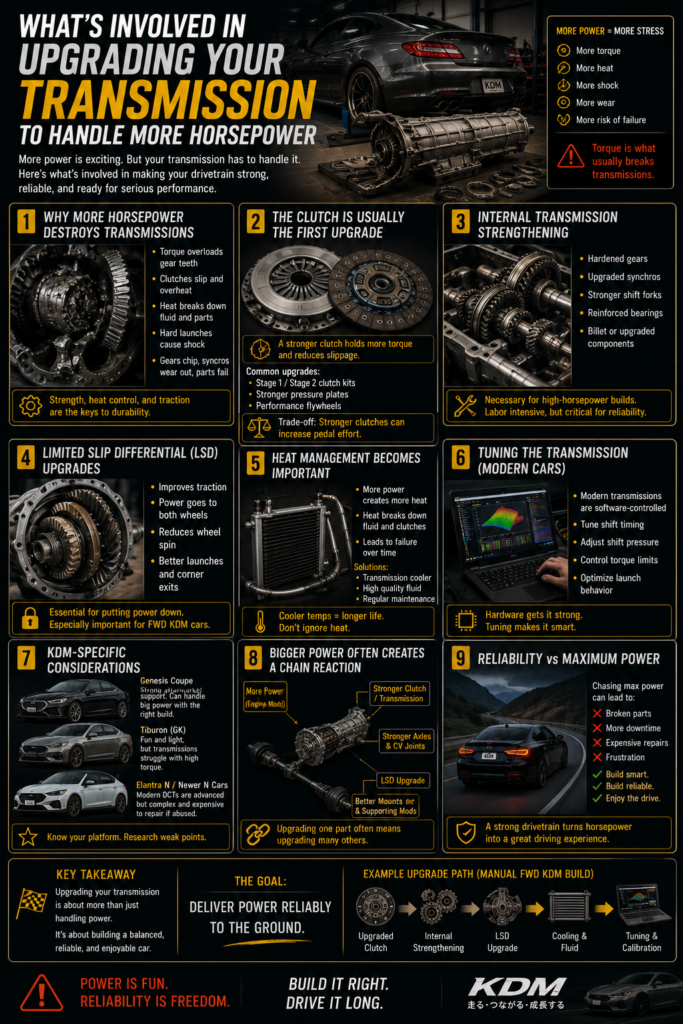
⚙️ 1. Why More Horsepower Destroys Transmissions


Horsepower gets attention.
But:
👉 Torque is what usually kills transmissions.
When you increase power:
- Gear teeth experience more stress
- Clutches slip harder
- Heat increases dramatically
- Drivetrain shock rises during launches
Eventually:
- Gears chip
- Synchros wear out
- Clutches fail
- Differentials break
🔧 2. The Clutch Is Usually the First Upgrade


For manual cars, the clutch is often the first limitation.
A stronger clutch helps:
- Hold higher torque
- Reduce slipping under boost
- Improve launch durability
Common upgrades:
- Stage 1 / Stage 2 clutch kits
- Stronger pressure plates
- Performance flywheels
But there’s a trade-off:
👉 Stronger clutches can reduce daily-driving comfort.
🧱 3. Internal Transmission Strengthening


Once power rises further:
👉 Internal upgrades may become necessary.
This can include:
- Hardened gears
- Upgraded synchros
- Reinforced shift forks
- Stronger bearings
This is where costs rise quickly.
Because transmission work is:
👉 Highly labor intensive.
🔥 4. Limited Slip Differential (LSD) Upgrades


A stock open differential struggles once power increases.
An LSD helps:
- Improve traction
- Reduce wheel spin
- Transfer power more evenly
Especially important for:
- Front-wheel-drive KDM builds
- Turbo Tiburons
- Elantra N setups
👉 It doesn’t just improve launches—
It changes how the car puts power down entirely.
🌡️ 5. Heat Management Becomes Important


More power = more heat.
And heat destroys:
- Transmission fluid
- Clutch packs
- Internal components
Automatic cars especially benefit from:
- Transmission coolers
- Better fluid
- More frequent maintenance
👉 Heat is often the silent killer.
💻 6. Tuning the Transmission (Modern Cars)


Modern transmissions are software-controlled.
That means tuning now involves:
- Shift pressure adjustments
- Shift timing
- Torque limits
- Launch behavior
Especially with:
- DCTs
- Modern automatics
👉 Software matters almost as much as hardware now.
🚗 7. KDM-Specific Considerations


KDM platforms have unique challenges.
Some transmissions:
- Handle moderate power surprisingly well
- Others become weak points quickly
Examples:
- Older Tiburon manuals often struggle at higher torque levels
- Genesis Coupe platforms have stronger aftermarket support
- Modern Hyundai N DCTs are sophisticated but expensive to repair
👉 Researching your exact platform matters heavily.
⚠️ 8. Bigger Power Often Creates a Chain Reaction
One upgrade leads to another.
More horsepower may require:
- Stronger clutch
- Better axles
- LSD
- Mount upgrades
- Transmission rebuild
This is why experienced builders say:
👉 “Power exposes weak points.”
🧠 9. Reliability vs Maximum Power
This is where smart builders separate themselves.
You can chase maximum dyno numbers.
But many experienced enthusiasts instead choose:
👉 Conservative power with drivetrain reliability.
Because:
- Broken transmissions ruin enjoyment fast
- Downtime kills momentum
- Constant repairs become exhausting
🔮 Final Thought
Upgrading a transmission isn’t glamorous.
It’s rarely:
- Loud
- Visible
- Social-media flashy
But it’s one of the most important parts of building a properly balanced performance car.
Because real performance isn’t:
👉 Just making power.
It’s:
👉 Delivering that power reliably to the ground
And the best builds understand:
👉 A strong drivetrain is what turns horsepower into a usable experience.