0
 0
Among South Korea’s automobile manufacturers, SsangYong may have the most chaotic history of all.
Hyundai grew progressively larger.
Kia nearly died once and then found long-term stability inside Hyundai Motor Group.
SsangYong seemed to nearly die every decade.
It changed ownership repeatedly.
It survived the destruction of the chaebol that gave it its famous name.
It belonged to Daewoo.
Then creditors.
Then a Chinese manufacturer.
Then creditors again.
Then an Indian manufacturer.
Then bankruptcy court again.
Then an attempted sale that collapsed at the last moment.
And finally another Korean conglomerate stepped in and gave the company an entirely new name.
Yet throughout all of this, the factory in Pyeongtaek continued producing vehicles.
The Korando survived.
The Musso name returned.
The Rexton continued.
And the company’s specialization in SUVs and rugged vehicles remained remarkably consistent.
That is the fascinating part of the SsangYong story.
Its ownership changed repeatedly.
Its financial condition changed repeatedly.
Even its name disappeared.
But the company’s basic automotive personality proved extremely difficult to kill.
Before There Was SsangYong, There Was Ha Dong-Hwan
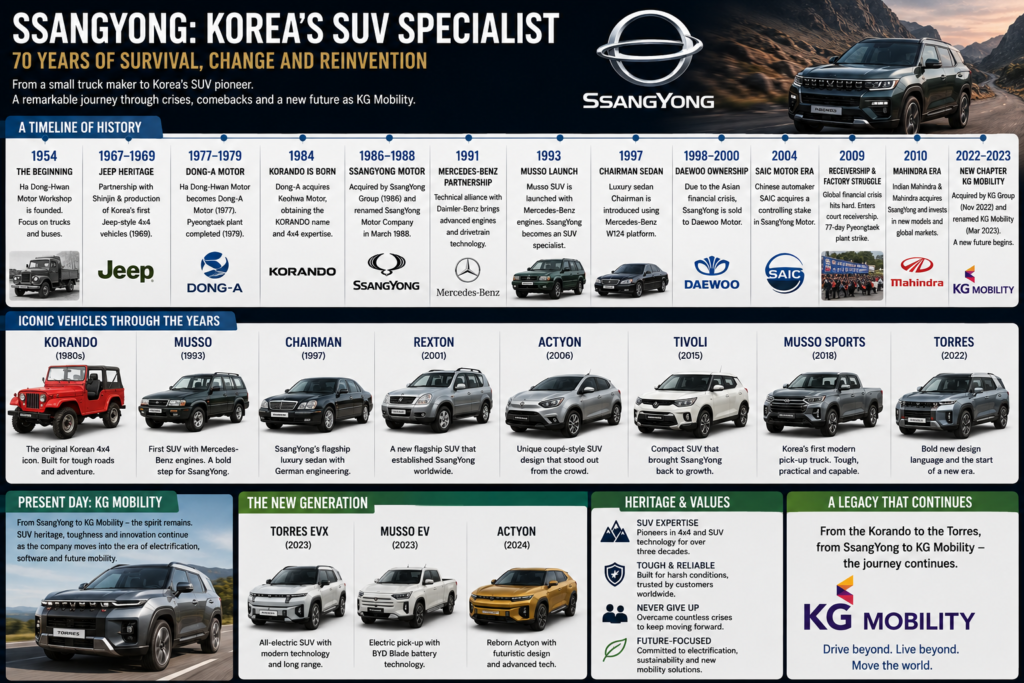
The modern company traces its history to the establishment of Ha Dong-Hwan Motor Workshop in 1954.
It was not originally a passenger-car manufacturer. The company concentrated on trucks, buses and specialized vehicles—the kinds of machines a recovering Korean economy actually needed.
This gave the company a fundamentally different origin from both Hyundai and Kia.
Hyundai Motor eventually emerged from Chung Ju-yung’s enormous construction-centered industrial organization.
Kia began through bicycles and progressively climbed into motorcycles, three-wheelers and cars.
The company that would become SsangYong instead developed around commercial vehicles and rugged utility machines.
That distinction would shape virtually everything that followed.
The American Military Helps Create a Korean 4×4 Specialist
The Korean automobile industry of the 1950s and 1960s grew partly from the extraordinary quantity of military equipment left in and moving through the country after the Korean War.
Ha Dong-Hwan became involved in producing buses and utility vehicles and later worked with Shinjin Automotive. KGM’s official corporate history records a partnership with Shinjin in 1967 and identifies 1969 as the beginning of Korea’s first private Jeep production.
These vehicles established expertise that would eventually become the company’s most important competitive advantage:
four-wheel drive.
Long before the SUV became the dominant family-car format that it is today, the predecessor of SsangYong was already learning how to build vehicles intended for difficult roads and commercial use.
That specialization ultimately became more valuable than anyone in the 1960s could have imagined.
Dong-A Motor Appears
In 1977, Ha Dong-Hwan Motor became Dong-A Motor Company. Two years later, the company completed its Pyeongtaek production facility—the factory location that remains central to KG Mobility today.
Dong-A was still a relatively small player compared with the emerging Hyundai operation.
But it was developing a niche.
Rather than attempting to beat Hyundai directly in ordinary compact sedans, Dong-A increasingly became associated with utility vehicles.
Then came a crucial acquisition.
Keohwa Gives the Company the Korando
Another Korean company, Keohwa, had continued the local Jeep lineage.
Dong-A acquired Keohwa in 1984, obtaining its vehicle operations and, critically, the Korando name. KGM’s modern heritage materials continue to identify the Korando as one of the foundational names in its history.
Korando became one of the longest-lived Korean automotive nameplates.
The name has traditionally been explained through the phrase:
“Korea Can Do.”
It is difficult to imagine a more appropriate slogan for the Korean automotive industry of that era.
The Korean industry was still proving that it could build internationally competitive vehicles at all.
The Korando essentially turned that national industrial confidence into a model name.
Enter the SsangYong Group
The automobile manufacturer still was not called SsangYong.
That changed after the SsangYong Business Group acquired Dong-A Motor in 1986. The company formally became SsangYong Motor Company in March 1988.
The Korean name 쌍용—SsangYong—uses characters meaning “double dragon” or “twin dragons.”
It was an imposing identity.
And under SsangYong Group Chairman Kim Suk-won, the automotive operation was about to become much more ambitious.
Kim had a strong personal interest in automobiles, and the SsangYong Group poured resources into turning its newly acquired automaker into a serious four-wheel-drive manufacturer. Contemporary historical accounts describe a massive expansion into SUVs and related vehicles under his leadership.
SsangYong even acquired the unusual British specialty manufacturer Panther Westwinds in 1987, an indication of how internationally adventurous the group had become.
But the much more important foreign relationship began a few years later.
Mercedes-Benz Changes SsangYong Forever
In 1991, SsangYong formed a technical alliance with Daimler-Benz, the company behind Mercedes-Benz.
This was a major achievement for a relatively small Korean manufacturer.
The partnership gave SsangYong access to proven Mercedes-Benz technology at a time when Hyundai was still establishing its own independent engineering capabilities and Kia remained heavily influenced by Mazda.
KGM’s official history identifies the 1991 Mercedes-Benz alliance as one of the central milestones in the company’s development.
For SsangYong, Mercedes technology provided something more valuable than prestige.
It offered a shortcut.
Instead of spending enormous amounts of money independently developing every engine, transmission and drivetrain component, SsangYong could build around sophisticated technology that had already been proven elsewhere.
The first major product to demonstrate the relationship would become the most important vehicle SsangYong had yet created.
1993: The Musso Arrives
The SsangYong Musso launched in 1993.
It was a substantial, distinctive SUV combining Korean manufacturing with Mercedes-derived engines and drivetrain technology.
The Musso could be equipped with Mercedes-designed gasoline and diesel engines, including inline-six petrol power and five-cylinder diesel configurations.
That gave SsangYong a powerful marketing argument.
This was a Korean SUV from a relatively obscure manufacturer—but parts of its mechanical foundation came from one of Germany’s most respected luxury brands.
The Musso also looked unlike the conservative Japanese SUVs of the period.
British designer Ken Greenley gave it unusually rounded styling that some customers loved and others found strange.
That willingness to look strange would eventually become almost as much a SsangYong characteristic as four-wheel drive.
SsangYong Becomes Korea’s SUV Company
The early 1990s effectively defined the company’s identity.
Korando provided the compact rugged 4×4.
Musso moved into a larger and more sophisticated SUV category.
In 1995 SsangYong launched the Istana, a light commercial vehicle also connected technically with Mercedes-Benz.
A completely redesigned Korando followed in 1996.
This happened just before SUVs became one of the most important product categories in the world.
SsangYong had therefore found a niche that made strategic sense.
It could never realistically match Hyundai’s total production scale.
But perhaps it did not have to.
It could become Korea’s SUV specialist.
That identity survives within KG Mobility even today; the current company explicitly describes itself as an SUV-specialized manufacturer.
And Then SsangYong Builds a Luxury Sedan
Having established itself around off-roaders, SsangYong did something unexpected.
It built the Chairman.
Launched in 1997, the Chairman was a full-size luxury sedan based heavily around Mercedes-Benz technology. The first generation drew upon the Mercedes W124 architecture and used Mercedes-derived powertrains.
The Chairman demonstrated SsangYong’s strange confidence during this period.
The company that had built Jeeps and utility vehicles now wanted to challenge Hyundai’s Grandeur and Daewoo’s luxury sedans.
And instead of creating an entirely new luxury platform from scratch, it leveraged its Mercedes relationship.
The result looked vaguely European, carried substantial German engineering beneath its Korean bodywork and occupied an unusual place in the domestic market.
For years, seeing a Chairman in Korea communicated something rather different from seeing an ordinary SsangYong SUV.
It was the company’s attempt to demonstrate that SsangYong could move beyond mud and four-wheel drive.
Unfortunately, it arrived at almost exactly the wrong moment.
1997: Korea’s Financial Crisis Hits the SsangYong Empire
The Asian financial crisis devastated South Korea’s debt-heavy conglomerates.
The SsangYong Group was highly exposed.
Like the old Hyundai empire, SsangYong had expanded across numerous unrelated businesses through the chaebol model.
Unlike Hyundai, it lacked enough strong divisions to preserve the group intact.
The broader SsangYong conglomerate began breaking apart after the crisis.
And the automobile business needed a new owner.
That owner became another Korean chaebol:
Daewoo.
Daewoo Buys SsangYong
Daewoo Motor acquired a controlling interest in SsangYong during the late 1990s as Daewoo Chairman Kim Woo-jung pursued an extraordinarily aggressive expansion strategy. Contemporary reporting described Daewoo’s acquisition of the troubled Korean SUV manufacturer during this period.
For a brief period, SsangYong vehicles were absorbed into Daewoo’s automotive world.
In some markets, the Musso became the Daewoo Musso.
The Korando received Daewoo branding.
The Chairman also became associated with Daewoo.
This creates one of the strangest pieces of Korean automotive history.
Vehicles developed by SsangYong using Mercedes technology were suddenly being sold with Daewoo badges.
But Daewoo had a much bigger problem.
Its own corporate empire was collapsing.
SsangYong Escapes Daewoo Because Daewoo Dies First
Daewoo’s extraordinary debt eventually destroyed the group.
By 2000, SsangYong was again separated as Daewoo attempted to dispose of assets and creditors took increasing control.
In a strange way, SsangYong survived because the company that had purchased it collapsed even more dramatically.
General Motors eventually acquired major portions of Daewoo Motor.
But GM did not take SsangYong.
The smaller SUV company was left searching for another future.
And somehow it kept producing vehicles.
2001: Rexton Gives SsangYong Another Life
In 2001, SsangYong launched the Rexton.
The large SUV became another critical product in the company’s history and eventually one of its defining nameplates.
The Rexton maintained the company’s emphasis on rugged SUV architecture while pushing further toward comfort and premium positioning.
Then came the Musso Sports in 2002, which KGM identifies as Korea’s first pickup truck in its historical timeline.
This combination became extremely important:
SUVs.
Pickups.
Diesel engines.
Four-wheel drive.
SsangYong’s product identity was becoming narrower—but also clearer.
The company had effectively realized that trying to compete with Hyundai and Kia in every conventional passenger-car segment made little sense.
Its survival depended on being different.
Then Came the Strange-Looking SsangYongs
Anyone who followed Korean cars during the 2000s probably remembers the period when SsangYong design became particularly adventurous.
The Rodius arrived in 2004.
The Kyron followed in 2005.
The Actyon came later that year.
Actyon Sports followed in 2006.
These cars were practically impossible to confuse with competitors.
Whether that was always a good thing became another question.
The Rodius in particular developed an international reputation for unconventional styling.
But the weirdness also demonstrated something interesting.
SsangYong was not simply copying Hyundai, Toyota or Mitsubishi.
It had its own visual vocabulary.
In an automotive industry increasingly dominated by safe corporate styling, a SsangYong could be unmistakably a SsangYong from half a parking lot away.
China Comes Calling
The next owner arrived from China.
In 2004, SAIC Motor, one of China’s largest automotive manufacturers, acquired a controlling stake in SsangYong.
The logic seemed reasonable.
SAIC wanted technology and international automotive capability.
SsangYong needed capital and access to a much larger organization.
South Korea possessed considerably more advanced vehicle-development knowledge than China at the time, particularly in areas such as diesel engines and SUVs.
In theory, each side had something the other wanted.
In reality, the relationship became extraordinarily contentious.
The SAIC Era Becomes Bitter
Workers increasingly accused SAIC of failing to invest sufficiently in SsangYong and of benefiting disproportionately from Korean technology.
SAIC and management faced a company with weak profitability and products requiring enormous future investment.
Then came the 2008 global financial crisis.
Demand for large SUVs collapsed.
SsangYong’s financial position deteriorated rapidly.
In January 2009, the company entered court receivership.
Management proposed an enormous restructuring.
Thousands of jobs were threatened.
And one of the most dramatic labour conflicts in modern Korean industrial history began.
The 2009 Pyeongtaek Factory Occupation
Workers facing dismissal occupied SsangYong’s Pyeongtaek factory.
The confrontation lasted approximately 76–77 days.
Workers barricaded sections of the factory.
Police eventually moved in.
Images of helicopters, tear gas, improvised worker defenses and riot police inside an automobile factory became symbols of the social cost of Korea’s industrial restructuring.
Reuters reported that SsangYong sought to reduce its approximately 7,100-person workforce by more than one-third and that around 1,670 employees had already left before hundreds of remaining workers continued the occupation.
SsangYong estimated that the shutdown cost approximately 316 billion won in lost production.
The dispute eventually ended in August 2009.
But the emotional consequences lasted far longer.
Few automotive-company histories contain an episode this severe.
SsangYong had moved beyond financial distress into a national argument about labour, foreign ownership and the human consequences of industrial failure.
And yet once again:
The company did not disappear.
India’s Mahindra Becomes the Next Owner
SsangYong emerged from its restructuring process and went searching for another owner.
This time the successful buyer came from India.
Mahindra & Mahindra made particular strategic sense because Mahindra itself specialized heavily in SUVs and utility vehicles.
In November 2010, Mahindra agreed to acquire SsangYong for approximately 522.5 billion won, around $464 million at the time.
The transaction was completed in 2011, giving Mahindra roughly 70 percent ownership initially.
For once, SsangYong had an owner that seemed culturally aligned with its actual product strength.
Mahindra understood:
Four-wheel drive.
Utility vehicles.
Diesel engines.
Developing markets.
The hope was that Indian capital and distribution could combine with Korean vehicle-development expertise.
For a while, the strategy appeared promising.
Tivoli Becomes SsangYong’s Surprise Hit
The most important product of the Mahindra period arrived in 2015.
The Tivoli was smaller, more modern and more urban than the traditional Rexton or Korando.
It entered the rapidly growing compact-crossover market and became an important sales success in South Korea. KGM’s own corporate history describes Tivoli as a defining compact-SUV product and highlights its numerous domestic and international awards.
Tivoli mattered because it showed SsangYong could still create a competitive vehicle rather than merely survive on old SUV engineering.
The longer Tivoli Air followed.
A new Rexton arrived in 2017.
The modern Musso pickup returned in 2018.
An all-new Korando followed in 2019.
For a moment, the company seemed to have achieved something close to stability.
But sales and profits remained fragile.
Mahindra Eventually Decides Enough Is Enough
Mahindra repeatedly invested in SsangYong.
By 2019, its stake had increased to roughly 74.65 percent.
But the Korean subsidiary continued producing losses, particularly as exports weakened.
By 2020 Mahindra decided that it could no longer justify continuing to provide major equity support. Credit assessments at the time specifically noted SsangYong’s deteriorating results and Mahindra’s decision to restrict additional funding.
Then COVID-19 hit.
Global automobile demand and supply chains were disrupted.
SsangYong’s already weak position worsened.
In December 2020, the company filed for another restructuring process. Mahindra subsequently ceased consolidating SsangYong into its own financial results.
Once again, SsangYong was effectively up for sale.
The Edison Motors Rescue That Wasn’t
For a while, it appeared that an electric-vehicle company called Edison Motors would become SsangYong’s next owner.
In January 2022, a consortium led by Edison signed an agreement to acquire the struggling automaker for approximately 305 billion won.
The proposal fitted the moment.
SsangYong desperately needed a path into electrification.
Edison specialized in electric commercial vehicles.
The future SsangYong could theoretically abandon its dependence on diesel SUVs and emerge as an EV company.
Then the deal collapsed.
Edison failed to make the required acquisition payment.
By April 2022, Mahindra confirmed that the sale agreement had been terminated.
Think about how extraordinary this must have looked from inside Pyeongtaek.
Employees had survived:
Daewoo.
SAIC.
A bankruptcy.
A violent labour dispute.
Mahindra.
Another receivership.
And now the supposed buyer had failed to provide the money needed to complete the rescue.
For perhaps the fourth time in its history, SsangYong appeared to be running out of future.
Then KG Group Appears
The next bidder was KG Group, another Korean industrial conglomerate.
Unlike Edison, KG was not primarily an automobile manufacturer.
Its interests included businesses in areas such as chemicals, steel and other industrial sectors.
A KG-led consortium was chosen as the final bidder in June 2022. The proposed restructuring involved substantial investment, with the consortium planning approximately 900 billion won in total commitments surrounding the acquisition and rehabilitation.
The acquisition proceeded.
KGM’s official corporate history records November 2022 as the point when the automaker was acquired by KG Group.
This time the rescue actually happened.
But KG Chairman Kwak Jae-sun concluded that financial restructuring alone was not enough.
The name itself had become part of the problem.
Why Kill the SsangYong Name?
The decision was emotionally complicated.
SsangYong had existed as an automotive brand for 35 years.
Korando.
Musso.
Rexton.
Chairman.
Tivoli.
All had carried the SsangYong identity.
Yet the name had become associated not only with SUVs but with repeated financial collapse.
Bankruptcy.
Foreign ownership.
Labour conflict.
Failed acquisitions.
For consumers and investors, “SsangYong” increasingly carried baggage.
KG therefore decided on a radical break.
At a shareholder meeting in March 2023, SsangYong Motor Company officially changed its corporate name to:
KG Mobility
The company described the change as the beginning of its transition toward future technologies including dedicated EV platforms, autonomous driving and broader mobility systems.
After 35 years, SsangYong Motor officially ceased to exist as a corporate name.
But the company underneath it survived.
Again.
Torres Becomes the Bridge Between SsangYong and KGM
One of the most important vehicles in the transition was the Torres.
Interestingly, Torres launched in July 2022, before the KG takeover was completely finalized.
That makes it a perfect bridge vehicle.
It was developed by SsangYong.
But it became one of the principal products of KG Mobility.
Its deliberately rugged styling also introduced the company’s “Powered by Toughness” design philosophy, built around what KGM calls resilience and modernity while preserving the spirit of the old Korando.
That design direction is important.
KGM did not attempt to reinvent the company as another anonymous urban crossover manufacturer.
It leaned harder into the thing SsangYong had always understood:
rugged-looking SUVs.
Electrification Finally Arrives
Before the renaming, SsangYong had already launched the Korando E-Motion, its first battery-electric SUV, in 2022.
Under KG ownership, electrification accelerated.
The Torres EVX followed in 2023.
Then KGM introduced the Musso EV, its fully electric pickup, using an 80.6-kWh BYD Blade battery and targeting approximately 400 kilometres of driving range under Korean testing conditions.
This points toward a new version of the old SsangYong formula.
Instead of abandoning SUVs and pickups for EVs:
electrify the SUVs and pickups.
That is a much more coherent identity.
BYD Shows How Different the New Company Is
KGM’s EV strategy also illustrates how much the global automotive world has changed.
During the 1990s SsangYong looked to Mercedes-Benz in Germany for advanced technology.
Today KGM can look toward BYD in China for battery technology.
The direction of technological learning in the global auto industry has changed dramatically.
KGM is embracing that reality rather than pretending it must independently develop every component.
Its current strategy combines internal SUV expertise with outside battery and electrification technology where useful.
This resembles the survival instinct visible throughout the company’s history:
Use whatever partnership allows the company to keep moving.
KGM Is Becoming More Than a Passenger-Car Manufacturer Again
KG Group has also expanded the automotive business beyond the traditional SsangYong product range.
KGM established KG S&C for specialty and converted vehicles and created KGM Commercial for products including electric buses and future commercial vehicles.
That is an interesting return to the company’s beginnings.
Remember Ha Dong-Hwan Motor Workshop in 1954.
Trucks.
Buses.
Special-purpose vehicles.
Seven decades later, the company is once again expanding into:
Commercial vehicles.
Special-purpose vehicles.
SUVs.
Pickups.
Only now they increasingly involve electric drivetrains, software and advanced electronics.
The company has almost travelled in a circle.
SsangYong Was Never Really a Normal Car Company
That may be the key to understanding its survival.
SsangYong was almost never strong enough to compete directly with Hyundai and Kia across the full automobile market.
It rarely had the capital to develop:
Small hatchbacks.
Compact sedans.
Midsize sedans.
Large sedans.
Sports cars.
MPVs.
SUVs.
Pickups.
EVs.
All simultaneously.
Whenever it tried to expand too far, financial reality eventually intervened.
Its strongest periods generally occurred when it remembered its specialization.
Korando.
Musso.
Rexton.
Tivoli.
Torres.
Musso pickup.
These were vehicles with some connection to utility, outdoor use or SUV identity.
That became the company’s reason to exist.
Its Weakness Was Always Scale
SsangYong’s engineering was not necessarily its greatest problem.
Its scale was.
Developing a modern automobile is extraordinarily expensive.
A small manufacturer still needs to pay for:
Crash testing.
Emissions development.
Electronic architecture.
Engines.
Transmissions.
Software.
Factories.
Dealer networks.
Safety systems.
Infotainment.
Global certification.
A company producing relatively modest volumes must spread those costs across far fewer vehicles than Hyundai, Toyota or Volkswagen.
That puts constant pressure on profitability.
It also explains SsangYong’s repeated dependence on larger partners.
Mercedes-Benz.
Daewoo.
SAIC.
Mahindra.
KG.
Each partnership provided some combination of:
Technology.
Capital.
Distribution.
Purchasing power.
Or corporate stability.
The recurring challenge was finding an owner willing to invest long enough for the company to become sustainably profitable.
And Yet the Small Size Also Made SsangYong Interesting
There was an upside.
SsangYong could build vehicles the larger Korean manufacturers sometimes avoided.
A weird luxury sedan based on German engineering?
Chairman.
An unusual rounded Mercedes-powered SUV?
Musso.
A genuinely rugged compact 4×4?
Korando.
A pickup when Hyundai and Kia largely ignored pickups?
Musso Sports.
A giant strangely styled people mover?
Rodius.
Being small sometimes gave SsangYong permission to be strange.
That produced failures.
It also produced personality.
SsangYong Helped Create Korean SUV Culture
The company also deserves more credit than it usually receives for its role in popularizing SUVs within Korea.
KGM’s own corporate history describes the business as a pioneer in Korea’s SUV industry and credits its range with contributing to the expansion of SUVs in the domestic market.
Before Santa Fe.
Before Tucson.
Before Sorento.
Before Sportage became a global crossover powerhouse.
There was Korando.
There was Musso.
SsangYong specialized in utility vehicles before the rest of the industry realized that almost everybody would eventually want one.
In that sense, SsangYong chose the correct category.
It simply struggled to develop the corporate scale needed to dominate it.
The Company’s Ownership History Reads Like a Map of Asian Industrialization
There is another fascinating way to read SsangYong’s story.
Look at who supplied its technology and capital over time.
Early Korea
Military and commercial-vehicle manufacturing created the foundation.
SsangYong Group
A Korean chaebol attempted to transform it into an international SUV company.
Mercedes-Benz
German engineering helped elevate its technology.
Daewoo
Another Korean chaebol tried to absorb it.
SAIC
China’s emerging automotive industry acquired it during China’s industrial rise.
Mahindra
India’s growing industrial sector attempted to use SsangYong as a global technology and SUV platform.
KG Group
Korean capital eventually brought the company back under domestic ownership.
The automaker’s changing owners almost mirror shifts in Asian industrial power.
The Most SsangYong Thing About KGM Is That It Survived the SsangYong Name
There is something almost philosophical about the latest transformation.
Most automobile companies treat their name as sacred.
SsangYong eventually concluded that the company mattered more than the name.
So it discarded the name.
The factories remained.
The engineers remained.
Korando remained.
Rexton remained.
Musso remained.
The SUV philosophy remained.
The Pyeongtaek manufacturing base remained.
The double-dragon era ended, but much of its automotive DNA continued inside KG Mobility.
That distinction is important for enthusiasts.
KGM is not an unrelated startup that purchased an old factory.
It is the legal and industrial continuation of SsangYong Motor.
Is KGM Finally Stable?
For the first time in years, there are signs that the company has regained some financial and product stability.
KGM’s official financial summary reports 110,535 vehicles sold in 2025 and revenue above 4.3 trillion won.
The company is expanding exports and selling through networks covering more than 120 countries, according to its corporate materials.
Its range now combines established models such as Rexton and Musso with newer vehicles including Torres, Torres EVX, Actyon and Musso EV.
Whether that becomes permanent stability remains to be seen.
KGM is still tiny compared with Hyundai Motor Group.
It faces aggressive Chinese manufacturers.
Its electric transition requires substantial investment.
And many global customers are still learning that KGM is the company they once knew as SsangYong.
But this may also be the strongest ownership environment the company has experienced in years.
Hyundai and Kia Won the Scale War. SsangYong Won the Survival War.
Place the three major Korean automotive histories beside one another and their personalities become remarkably different.
Hyundai
Built an enormous industrial structure and progressively internalized technology.
Kia
Repeatedly reinvented itself, collapsed once and ultimately gained strength through integration with Hyundai.
SsangYong
Specialized, expanded, collapsed, changed owners—and somehow repeatedly survived without being absorbed permanently into a larger automobile manufacturer.
SsangYong never became another Hyundai.
It never became another Kia.
It never became Daewoo.
It never became SAIC Korea.
It never became Mahindra Korea.
And now, technically, it is not even SsangYong anymore.
Yet somehow the company remains recognizable.
That may be its greatest achievement.
The Korean Car Company That Wouldn’t Die
In 1954, Ha Dong-Hwan began building practical commercial vehicles in a country still recovering from war.
That operation evolved into Dong-A.
Dong-A absorbed the Korean Jeep business and Korando.
SsangYong Group acquired Dong-A.
Mercedes technology produced Musso.
The company expanded into luxury with Chairman.
The Asian financial crisis destroyed its parent group.
Daewoo bought it.
Daewoo collapsed.
SAIC bought it.
The global financial crisis pushed it into receivership.
Workers occupied the factory.
Mahindra rescued it.
Mahindra eventually stopped funding it.
SsangYong entered restructuring again.
Edison Motors agreed to buy it.
The deal collapsed.
KG Group stepped in.
Then the SsangYong name itself disappeared.
Any one of those events could have ended an automobile manufacturer.
Together they produced one of the most improbable survival stories in the global car industry.
Today the sign above the company reads:
KG Mobility.
But look underneath the Actyon, Torres, Rexton or Musso and the lineage is obvious.
The old company has not really vanished.
It has done what it has always done.
It adapted.
It found another owner.
It found another technology.
It found another version of itself.
And then it kept building SUVs.