0
0
 0
0
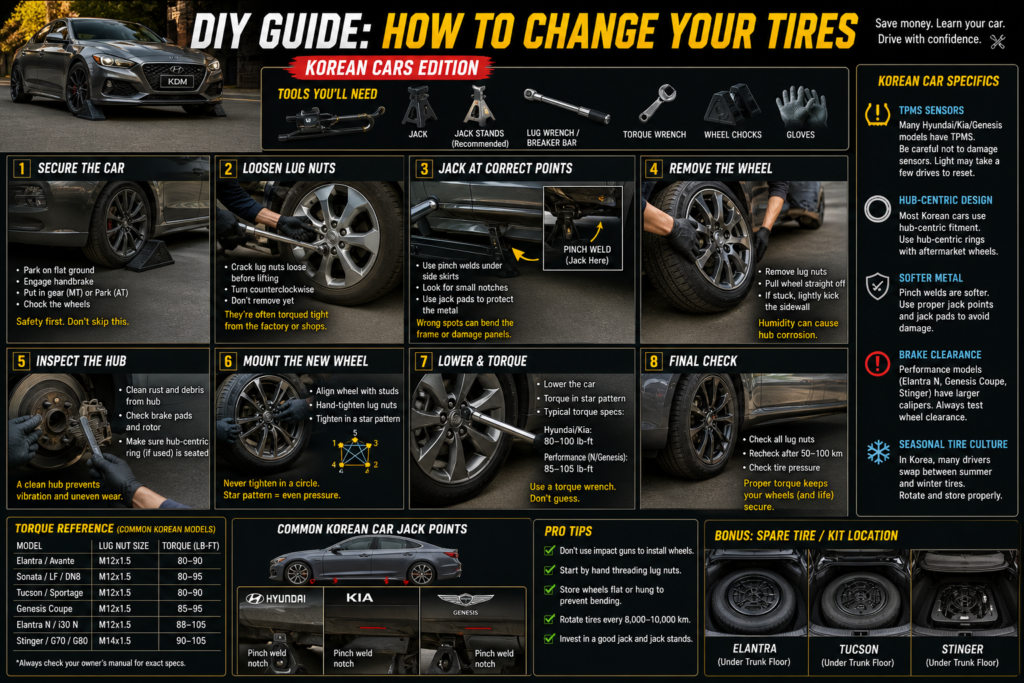
Changing your own tires is one of those skills that separates casual drivers from true car enthusiasts. And if you’re building in the KDM space—whether it’s a Tiburon, Elantra N, or Genesis Coupe—this is non-negotiable knowledge.
While the fundamentals are universal, Korean cars do have a few quirks and patterns worth knowing.
Let’s break it down step-by-step.
🧰 What You’ll Need


Basic tools:
- Jack (factory scissor jack or hydraulic preferred)
- Lug wrench or breaker bar
- Torque wrench (recommended, not optional if you care about your wheels)
- Wheel chocks (or a brick in a pinch)
- Gloves
👉 Many Korean cars come with compact emergency kits—but they’re bare minimum, not ideal for regular use.
🛑 Step 1: Secure the Car Properly


Before anything:
- Park on flat ground
- Engage handbrake
- Put car in gear (manual) or Park (auto)
- Place chocks behind wheels
👉 Korean cars (especially lighter ones like older Hyundai/Kia models) can shift more easily if not secured.
🔧 Step 2: Loosen Lug Nuts (Before Lifting)


Crack the lug nuts loose before lifting the car.
- Turn counterclockwise
- Use body weight if needed
- Don’t fully remove yet
👉 On many Korean cars, lug nuts are often torqued tighter than expected—especially after shop visits.
🏗️ Step 3: Jack the Car at the Correct Points


This is where many people mess up.
Use designated jack points:
- Usually along the pinch welds under side skirts
- Marked by small notches
⚠️ Korean car-specific note:
- Hyundai/Kia pinch welds can be softer metal
- Using the wrong jack can bend them easily
👉 Consider a jack pad adapter to protect the welds.
🛞 Step 4: Remove the Wheel


Now:
- Fully remove lug nuts
- Pull wheel straight off
If it’s stuck:
- Light kick at the sidewall
- Or tap from behind
👉 Korean cars (especially in humid climates like Korea) can get hub corrosion, making wheels stick.
🔍 Step 5: Inspect Before Installing New Wheel


Don’t rush this step.
Check:
- Rust or debris on hub
- Brake pad thickness
- Rotor condition
👉 If you’re running aftermarket wheels (common in KDM builds):
- Ensure hub-centric rings are properly seated
- Korean cars are often hub-centric, not lug-centric
🔄 Step 6: Mount the New Wheel


- Align wheel with studs
- Hand-tighten lug nuts first
Use a star pattern:
- Ensures even pressure
- Prevents warping
👉 Never fully tighten one lug at a time.
🔽 Step 7: Lower and Torque Properly


Lower the car, then torque.
Typical torque specs (check your model):
- Hyundai/Kia: ~80–100 lb-ft
- Performance models (like N cars): slightly higher
👉 Over-tightening is just as bad as under-tightening.
⚠️ Korean Car-Specific Tips (Important)
1. TPMS Sensors
Many newer Hyundai/Kia/Genesis models have TPMS (tire pressure sensors).
- Be careful not to damage them
- After swap, warning light may need a short drive to reset
2. Stud & Lug Quality
Some Korean models (especially older ones) have:
- Softer studs
- Easier to strip if over-torqued
👉 Always hand-thread first. No impact gun abuse.
3. Brake Clearance (Performance Models)
On cars like:
- Elantra N
- Genesis Coupe
- Stinger
👉 Aftermarket wheels must clear larger brake calipers
Always test fit before full install.
4. Seasonal Tire Culture (Korea Insight)
In Korea:
- Many drivers swap summer ↔ winter tires seasonally
- Storage and rotation matters more
👉 If you’re in Seoul, this becomes part of your yearly routine.
🔥 Final Thought
Changing your own tires isn’t just maintenance—it’s part of the culture.
It connects you to:
- Your car’s condition
- Your build quality
- Your driving confidence
And in the KDM world, where personalization matters, this is one of the first steps toward true ownership of your build.