0
0
 0
0
Turbochargers have revolutionized modern automotive engineering by enabling smaller engines to produce greater power and efficiency. From high-performance sports cars to fuel-efficient daily drivers, turbocharging has become a cornerstone of contemporary vehicle design—especially in Korean performance models like the Hyundai Elantra N, Kia Stinger GT, and Genesis G70.
This guide explains how a turbocharger works, its key components, advantages, and why it plays a critical role in modern engines.
What Is a Turbocharger?
A turbocharger is a forced-induction device that increases an engine’s power output by compressing incoming air. By forcing more oxygen into the combustion chamber, the engine can burn more fuel, producing greater power without increasing engine size.
Key Benefits of Turbocharging
- Increased horsepower and torque
- Improved fuel efficiency
- Reduced emissions
- Enhanced engine performance
- Better power-to-weight ratio
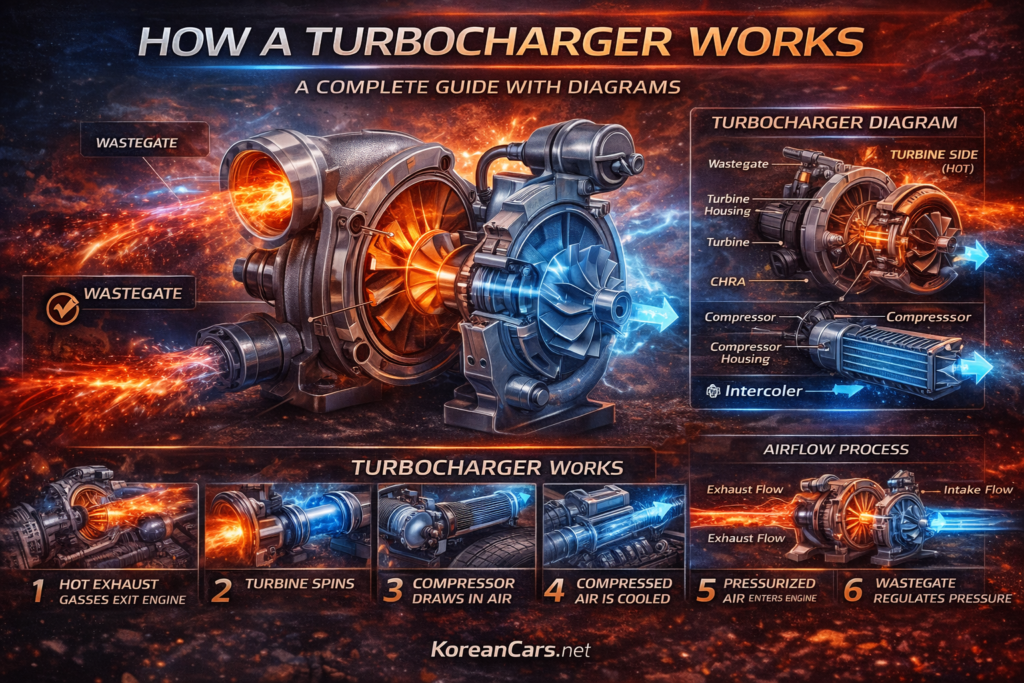
Turbocharger Diagram: Basic Operation


A turbocharger consists of two primary sections connected by a shaft:
- Turbine Side (Hot Side): Driven by exhaust gases.
- Compressor Side (Cold Side): Compresses incoming air and sends it into the engine.
Main Components of a Turbocharger
1. Turbine
The turbine is powered by exhaust gases exiting the engine. As exhaust flows through the turbine housing, it spins the turbine wheel at extremely high speeds—often exceeding 200,000 RPM.
2. Compressor
The compressor draws in air, compresses it, and forces it into the engine’s intake manifold. This compressed air increases oxygen levels, allowing for more powerful combustion.
3. Center Housing (CHRA)
The Central Housing Rotating Assembly contains:
- The shaft connecting the turbine and compressor
- Bearings for smooth rotation
- Oil channels for lubrication and cooling
4. Wastegate
The wastegate regulates boost pressure by diverting excess exhaust gases away from the turbine to prevent overboost.
5. Intercooler
The intercooler cools compressed air before it enters the engine, improving efficiency and reducing the risk of engine knock.
Turbocharger Components Diagram


These components work together to deliver increased power while maintaining engine efficiency and reliability.
Step-by-Step: How a Turbocharger Works
Step 1: Exhaust Gases Exit the Engine
Hot exhaust gases flow from the engine into the turbine housing.
Step 2: The Turbine Spins
The exhaust gases spin the turbine wheel, converting heat energy into mechanical energy.
Step 3: The Compressor Draws in Air
The spinning shaft drives the compressor, which pulls in and compresses fresh air.
Step 4: Compressed Air Is Cooled
The intercooler reduces the temperature of the compressed air, increasing its density.
Step 5: Pressurized Air Enters the Engine
Cool, dense air enters the combustion chamber, allowing more fuel to be burned and producing greater power.
Step 6: The Wastegate Regulates Pressure
The wastegate controls boost levels to protect the engine and maintain optimal performance.
Turbocharger Airflow Diagram


This airflow process illustrates how exhaust energy is recycled to enhance engine performance.
Types of Turbochargers
| Type | Description | Common Applications |
|---|---|---|
| Single Turbo | One turbocharger powers the engine | Hyundai Elantra N |
| Twin-Turbo | Two turbos improve performance and efficiency | Kia Stinger GT |
| Twin-Scroll Turbo | Separates exhaust pulses for better response | Genesis G70 |
| Variable Geometry Turbo (VGT) | Adjusts airflow for optimal efficiency | Diesel engines |
| Electric Turbo | Uses electric assistance to reduce lag | Next-generation vehicles |
Advantages of Turbocharging
1. Increased Power
Turbochargers significantly boost engine output without increasing displacement.
2. Improved Fuel Efficiency
Smaller turbocharged engines consume less fuel while delivering strong performance.
3. Reduced Emissions
Better combustion efficiency results in lower emissions.
4. Altitude Compensation
Turbocharged engines perform better at high altitudes where air density is lower.
Common Disadvantages
| Disadvantage | Explanation |
|---|---|
| Turbo Lag | Delay in power delivery before boost builds |
| Increased Heat | Requires advanced cooling systems |
| Higher Maintenance | Needs high-quality oil and regular servicing |
| Complexity | Adds additional components to the engine |
Modern advancements such as twin-scroll turbos and electric assistance have significantly reduced these drawbacks.
Turbocharged Korean Cars
Korean automakers have embraced turbocharging to enhance both performance and efficiency.
Popular Models
- Hyundai Elantra N – 2.0L Turbocharged Engine
- Hyundai Veloster N – Track-focused performance
- Kia Stinger GT – Twin-Turbo V6 power
- Genesis G70 – Luxury performance sedan
- Kia K5 GT – Turbocharged sport sedan
- Hyundai Sonata N Line – Performance-oriented comfort
These vehicles showcase the effectiveness of turbocharging in modern engineering.
Turbocharger vs. Supercharger
| Feature | Turbocharger | Supercharger |
|---|---|---|
| Power Source | Exhaust gases | Engine crankshaft |
| Efficiency | Higher | Lower |
| Fuel Economy | Better | Reduced |
| Turbo Lag | Present | Minimal |
| Complexity | Higher | Simpler |
Turbochargers are generally more efficient, making them the preferred choice for modern manufacturers.
Maintenance Tips for Turbocharged Engines
To ensure reliability and longevity:
- Use high-quality synthetic oil.
- Allow the engine to warm up before aggressive driving.
- Let the turbo cool down before shutting off the engine.
- Inspect intercooler and hoses regularly.
- Replace air filters periodically.
- Follow manufacturer maintenance schedules.
Proper care ensures optimal performance and durability.
Conclusion
Turbochargers have transformed the automotive industry by delivering greater power, efficiency, and innovation. By harnessing exhaust energy, they enable engines to produce impressive performance without increasing size or fuel consumption.
From everyday commuter vehicles to high-performance machines, turbocharging remains a vital technology shaping the future of mobility. As seen in Hyundai, Kia, and Genesis vehicles, this engineering marvel continues to redefine what modern engines can achieve.
Understanding how a turbocharger works is the first step toward appreciating the science behind performance.