0
0
 0
0
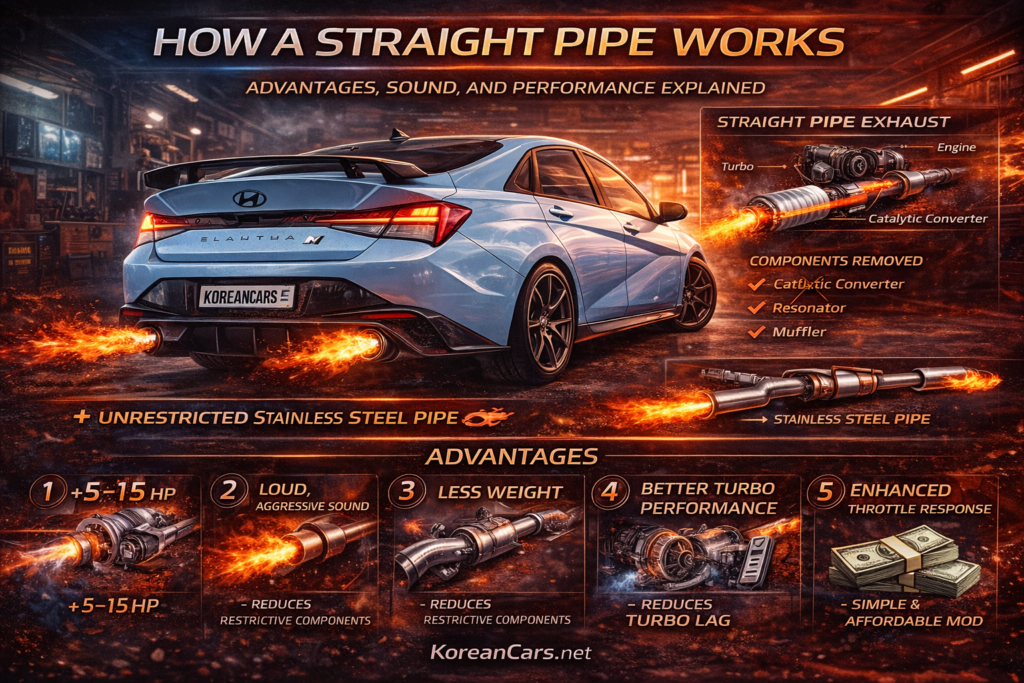
Few modifications spark as much excitement—and debate—among car enthusiasts as the straight pipe exhaust. Known for its raw sound, aggressive aesthetics, and performance potential, a straight pipe setup represents the purest form of exhaust modification. Whether installed on a turbocharged Hyundai Elantra N, a Kia Stinger GT, or a Genesis Coupe, this modification delivers an unmistakable driving experience.
In this guide, we explore how a straight pipe works, its advantages, potential drawbacks, and whether it’s the right upgrade for your build.
What Is a Straight Pipe Exhaust?
A straight pipe exhaust system replaces restrictive factory components—such as the muffler, catalytic converter, and resonator—with a continuous, unrestricted pipe. This allows exhaust gases to flow freely from the engine to the tailpipe.
Key Components Removed
- Muffler
- Resonator
- Catalytic Converter (in full straight pipe setups)
- Exhaust valves and restrictive chambers
The result is maximum airflow, reduced back pressure, and an aggressive exhaust note.
Straight Pipe Exhaust Diagram


This diagram illustrates how a straight pipe eliminates restrictions to optimize exhaust flow and sound output.
How a Straight Pipe Works
A straight pipe enhances engine performance by simplifying the path of exhaust gases. Here’s how the process works:
Step 1: Combustion Occurs in the Engine
Fuel ignites within the cylinders, producing exhaust gases as a byproduct.
Step 2: Exhaust Gases Exit the Engine
The gases travel through the exhaust manifold and into the exhaust system.
Step 3: Restrictions Are Eliminated
Unlike factory systems, a straight pipe removes components that reduce noise and emissions but restrict airflow.
Step 4: Gases Flow Freely Through the Pipe
With fewer obstructions, exhaust gases exit more efficiently, reducing back pressure.
Step 5: Performance and Sound Are Enhanced
The improved airflow increases horsepower potential and produces a louder, more aggressive exhaust note.
Exhaust Flow Comparison: Stock vs. Straight Pipe


This comparison highlights the efficiency gains achieved by removing restrictive components from the factory exhaust system.
Advantages of a Straight Pipe Exhaust
1. Increased Horsepower and Torque
By reducing back pressure, the engine can expel exhaust gases more efficiently, allowing it to produce more power.
Estimated Gains: 5–15 horsepower, depending on the vehicle and engine configuration.
2. Aggressive and Unfiltered Sound
A straight pipe delivers a loud, raw exhaust note that many enthusiasts crave.
Sound Characteristics:
- Deep and throaty in naturally aspirated engines
- Sharp and explosive in turbocharged vehicles
- Enhanced turbo spool and blow-off sounds
3. Reduced Weight
Factory exhaust systems contain multiple heavy components. Removing them reduces overall vehicle weight, improving performance.
4. Improved Turbocharger Efficiency
Turbocharged engines benefit significantly from reduced exhaust restrictions, allowing the turbo to spool faster.
Ideal for:
- Hyundai Elantra N
- Hyundai Veloster N
- Kia Stinger GT
- Genesis G70
- Hyundai Genesis Coupe
5. Simplicity and Cost Efficiency
Straight pipes are mechanically simple, making them relatively affordable compared to complex performance exhaust systems.
6. Enhanced Throttle Response
Freer airflow allows the engine to respond more quickly to throttle inputs, creating a more engaging driving experience.
Advantages at a Glance
| Benefit | Description |
|---|---|
| Increased Power | Improved exhaust flow enhances engine output |
| Aggressive Sound | Loud and distinctive exhaust note |
| Reduced Weight | Eliminates heavy factory components |
| Improved Turbo Performance | Faster turbo spool and reduced lag |
| Better Throttle Response | More responsive acceleration |
| Cost-Effective | Simple and affordable modification |
| Motorsport Aesthetic | Race-inspired performance upgrade |
Potential Drawbacks
While straight pipes offer numerous advantages, they also come with considerations.
| Drawback | Explanation |
|---|---|
| Excessive Noise | May be too loud for daily driving |
| Legal Restrictions | Often illegal on public roads in many regions |
| Emissions Issues | Removal of catalytic converters increases pollution |
| Cabin Drone | Can create unwanted interior noise |
| Check Engine Lights | May require ECU tuning or O2 sensor spacers |
| Reduced Resale Value | Not suitable for all buyers |
Straight Pipe vs. Cat-Back Exhaust
| Feature | Straight Pipe | Cat-Back Exhaust |
|---|---|---|
| Noise Level | Extremely Loud | Moderate and Tuned |
| Emissions Compliance | Often Non-Compliant | Typically Legal |
| Performance Gains | Maximum Potential | Balanced Performance |
| Daily Drivability | Limited | Comfortable |
| Cost | Lower | Higher |
| Practicality | Track-Focused | Street-Friendly |
For most drivers, a cat-back system offers a balanced compromise, while straight pipes are ideal for track builds.
Best Korean Cars for a Straight Pipe Setup
Straight piping is especially popular among KDM enthusiasts.
Recommended Platforms
- Hyundai Elantra N
- Hyundai Veloster N
- Hyundai Genesis Coupe
- Kia Stinger GT
- Genesis G70
- Kia Forte GT
- Hyundai Sonata N Line
These vehicles respond well to exhaust modifications, particularly when paired with ECU tuning.
Is a Straight Pipe Legal?
Straight pipes are often restricted due to emissions and noise regulations. Always check local laws before installation.
General Guidelines
- Track Use: Typically permitted
- Street Use: Often restricted or illegal
- Emissions Testing: May result in failure without catalytic converters
Compliance varies by country, state, and province.
Maintenance Tips for Straight Pipe Systems
To ensure optimal performance and longevity:
- Inspect welds and clamps regularly.
- Monitor oxygen sensors and ECU readings.
- Check for exhaust leaks.
- Use high-quality stainless steel piping.
- Retune the ECU when necessary.
Proper maintenance ensures reliability and peak performance.
Conclusion
A straight pipe exhaust represents the ultimate expression of automotive freedom—unrestricted airflow, aggressive sound, and enhanced performance. For enthusiasts seeking a race-inspired driving experience, few modifications deliver such immediate and dramatic results.
However, this upgrade is best suited for track-focused builds or dedicated project cars due to its noise levels and legal considerations. When installed responsibly, a straight pipe transforms both the sound and character of any performance vehicle.
For those who believe louder truly is better, the straight pipe remains the ultimate statement in automotive expression.