0
0
 0
0
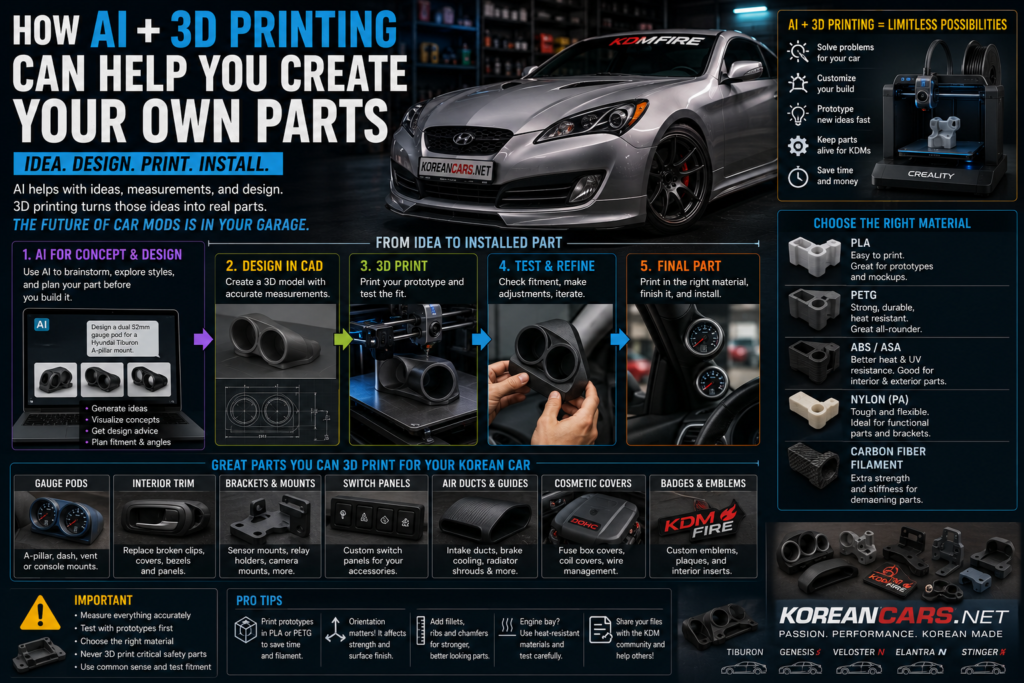
Car modification has always been about creativity. Enthusiasts have been cutting, welding, sanding, fiberglassing, and fabricating custom parts for decades. But now, two technologies are making custom car parts more accessible than ever: artificial intelligence and 3D printing.
On their own, each technology is powerful. AI can help with ideas, measurements, design options, airflow concepts, and problem solving. 3D printing can turn those ideas into physical parts. Together, they can give car enthusiasts a new way to create custom interior pieces, brackets, trim parts, prototypes, aero concepts, gauge pods, intake ducting, and hard-to-find replacement pieces.
For Korean car owners, this could become especially useful. Many older KDM platforms like the Hyundai Tiburon, Tuscani, first-generation Genesis Coupe, older Kia models, and early Hyundai performance cars no longer have the same aftermarket support as newer enthusiast platforms. When parts become discontinued, rare, or expensive, AI-assisted 3D printing could help keep these cars alive.
Why This Matters for Car Enthusiasts
Not every car has huge aftermarket support.
If you own a Toyota Supra, Nissan 240SX, Honda Civic, or Mazda Miata, there are thousands of parts available. But if you own a Hyundai Tiburon, older Kia Forte Koup, Genesis Coupe, Veloster, or less common Korean platform, you may have to work harder to find specific parts.
That is where 3D printing becomes interesting.
Instead of waiting for a company to produce a small plastic bracket, vent insert, badge mount, trim piece, switch panel, or custom gauge pod, owners can potentially design and produce it themselves.
Companies in the automotive additive manufacturing space already promote 3D printing for rapid prototyping, custom parts, aftermarket pieces, replacement parts, and tooling. Formlabs, for example, highlights automotive uses ranging from rapid prototyping to end-use and aftermarket parts. (Formlabs)
For the enthusiast world, that means the same concept can be scaled down to the garage.
Where AI Comes In
AI does not replace skill, measurement, or testing. But it can help speed up the creative process.
AI can help with:
- Brainstorming part ideas
- Creating visual concepts
- Suggesting design improvements
- Explaining material choices
- Helping write CAD prompts or design notes
- Comparing shapes and functions
- Generating styling directions
- Planning airflow or mounting concepts
- Troubleshooting print failures
- Improving documentation
Think of AI as the design assistant, and the 3D printer as the tool that brings the idea into the physical world.
For example, you might tell an AI tool:
“I want a custom gauge pod for a Hyundai Tiburon that fits near the driver-side A-pillar and holds a boost gauge.”
AI can help you think through the shape, angle, mounting approach, visibility, and possible issues before you even open CAD software.
AI for Concept Design
One of the biggest advantages of AI is fast ideation.
Before 3D printing existed, you might sketch ideas on paper or search forums for inspiration. Now, AI image tools can help create visual concepts for:
- Custom vents
- Front lips
- Interior trim panels
- Switch panels
- Gauge pods
- Speaker adapters
- Emblem designs
- Aero fins
- Intake duct shapes
- Cosmetic covers
This does not mean the AI image is ready to print. A picture is not a usable part. But it can provide direction.
You can explore styles like:
- OEM-plus
- Race-inspired
- Cyberpunk
- Minimalist
- Retro 2000s tuner
- Carbon-fiber-look
- Track-focused
- Widebody concept
Once you know the look you want, you can move into measurement and CAD design.
AI and CAD Design
The real step happens in CAD software.
CAD stands for computer-aided design. It is where the part becomes a measured 3D model rather than just an idea.
AI can support this process by helping you think through:
- Dimensions
- Mounting points
- Screw hole placement
- Wall thickness
- Ventilation
- Material strength
- Clearance
- Assembly order
- Print orientation
- Support structure
Generative design is another important concept. In generative design, software explores many possible shapes based on goals like strength, weight, space, and material use. Formlabs describes generative design as a method that can create complex shapes that are often well suited for 3D printing. (Formlabs)
This is especially useful because 3D printing does not need to follow the same rules as traditional manufacturing. A printed part can include internal lattices, unusual curves, lightened structures, and complex shapes that would be difficult to machine or mold.
The Hyundai Example: 3D Printing Is Already Serious
This is not just a hobbyist fantasy.
Hyundai has already been involved in advanced 3D-printed automotive part design. Materialise documented a Hyundai Automotive and SL Corporation project involving a 3D-printed headlight heat sink that used lattice structures to improve weight, thermal efficiency, manufacturing lead time, and build success rates. (Materialise)
That matters because it shows the technology is not only for toys, keychains, or decorative parts. When properly engineered, 3D printing can solve real automotive design problems.
For enthusiasts, the lesson is not that you should start printing critical engine components at home. The lesson is that 3D printing allows new design freedom, especially for parts where shape, fitment, weight, and customization matter.
Great DIY Car Parts to 3D Print
For most enthusiasts, the best starting point is non-critical parts.
Good candidates include:
Interior Trim Pieces
Older cars often have broken or missing plastic interior pieces. 3D printing can help recreate:
- Clips
- Covers
- Bezels
- Small trim panels
- Switch blanks
- Console inserts
These are useful because they are usually low-load and easy to test.
Gauge Pods
Boost gauges, oil pressure gauges, wideband gauges, and temperature gauges often need custom mounting.
A 3D printer can help create:
- A-pillar pods
- Vent gauge mounts
- Dashboard pods
- Center console mounts
- Steering column mounts
For turbocharged Korean cars like the Tiburon, Genesis Coupe 2.0T, Veloster Turbo, or Elantra N, this can be especially useful.
Switch Panels
If you have added accessories, you may need clean switch placement.
Examples include:
- Auxiliary lighting switches
- Fan override switches
- Air suspension controls
- Exhaust valve controls
- Dash cam power switches
- Accessory USB panels
A printed switch panel can look far cleaner than random switches drilled into the dashboard.
Brackets and Mounts
3D printing is excellent for custom brackets, especially during prototyping.
You can make:
- Sensor brackets
- Camera mounts
- Phone mounts
- Relay mounts
- Small module holders
- Trim support brackets
- Wiring guide clips
For final parts, material choice matters. A bracket inside the cabin has different demands than one near engine heat.
Intake Ducting and Air Guides
AI and 3D printing can be useful for experimenting with airflow ideas.
Possible parts include:
- Airbox snorkels
- Cold air guides
- Brake cooling duct prototypes
- Radiator shrouds
- Vent adapters
However, heat resistance and airflow testing become more important here. Engine bay parts need better material selection than interior parts.
Cosmetic Covers
Printed parts can help clean up an engine bay or interior.
Examples include:
- Fuse box covers
- Battery covers
- ECU covers
- Coil pack covers
- Wire management covers
These can make a build look more finished, especially at meets.
Badge and Emblem Projects
For KDM builds, custom badging can be part of the identity.
3D printing can help create:
- Custom Tuscani-style accents
- KDM Fire badges
- KoreanCars.net display pieces
- Club plaques
- Show board details
- Interior emblem inserts
These are great beginner projects because they are visual rather than structural.
Parts You Should Be Careful With
Not every car part should be 3D printed at home.
Be extremely careful with:
- Brake components
- Steering components
- Suspension arms
- Wheel spacers
- Seat belt mounts
- Engine mounts
- Jacking points
- Load-bearing chassis parts
- Anything exposed to extreme heat
- Anything where failure could cause a crash
Even if a printed part looks strong, that does not mean it is safe.
Layer direction, material type, temperature, UV exposure, vibration, and fatigue all affect real-world durability.
For safety-critical parts, use professionally engineered components with proper testing.
Choosing the Right 3D Printing Material
Material choice is one of the most important decisions.
PLA
PLA is easy to print and good for basic prototypes.
Best for:
- Test fitting
- Mockups
- Decorative pieces
- Indoor items
Avoid using PLA for hot areas because it can soften with heat.
PETG
PETG is stronger and more temperature-resistant than PLA.
Best for:
- Interior parts
- Light-duty brackets
- Trim pieces
- Switch panels
- Basic functional parts
It is a good middle-ground material for many hobbyists.
ABS
ABS has better heat resistance and is commonly associated with automotive plastic parts.
Best for:
- Interior pieces
- Some exterior trim
- More durable functional parts
However, ABS can be harder to print because it may warp and often requires better ventilation and enclosure control.
ASA
ASA is similar to ABS but generally better for outdoor use because it has improved UV resistance.
Best for:
- Exterior trim
- Sun-exposed parts
- Badges
- Durable covers
ASA is one of the better hobbyist options for exterior automotive parts.
Nylon
Nylon is strong, tough, and useful for functional parts.
Best for:
- Brackets
- Clips
- Mechanical parts
- More durable mounts
It can absorb moisture and may require careful printing conditions.
Carbon-Fiber-Reinforced Filaments
Carbon-fiber-filled nylon or PETG can be stronger and stiffer than standard materials.
Best for:
- Strong brackets
- Lightweight functional parts
- Higher-end custom pieces
These materials often require hardened printer nozzles and more tuning.
The Workflow: From Idea to Installed Part
Here is a simple process for creating a custom part.
Step 1: Identify the Problem
Start with a real need.
For example:
“My Tiburon has a broken interior trim clip.”
“I need a cleaner place to mount my boost controller.”
“I want a custom vent gauge pod.”
“My Genesis Coupe needs a bracket for an aftermarket module.”
The best printed parts usually solve a specific problem.
Step 2: Measure Everything
Accurate measurements matter.
Use:
- Digital calipers
- Ruler
- Contour gauge
- Photos
- Cardboard templates
- Existing broken part
- 3D scan if available
AI can help you plan, but it cannot magically know the exact measurements of your car.
Step 3: Create or Modify a CAD Model
You can design from scratch or modify an existing model.
Common tools include:
- Fusion-style CAD software
- Blender for visual shapes
- Tinkercad for simple beginner parts
- 3D scanning apps
- Mesh editing software
AI can help explain how to approach the model, but you still need to confirm dimensions.
Step 4: Print a Prototype
Do not print the final version first.
Print a rough test version.
Check:
- Fitment
- Clearance
- Screw holes
- Angles
- Flex
- Visibility
- Interference
- Ease of installation
This is where 3D printing is powerful. You can test, revise, and print again.
Step 5: Improve the Design
After the first test, adjust the design.
You may need to:
- Thicken walls
- Add ribs
- Change hole size
- Improve clip shape
- Round edges
- Add clearance
- Change material
- Change print orientation
This is where AI can help you troubleshoot why a part failed or how to improve it.
Step 6: Print the Final Version
Once the part fits, print in the correct material.
For a final part, consider:
- Stronger filament
- Better infill
- More wall layers
- Correct print orientation
- Heat resistance
- UV resistance
- Sanding and finishing
A part that fit perfectly in PLA may need to be reprinted in PETG, ASA, ABS, nylon, or carbon-fiber-reinforced material depending on use.
Step 7: Finish the Part
Raw 3D prints can look rough.
Finishing options include:
- Sanding
- Primer
- Paint
- Filler primer
- Vinyl wrap
- Clear coat
- Texture coating
- Carbon-look finish
- Heat-set threaded inserts
The difference between “home 3D print” and “professional custom part” is often finishing.
How AI Makes This Easier
AI can support almost every stage.
Idea Generation
AI can help suggest multiple ways to solve the same problem.
Design Review
You can describe the part and ask what might fail.
Material Selection
AI can help compare materials for heat, strength, flexibility, and UV exposure.
CAD Guidance
AI can explain how to build shapes, add mounting holes, or design brackets.
Print Troubleshooting
AI can help diagnose:
- Warping
- Layer separation
- Weak parts
- Poor bed adhesion
- Stringing
- Bad overhangs
- Dimensional inaccuracy
Documentation
AI can help you create install guides, parts lists, and build notes.
For a car community, this is huge. Imagine a KDM owner designing a part once, then sharing the file and instructions with other owners who have the same problem.
The Future: AI-Designed KDM Parts Libraries
One of the most exciting possibilities is community-driven parts libraries.
Imagine a future where Korean car owners can download or customize files for:
- Tiburon interior clips
- Tuscani badge adapters
- Genesis Coupe gauge pods
- Veloster N intake guides
- Elantra N aero prototypes
- Stinger trunk organizers
- KDM Fire club plaques
- KoreanCars.net show displays
This could help keep older Korean cars alive long after factory parts become discontinued.
Protolabs notes that 3D printing replacement parts can also create opportunities to improve or modernize older designs rather than simply reproduce them exactly. (Protolabs)
That idea fits perfectly with enthusiast culture. We do not always want the part exactly as it was. Sometimes we want a better version.
How This Could Change the Aftermarket
Traditional aftermarket companies need demand. If there are not enough owners willing to buy a part, the company may never produce it.
That is one reason less common platforms get ignored.
3D printing changes the economics.
Instead of needing a huge production run, a part can be produced:
- One at a time
- Locally
- On demand
- In small batches
- Customized for each owner
EOS, an industrial 3D printing company, highlights automotive additive manufacturing uses such as customized parts, tooling, spare parts management, and engine-related applications. (EOS GmbH)
For hobbyists, this does not mean everyone becomes a factory. But it does mean the gap between “idea” and “part” becomes much smaller.
Will 3D Printing Replace Traditional Parts?
Not completely.
Mass-produced parts are still better for many applications. Injection-molded plastic, forged metal, CNC machining, stamped steel, and traditional composites all have their place.
3D printing is best when you need:
- Customization
- Small production runs
- Rare replacement parts
- Prototypes
- Complex shapes
- Fast iteration
- Personalization
It is not always best when you need:
- Maximum strength
- High-volume production
- Certified safety parts
- Extreme heat resistance
- Critical structural performance
The future is not 3D printing replacing everything. The future is 3D printing filling gaps that traditional manufacturing ignores.
Why Korean Car Owners Should Pay Attention
KDM owners often understand what it means to be overlooked by the aftermarket.
That makes AI and 3D printing especially valuable.
A Honda owner might be able to buy five versions of the same part from different companies. A Tiburon owner might have to search forums, eBay, Facebook Marketplace, or junkyards for months.
With AI-assisted design and 3D printing, owners can take more control.
This does not just help one car. It helps the whole community.
Every custom part becomes a potential shared solution. Every prototype becomes a starting point. Every solved problem makes the platform easier to own.
That is how enthusiast communities grow.
Final Thoughts
AI and 3D printing are not magic buttons. They will not instantly create perfect, road-safe parts without measurement, testing, and common sense.
But they are powerful tools.
AI helps with the thinking.
3D printing helps with the making.
Together, they give car enthusiasts a new way to solve problems, personalize builds, and keep older platforms alive.
For Korean car owners, this could be especially important. As cars like the Hyundai Tiburon, Tuscani, Genesis Coupe, Veloster N, Elantra N, and Kia Stinger continue building their place in enthusiast culture, custom parts will become part of the identity.
The next great KDM part might not come from a huge aftermarket company.
It might come from one owner with a problem, an idea, an AI assistant, a CAD file, and a 3D printer in the garage.