0
0
 0
0
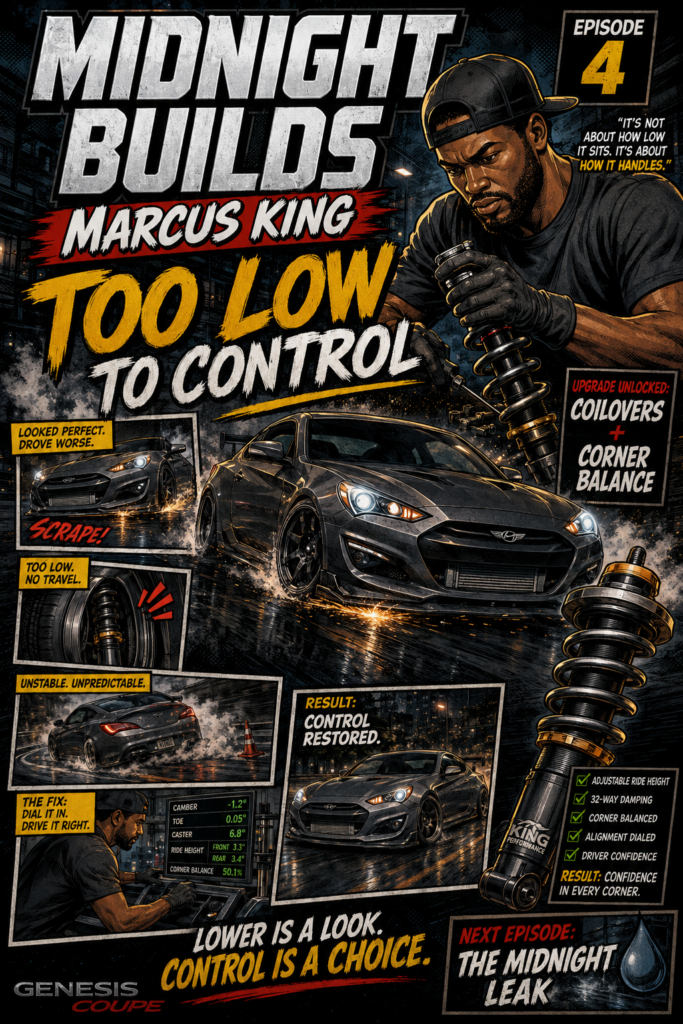
Marcus King had spent months teaching his Genesis Coupe how to make power.
Then he taught it how to put that power down.
After that, he made sure it could stop.
Now only one major system remained untouched.
The suspension.
The Genesis sat beneath the garage lights, its factory ride height suddenly looking enormous to Marcus.
The wheel gap hadn’t bothered him before.
Now it was all he could see.
He stepped back, tilted his head and imagined the car lower—its body sitting tightly over the wheels, its stance sharper and more purposeful.
But appearance wasn’t the real goal.
Marcus wanted response.
Less body roll.
Faster transitions.
More confidence through corners.
He wanted the Genesis to feel like one solid machine instead of several heavy parts negotiating with one another.
A week later, the garage floor was covered in boxes.
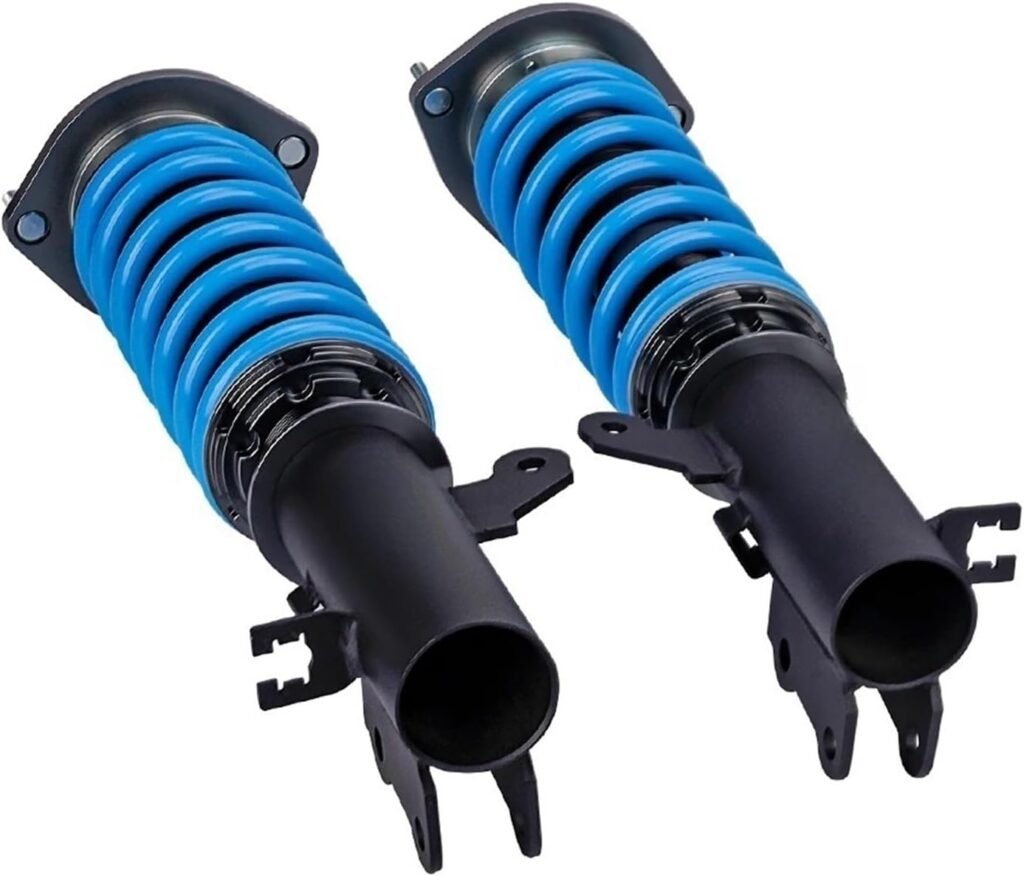
Adjustable coilovers.
Stiffer rear springs.
Spherical-bearing control arms.
Adjustable sway-bar links.
Rear camber arms.
A suspension setup capable of transforming the car—provided Marcus got every measurement right.
He opened the first box and smiled.
“This should make things interesting.”
The installation took most of the night.
The factory struts came out.
The new coilovers went in.
Marcus adjusted each threaded body, carefully comparing the measurements.
But as the hours passed, precision slowly gave way to exhaustion.
One more turn lower.
Then another.
He stood back and looked at the finished car.
The Genesis sat dramatically closer to the ground.
The wheels filled the arches perfectly.
The front splitter hovered only inches above the concrete.
Marcus folded his arms.
“Now that looks serious.”
The following afternoon, he rolled the Genesis out of the garage.
Immediately, the car felt different.
The steering was quicker.
The chassis responded instantly.
Every small movement of the wheel produced a reaction.
At low speed, it felt incredible.
Tight.
Sharp.
Mechanical.
Marcus grinned.
Then he reached the first uneven section of pavement.
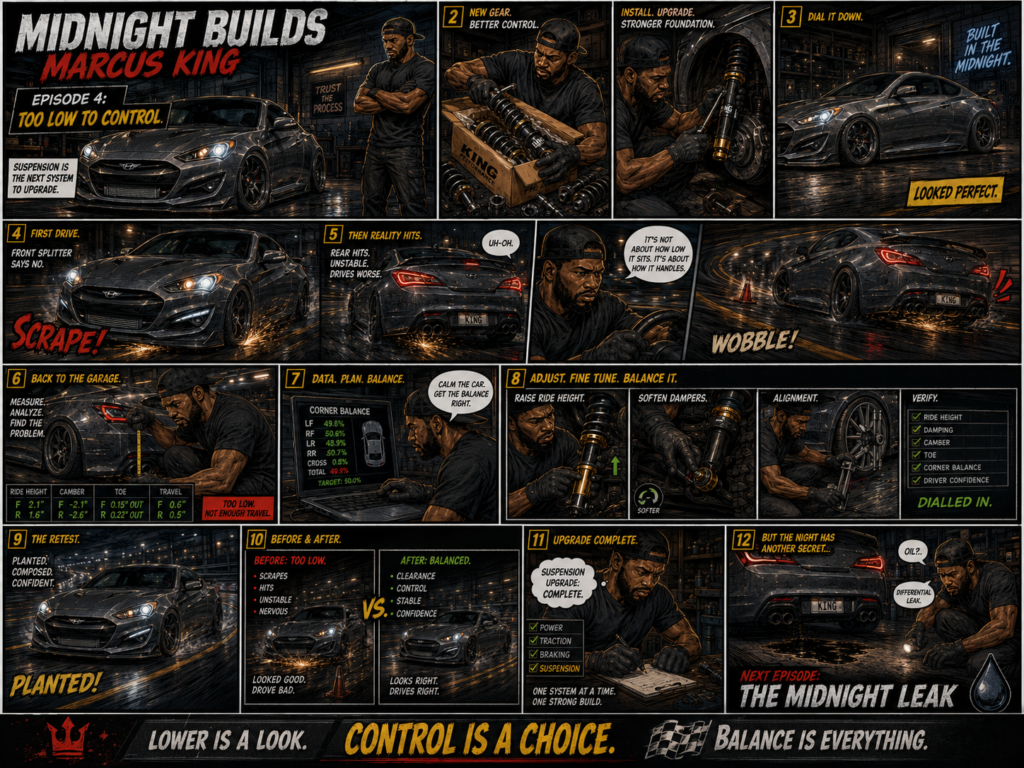
SCRAAAAAPE!
The splitter dragged across the road.
Marcus winced.
“All right. Minor adjustment.”
A second bump followed.
THUD!
The rear suspension compressed hard.
The tire struck the inside of the fender.
Marcus slowed down.
The car continued bouncing long after the road had flattened.
“That isn’t right.”
He drove carefully toward a closed handling course operated by a nearby performance shop.
This was where the suspension would face its real test.
Marcus accelerated through the first sweeping corner.
The front end responded quickly.
Too quickly.
The rear followed a fraction of a second later, suddenly rotating harder than expected.
Marcus corrected.
The Genesis snapped back in the opposite direction.
He caught it, straightened the car and immediately reduced his speed.
“What was that?”
He tried another corner.
The same problem returned.
The front tires turned in sharply, but the rear felt nervous and disconnected.
On the next braking zone, the car wandered slightly across the pavement.
The steering wheel pulled in Marcus’s hands.
The Genesis looked planted.
But it felt unstable.
Marcus completed one slow lap and returned directly to the garage.
He parked beneath the lights and stepped out.
The car looked perfect.
Low.
Wide.
Aggressive.
But Marcus wasn’t smiling.
He crouched beside the front wheel and studied the angle.
Too much negative camber.
He checked the rear.
One side sat lower than the other.
Then he measured the suspension travel.
Almost none.
By lowering the car too far, he had pushed the control arms beyond their ideal geometry.
The suspension wasn’t absorbing the road anymore.
It was fighting it.
Marcus stood up and stared at the Genesis.
“I built a photograph.”
He tossed the tape measure onto the workbench.
“Not a performance car.”
The next morning, Marcus began again.
He raised the car.
Not much.
Just enough to restore usable suspension travel.
He reset the spring preload according to the manufacturer’s specifications.
Then he disconnected the sway-bar links and measured the ride height at all four corners.
The front-left corner was carrying too much weight.
The rear-right was barely contributing.
No wonder the car felt unpredictable.
Marcus placed individual scales beneath each wheel.
The numbers appeared on his laptop.
He adjusted one coilover.
Checked again.
Adjusted another.
Checked again.
Each change shifted weight diagonally through the chassis.
A few millimetres at one corner changed the load at all four tires.
Marcus worked slowly.
Raise.
Measure.
Lower.
Measure.
Repeat.
Hours passed.
The Genesis gradually became level—not merely in appearance, but in balance.
Next came the alignment.
Marcus reduced the extreme camber.
He corrected the rear toe.
He added a small amount of front toe-out for sharper turn-in, while keeping the rear slightly stable under acceleration.
Then he adjusted the dampers.
The first setup had been almost fully stiff.
A common mistake.
Stiff felt fast on smooth pavement, but without compliance, the tires couldn’t remain connected to the road.
Marcus softened the compression.
Then the rebound.
One click at a time.
That evening, he returned to the handling course.
The Genesis no longer sat impossibly low.
But it still looked purposeful.
More importantly, it now had room to move.
Marcus entered the first corner carefully.
The front tires responded.
The rear followed naturally.
No delay.
No sudden rotation.
No correction.
He increased his speed.
The car leaned slightly, settled onto the outside tires and held its line.
Marcus smiled.
“There you are.”
Through the next series of corners, the Genesis flowed from one direction to the other.
The chassis remained controlled without becoming rigid.
The tires stayed planted over uneven pavement.
The steering communicated exactly how much grip remained.
For the first time, Marcus didn’t feel like he was commanding the car.
They were working together.
He entered the final corner faster.
Braked hard.
Turned in.
The nose responded immediately.
The rear rotated just enough to help point the car toward the exit.
Marcus rolled onto the throttle.
Boost built.
The limited-slip differential locked.
Both rear tires pushed the Genesis forward.
No rubbing.
No bouncing.
No instability.
Just one clean movement from braking to cornering to acceleration.
Back at the garage, Marcus parked beside the whiteboard.
He picked up the marker.
Power.
✓
Traction.
✓
Braking.
✓
Suspension.
✓
He stepped back and studied the list.
The Genesis was becoming faster.
But that wasn’t the lesson of the night.
Marcus had learned that modifications didn’t work simply because they were expensive.
And a car wasn’t better simply because it sat lower.
Every component had to operate as part of a system.
Every adjustment had consequences.
The best setup wasn’t the most extreme.
It was the one that allowed everything to work together.
Marcus glanced across the garage.
The Genesis Coupe rested beneath the lights, calm and balanced.
Then he noticed a faint puddle forming beneath the rear of the car.
He walked closer.
Dark fluid.
A sharp smell.
Marcus crouched and followed the trail toward the differential housing.
His expression changed.
The new limited-slip differential was leaking.
He looked back toward the whiteboard.
Then slowly erased the checkmark beside Traction.
“Nothing stays finished for long.”
Next Episode: The Midnight Leak