0
 0
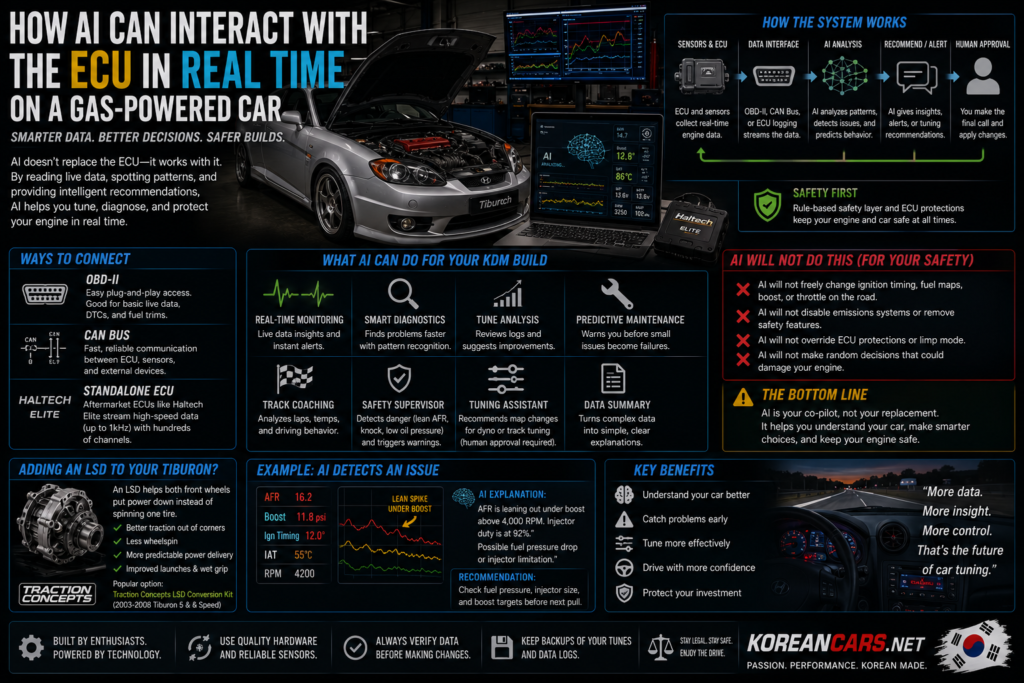
Modern cars are already computers on wheels. Even a gasoline-powered car depends on software to manage fuel, ignition timing, idle speed, boost control, emissions systems, cooling fans, knock response, and sensor feedback.
So the next question is natural:
Could artificial intelligence interact with the ECU in real time?
The answer is yes — but with major safety limits.
AI should not be treated like a random chatbot directly changing fuel maps, ignition timing, throttle control, or boost pressure while you are driving on public roads. That would be dangerous. A car’s engine management system is a real-time safety-critical control system, and bad decisions can damage the engine, make the car unsafe, or violate emissions laws.
But used properly, AI could become a powerful layer around the ECU: monitoring data, spotting problems, recommending changes, predicting failures, helping tuners understand logs, and eventually supporting controlled track or dyno-based calibration.
For Korean car enthusiasts — especially those working with modified platforms like the Hyundai Tiburon, Genesis Coupe, Veloster N, Elantra N, and Kia Stinger — this could become a major part of the future of tuning.
First: What Does the ECU Actually Do?
The ECU, or engine control unit, is the computer that manages the engine.
On a gasoline car, it may control or monitor:
- Fuel injection
- Ignition timing
- Idle control
- Throttle response
- Boost control
- Knock correction
- Air-fuel ratio
- Oxygen sensor feedback
- Coolant temperature
- Intake air temperature
- Crank and cam signals
- Misfire detection
- Emissions systems
- Fan control
- Limp mode
- Diagnostic trouble codes
In a modified car with an aftermarket ECU, the ECU may also manage wideband oxygen feedback, boost-by-gear, launch control, flex fuel, extra sensors, and custom data logging.
The ECU is already doing complex real-time work. AI would not replace that core job. It would sit above or beside it as a smarter interpretation and decision-support layer.
How the AI Would “Talk” to the Car
There are several possible communication paths.
- OBD-II
OBD-II is the standard diagnostic access point found on modern vehicles. It allows scan tools to read emissions-related diagnostic data, trouble codes, and some live sensor values. SAE J1979/ISO 15031-5 defines communication between a vehicle’s OBD system and external test equipment for legislated emissions-related OBD data.
This is the easiest way for an AI system to read basic information from a stock car.
Useful OBD data can include:
- RPM
- Vehicle speed
- Coolant temperature
- Intake air temperature
- Throttle position
- Fuel trims
- Oxygen sensor data
- Diagnostic codes
- Load calculation
The downside is that OBD-II is usually slower and more limited than direct ECU data. It is good for monitoring, but not ideal for high-speed performance control.
- CAN Bus
Modern vehicles use networks to let modules communicate. CAN, or Controller Area Network, was developed to allow automotive electronic components to share data over common communication lines rather than requiring separate wiring for every signal.
On a performance build, CAN can be used to share information between:
- ECU
- Digital dash
- Wideband controller
- Sensors
- Power distribution module
- Data logger
- Transmission controller
- Body control module
- External computer
For AI, CAN is important because it can provide real-time streams of engine and vehicle data.
- Aftermarket ECU Data Streams
For modified cars, an aftermarket ECU is often the best foundation.
For example, Haltech documents an ECU Broadcast CAN Protocol that defines channels and data streams broadcast by Haltech Elite and Nexus ECUs over CAN bus. Haltech also notes that its NEXUS R5 ECU can internally log up to 300 channels at speeds up to 1 kHz, showing how much data modern standalone systems can capture.
For a modified Korean car, this is where AI becomes especially interesting. Instead of only seeing basic OBD data, AI could analyze detailed channels like:
- Boost pressure
- Wideband AFR
- Fuel pressure
- Oil pressure
- Oil temperature
- Injector duty cycle
- Ignition timing
- Knock activity
- Engine protection status
- Throttle position
- Idle control duty
- Battery voltage
- Crank trigger errors
- Cam sync status
That level of data could help diagnose problems much faster.
The Safe Architecture: AI as a Supervisory Layer
The safest way to design this is not:
AI directly controls the engine.
The safer approach is:
ECU controls the engine.
AI watches the ECU data.
AI detects patterns.
AI gives warnings or recommendations.
A rule-based safety layer limits what can happen.
A human tuner approves real calibration changes.
In automotive software, deeply embedded systems often require predictability, safety, and responsiveness. AUTOSAR describes its Classic Platform as being used for embedded systems with hard real-time and safety constraints across domains including powertrain engine and transmission.
That matters because engine control is not the same as making a music playlist. It is deterministic, time-sensitive, and safety-critical.
AI should not be allowed to improvise freely inside that loop.
Level 1: AI as a Smart Dashboard
The simplest version is a read-only AI dashboard.
The AI reads live data and explains what is happening.
For example, it could say:
- “Coolant temperature is rising faster than normal.”
- “Battery voltage is dropping during idle.”
- “AFR is leaner than expected under light throttle.”
- “Boost is not matching target.”
- “Idle instability appears when intake air temperature rises.”
- “Knock correction is increasing at high load.”
- “Fuel trims suggest a possible vacuum leak.”
- “Oil pressure is lower than expected at hot idle.”
This would be extremely useful for enthusiasts.
Instead of staring at dozens of gauges and logs, the AI could summarize what matters.
For a turbo Tiburon with a standalone ECU, this could help detect issues before they become serious. If AFR starts drifting lean, fuel pressure drops, or trigger sync errors appear, the AI could flag it immediately.
This level is the safest because the AI does not control anything. It only watches and explains.
Level 2: AI as a Log Analysis Assistant
The next level is AI analyzing logs after a drive, dyno pull, or track session.
This may be even more useful than live interaction.
The AI could compare:
- RPM
- Boost
- AFR
- Timing
- Throttle
- Knock
- Fuel pressure
- Injector duty
- Coolant temperature
- Intake air temperature
- Oil pressure
- Battery voltage
Then it could identify patterns.
For example:
“At 4,800 rpm under 165 kPa manifold pressure, AFR goes lean by 0.6 points while injector duty exceeds 85%. Check fuel pressure and injector capacity before increasing boost.”
Or:
“Idle instability happens only when coolant temperature is above 88°C and battery voltage drops below 12.3V. Check alternator output, idle valve behavior, fan activation load, and grounding.”
This is where AI could be genuinely powerful for DIY tuners and small shops.
It would not replace a tuner, but it would help organize the evidence.
Level 3: AI as a Tuning Recommendation System
The next step is AI recommending calibration changes.
This is where caution becomes more important.
The AI might suggest:
- Adjusting idle target
- Reviewing fuel table areas
- Checking ignition timing in a specific load zone
- Reducing boost target under high intake temperature
- Increasing fan activation strategy
- Reviewing acceleration enrichment
- Checking closed-loop fuel correction limits
- Adjusting cold-start enrichment
- Looking at crank fuel settings
But those should be recommendations, not automatic changes.
A human tuner should still decide whether the recommendation is correct.
This is because engine tuning is not only pattern recognition. It requires understanding mechanical condition, fuel quality, sensor accuracy, emissions rules, heat, drivetrain load, and how the car is actually being used.
AI can help ask the right questions. It should not blindly write the tune.
Level 4: AI as a Safety Supervisor
A very useful version of AI would be a safety supervisor.
Instead of trying to make more power, the AI would protect the engine.
It could watch for danger patterns like:
- Lean AFR under boost
- Low oil pressure
- Overheating
- High intake air temperature
- Knock increase
- Fuel pressure drop
- Injector duty too high
- Trigger sync errors
- Battery voltage instability
- Misfire-like behavior
- Boost creep
- Sensor disagreement
If a dangerous pattern appears, the system could trigger warnings.
In a more advanced race-only setup, it could ask the ECU to switch to a safer mode, reduce boost target, or activate a conservative protection strategy — but only through pre-approved safe maps and hard limits.
This distinction is critical.
The AI should not invent a new emergency strategy while the car is moving. It should select from safe, tested fallback options.
Level 5: AI-Assisted Calibration on a Dyno or Test Bench
The most advanced realistic use is AI-assisted calibration in a controlled environment.
This is already an area of research. Recent work on automated ECU calibration using reinforcement learning describes an explainable approach tested with hardware-in-the-loop methods, specifically for automating calibration while following established automotive development principles. Other research on safe reinforcement learning for real-world engine control uses safety monitoring to reduce risk during testbench interaction.
The key words are controlled environment.
Dyno.
Test bench.
Simulation.
Hardware-in-the-loop.
Professional instrumentation.
Safety monitoring.
Human oversight.
That is very different from letting an AI experiment with ignition timing on a public road.
Why Real-Time AI Control Is Difficult
- Latency
Engine control happens extremely fast. Fuel and ignition events are calculated in milliseconds. AI systems, especially large models, are not always deterministic enough for direct low-level control.
A delay that is harmless in a conversation could be dangerous in an engine control loop.
- Determinism
ECUs need predictable behavior. If the same sensor inputs occur, the ECU should respond consistently.
AI models can be harder to validate because they may behave differently across edge cases.
- Sensor Reliability
AI is only as good as the data it receives.
If a sensor is wrong, the AI may reach the wrong conclusion.
Examples:
- Bad wideband reading
- Faulty MAP sensor
- Loose ground
- Weak crank sensor
- Failing fuel pressure sensor
- Heat-soaked intake sensor
- Poor calibration scaling
A human tuner knows to question the sensor. AI must be designed to do the same.
- Engine Damage Happens Quickly
A bad ignition or fuel decision under boost can damage an engine fast.
Possible failures include:
- Detonation
- Melted pistons
- Broken ring lands
- Burnt valves
- Turbo damage
- Head gasket failure
- Catalytic converter damage
- Overheating
- Oil starvation damage
This is why AI control must be conservative, supervised, and limited.
- Emissions and Legal Issues
Street cars must comply with emissions laws. AI should not be used to disable emissions systems, defeat monitors, bypass catalytic converters, or create illegal road tunes.
For street cars, AI should focus on reliability, diagnostics, maintenance, safety, and legal performance optimization.
What AI Could Do Well on a Gas Car
Predictive Maintenance
AI could detect small changes before they become failures.
Examples:
- Battery voltage slowly weakening
- Fuel pressure dropping over time
- Injector duty creeping higher
- Hot idle oil pressure trending lower
- Misfire patterns getting worse
- Coolant temperature recovery slowing down
This could be huge for older project cars.
Misfire Diagnosis
AI could compare RPM instability, AFR swings, ignition events, crank signal behavior, and cylinder contribution data to suggest likely misfire causes.
For example:
- Spark plug issue
- Coil issue
- Injector issue
- Compression issue
- Vacuum leak
- Trigger sync issue
- Bad ground
For modified cars, this could save hours of guessing.
Tune Health Monitoring
AI could tell you whether the tune appears healthy based on logs.
It could flag:
- Lean areas
- Rich bogging
- Knock trends
- Boost overshoot
- Idle instability
- Hot start problems
- Cold start problems
- Closed-loop corrections maxing out
This would help both DIY owners and professional tuners.
Track Session Coaching
For track cars, AI could compare driver behavior and engine data.
It could report:
- Heat soak after several laps
- Brake and throttle patterns
- Gear selection
- Cooldown needs
- Intake temperature rise
- Oil pressure behavior under cornering
- Boost consistency
- Lap-to-lap performance trends
For an Elantra N, Veloster N, or Genesis Coupe track build, this would be very useful.
Adaptive Safety Limits
AI could recommend safer limits based on conditions.
For example:
- Lower boost target when intake temperature is too high
- Warn against full-throttle pulls when coolant is cold
- Recommend cooldown when oil temperature rises
- Flag possible fuel starvation during long corners
- Suggest checking alignment or tire pressure based on vehicle behavior
Again, for street cars, this should be advisory or limited to pre-approved safety modes.
The Best Use Case for a Modified Tiburon
For a Hyundai Tiburon running a standalone ECU like a Haltech Elite, the most realistic AI setup would be:
- Read ECU data over CAN or logs
- Monitor AFR, boost, coolant, voltage, throttle, RPM, timing, and trigger errors
- Detect abnormal patterns
- Give live warnings
- Analyze logs after each drive
- Suggest areas for a tuner to review
- Track long-term reliability trends
For example, the AI could help answer:
Why does the car stall at idle?
Why does it start cold and then die?
Why is AFR leaner than before?
Why does voltage drop during cranking?
Why do trigger sync errors appear?
Why does boost overshoot in cold weather?
Why does idle change after fans turn on?
That is a perfect AI use case because it helps interpret data without risking uncontrolled engine changes.
A Safe System Design
A safe AI-ECU system would have several layers.
Layer 1: ECU
The ECU controls the engine directly.
It handles:
- Fuel
- Spark
- Idle
- Boost
- Safety limits
- Sensor inputs
Layer 2: Data Interface
This reads information from OBD, CAN, or the ECU logging system.
Layer 3: AI Analysis
The AI interprets the data and identifies patterns.
Layer 4: Rule-Based Safety Filter
Before any recommendation or action, a strict rules layer checks whether it is safe.
Layer 5: Human Approval
For tuning changes, a human tuner approves the final decision.
Layer 6: Fallback Mode
If anything goes wrong, the system returns to a known safe map or disables AI interaction entirely.
This is the right mindset: AI assists, but the ECU and human tuner remain in charge.
What Should Never Be Left Fully to AI
For safety reasons, AI should not freely control:
- Ignition timing
- Fuel maps
- Drive-by-wire throttle
- Brake systems
- Steering systems
- Airbag systems
- Stability control
- Emissions defeat functions
- Boost control on public roads
- Safety-critical limp-mode decisions without hard limits
These are not areas for casual experimentation.
If AI is ever involved in them, it should be in a professional test environment with strict validation.
Could AI Tune a Car Better Than a Human?
Eventually, in some areas, yes.
AI may become very good at:
- Searching large calibration spaces
- Finding efficient map areas
- Predicting knock risk
- Optimizing fuel economy
- Improving cold start behavior
- Detecting sensor drift
- Comparing thousands of logs
- Automating dyno calibration workflows
But human tuners still understand context.
They know if the fuel is bad.
They know if the owner installed cheap parts.
They know if a sensor is lying.
They know if the engine is tired.
They know if the driver is abusing the car.
They know when not to chase a number.
The best future is not AI replacing tuners. It is AI making good tuners faster, safer, and more informed.
How This Could Change KDM Modding
For Korean car enthusiasts, AI-assisted ECU interaction could be especially valuable because some KDM platforms have smaller aftermarket communities than Japanese or European cars.
AI could help owners of:
- Hyundai Tiburon
- Tuscani
- Genesis Coupe
- Veloster Turbo
- Veloster N
- Elantra N
- Kia Forte Koup
- Kia Stinger GT
With enough shared logs and community knowledge, AI tools could help identify common problems faster.
Imagine a KDM-specific AI assistant that understands:
- Common Tiburon idle issues
- Genesis Coupe boost behavior
- Veloster N heat management
- Elantra N track logs
- Stinger GT transmission temperature trends
- Common sensor failures
- Platform-specific tuning patterns
That could make the KDM scene stronger because owners would have better diagnostic support.
The Future: AI as the Co-Pilot for Engine Health
The most exciting near-term future is not AI making wild horsepower.
It is AI keeping cars alive.
A smart system could say:
“Do not do a pull yet. Coolant is warm, but oil temperature is not ready.”
“Boost is normal, but AFR is trending leaner than last week.”
“Your idle issue appears only when voltage drops and fans activate.”
“Knock activity increased after the last fuel fill-up.”
“Fuel pressure falls at high RPM. Do not increase boost until this is checked.”
That kind of AI would be extremely useful.
It would make modified cars safer, more reliable, and easier to understand.
Final Thoughts
AI can absolutely interact with a gas-powered car’s ECU in real time, but the safest and most realistic role is not full control.
The best role is intelligence around the ECU.
AI can monitor data, analyze logs, spot danger, recommend fixes, help tuners, predict failures, and protect the engine. It can become a powerful assistant for modified cars, especially those running standalone ECUs with rich data logging.
But engine control is serious. Fuel, ignition, throttle, boost, and emissions systems should never be treated casually. A gasoline engine under load can be damaged quickly by a bad decision, and a road car can become unsafe if software behaves unpredictably.
So the future is not:
“Let AI take over the ECU.”
The better future is:
“Let the ECU do the real-time control, let AI understand the data, and let the human tuner make the final call.”
For KDM enthusiasts, that could be a game changer. Whether you are tuning a turbo Tiburon, diagnosing a Genesis Coupe, tracking an Elantra N, or maintaining a Stinger GT, AI could become the tool that helps you understand your car more deeply than ever before.