0
0
 0
0
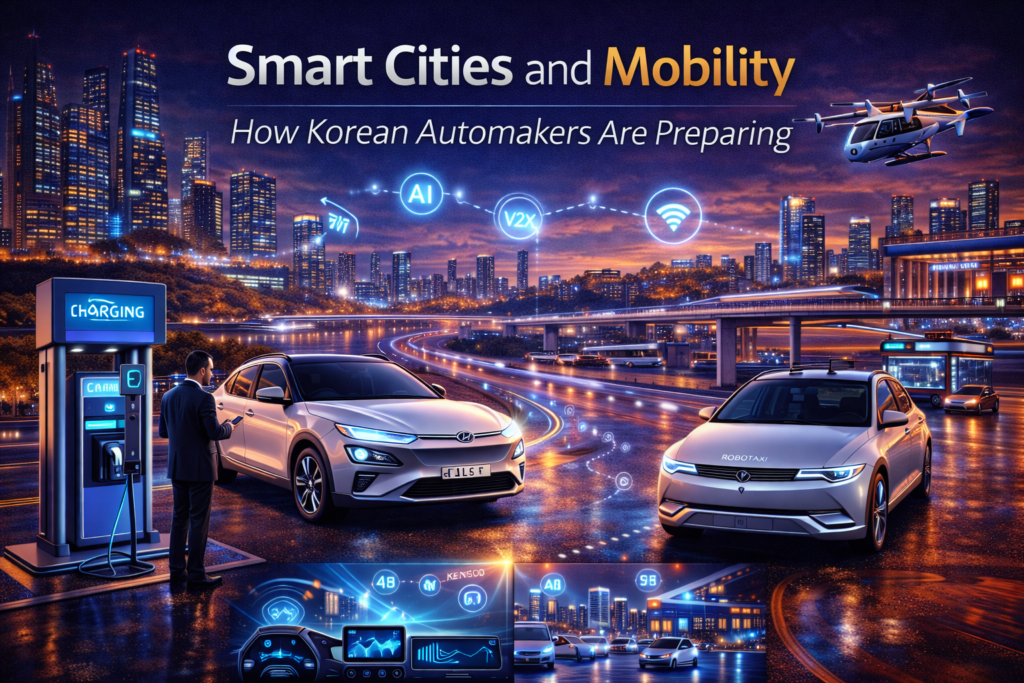
As urban populations surge and infrastructure strains under growing demand, cities around the world are being forced to rethink how people move. The solution is emerging in the form of smart cities—digitally connected urban environments where transportation, energy, and technology work together seamlessly.
At the center of this transformation are Korean automakers like Hyundai Motor Group, Kia, and Genesis. No longer just building cars, these companies are evolving into mobility solution providers, preparing for a future where vehicles are part of a much larger ecosystem.
What Is a Smart City?


A smart city uses data, connectivity, and automation to improve urban living. In transportation, this means:
- Real-time traffic optimization
- Autonomous vehicle integration
- Seamless multimodal transport (cars, trains, air mobility)
- Reduced congestion and emissions
Mobility becomes not just about getting from A to B—but doing so efficiently, intelligently, and sustainably.
Hyundai’s Vision: From Cars to Mobility Ecosystems


Hyundai Motor Group has made it clear: its future isn’t limited to automobiles.
Key Initiatives:
- Smart mobility platforms integrating vehicles with city infrastructure
- Autonomous driving development for safer, more efficient transport
- Urban Air Mobility (UAM) through Supernal
- Investment in robotics and AI
Hyundai envisions a world where your journey is planned, optimized, and executed by an intelligent system—before you even step outside.
Connected Vehicles: The Backbone of Smart Mobility


Modern Korean vehicles are becoming data-driven platforms.
Key Technologies:
- V2X (Vehicle-to-Everything) communication
- Cloud-based navigation and traffic data
- Over-the-air (OTA) updates
- AI-powered driving assistance
Cars are no longer isolated machines—they are nodes in a connected network.
Autonomous Driving: Redefining Urban Transport


Autonomous vehicles are a cornerstone of smart city mobility.
Korean automakers are investing heavily in:
- Advanced driver assistance systems (ADAS)
- Full self-driving capabilities
- Robotaxi services
The goal is clear:
- Reduce human error
- Improve traffic flow
- Enhance accessibility for all users
In a smart city, driving may become optional.
Electrification and Sustainability


Sustainability is a core pillar of smart cities.
Korean automakers are leading in:
- Electric vehicle platforms (E-GMP)
- Fast-charging infrastructure
- Hydrogen fuel cell development
- Integration with renewable energy grids
Vehicles like the Hyundai Ioniq 5 and Genesis GV60 are designed to fit seamlessly into these ecosystems.
Urban Air Mobility: Expanding into the Third Dimension


Smart cities aren’t just about roads—they’re about airspace.
Through Supernal, Korea is developing:
- eVTOL aircraft
- Vertiport infrastructure
- Integrated air-ground transport systems
This adds a new dimension to mobility—literally.
The Role of AI and Data
At the heart of smart mobility is data.
AI Applications:
- Predictive traffic management
- Personalized route planning
- Vehicle diagnostics and maintenance
- Energy optimization
Korean companies, with their strong tech and electronics background, are uniquely positioned to lead in this space.
Challenges to Overcome
Despite rapid progress, several challenges remain:
Infrastructure Costs
Building smart city networks requires massive investment.
Data Privacy
Balancing connectivity with user privacy is critical.
Regulation
Autonomous and connected systems need clear legal frameworks.
Public Adoption
Consumers must trust and adapt to new technologies.
Korea’s Competitive Advantage
Korea stands out globally due to:
- Advanced digital infrastructure (5G, IoT)
- Strong government support for smart cities
- Collaboration between tech, automotive, and energy sectors
- Rapid innovation cycles
Cities like Seoul are already acting as living laboratories for future mobility.
The Future: Seamless Mobility
Imagine a typical day in a Korean smart city:
- Your phone schedules your commute automatically
- An autonomous vehicle arrives at your door
- Traffic lights adapt in real time to optimize flow
- You transfer seamlessly to a flying taxi for long-distance travel
- Your vehicle charges itself using renewable energy
This is not decades away—it’s within reach.
Conclusion
The future of mobility is not just about better cars—it’s about smarter systems.
Korean automakers are leading this transformation by expanding beyond traditional vehicles into fully integrated mobility ecosystems. By combining connectivity, autonomy, electrification, and urban planning, they are helping shape the cities of tomorrow.
In this new world, mobility will be:
- Smarter
- Cleaner
- More efficient
- Fully connected
And Korea is making sure it’s ready.