0
0
 0
0
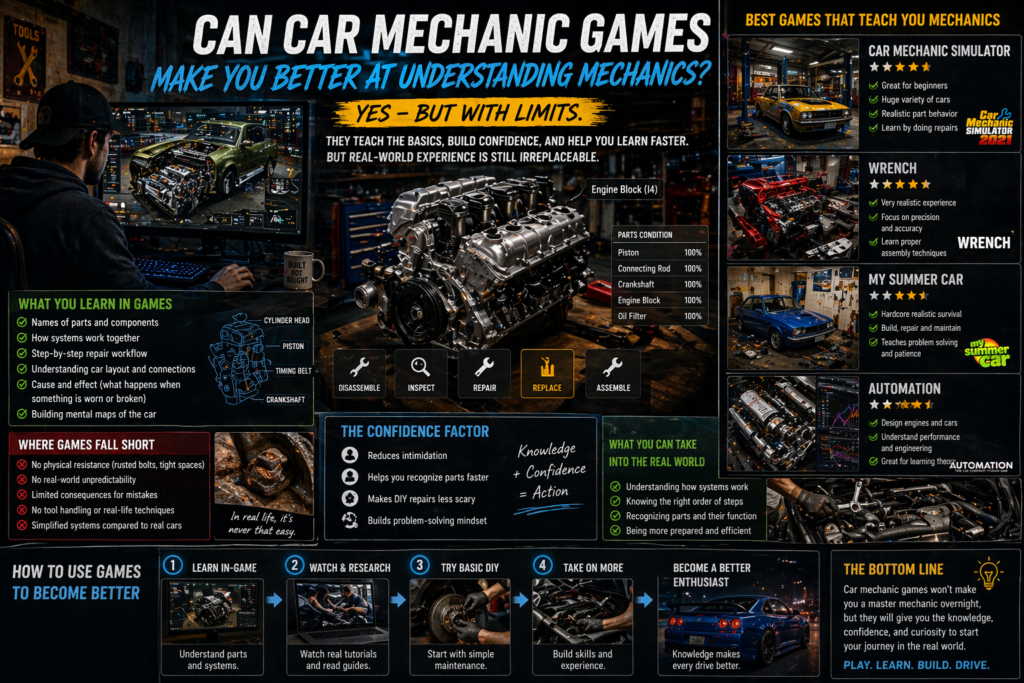
At first glance, car mechanic games might seem like simple entertainment—virtual wrenching without the grease, frustration, or cost. But for many enthusiasts, these games have become an unexpected gateway into real-world automotive knowledge.
So the question is:
👉 Can they actually make you better at understanding mechanics?
The answer is: yes—but with limits.
🧠 How Car Mechanic Games Teach You the Basics


Games like Car Mechanic Simulator break down complex systems into visual, interactive steps.
What You Learn:
- Names of parts (alternator, radiator, control arms, etc.)
- How components connect
- Basic workflow (diagnose → remove → replace → test)
- System relationships (engine, suspension, brakes)
For beginners, this is huge.
👉 It turns abstract mechanical concepts into something you can see and interact with.
🔧 Building “Mental Maps” of a Car
One of the biggest advantages of mechanic games is spatial understanding.
Instead of reading about an engine, you:
- Take it apart piece by piece
- See how everything fits together
- Reassemble it in order
This creates a mental blueprint of the car.
When you later open a real hood, things feel… familiar.
🎮 Games That Actually Help
🚗 Car Mechanic Simulator Series


Best for: Learning parts and basic repair flow
- Highly detailed component breakdowns
- Step-by-step repair systems
- Great for beginners
🛠️ Wrench


Best for: Realistic assembly and precision
- Focuses on accuracy (bolts, torque sequences)
- Much closer to real-world processes
- Steeper learning curve
🏁 My Summer Car


Best for: Understanding how things go wrong
- Brutally realistic (and frustrating)
- No hand-holding
- Teaches problem-solving and patience
🧪 Automation: The Car Company Tycoon Game


Best for: Understanding engineering concepts
- Engine design variables (compression, displacement, etc.)
- Performance trade-offs
- Great for conceptual knowledge
⚠️ Where Games Fall Short
Let’s be clear—games are not a replacement for real experience.
What They Don’t Teach Well:
- Physical effort (rusted bolts, tight spaces)
- Real-world unpredictability
- Tool handling skills
- Risk and consequences
In a game:
- You click → part comes off
In real life:
- You fight a seized bolt for 2 hours
👉 That gap matters.
🔥 The Confidence Factor
One of the biggest benefits isn’t knowledge—it’s confidence.
After playing mechanic games, people often:
- Feel less intimidated opening their hood
- Recognize components faster
- Are more willing to attempt simple repairs
That psychological shift is powerful.
🧩 From Game to Real Garage
The best way to use these games is as a stepping stone.
Ideal Path:
- Learn parts and systems in-game
- Watch real-world tutorials
- Try basic maintenance yourself
- Gradually increase complexity
Games give you the map—real life gives you the terrain.
🏎️ Bonus: Tuning Awareness
For enthusiasts working with systems like Haltech Elite 750 ECU or similar, games can also help conceptually:
- Understanding airflow and engine balance
- Seeing how changes affect performance
- Learning cause-and-effect relationships
Even if simplified, these ideas carry over.
🤔 So… Do They Actually Help?
✅ Yes, They Help With:
- Understanding parts and systems
- Visualizing how cars are assembled
- Building confidence
- Learning workflow and terminology
❌ No, They Don’t Replace:
- Hands-on experience
- Tool skills
- Real-world troubleshooting
- Mechanical intuition under pressure
Conclusion
Car mechanic games are more than just entertainment—they’re educational tools disguised as fun.
They won’t turn you into a master mechanic overnight.
But they will:
- Make you more comfortable around cars
- Help you understand what’s going on under the hood
- Give you a head start when you step into a real garage
And sometimes, that’s all you need.
👉 Because the hardest part of learning mechanics…
…is simply getting started.