0
0
 0
0
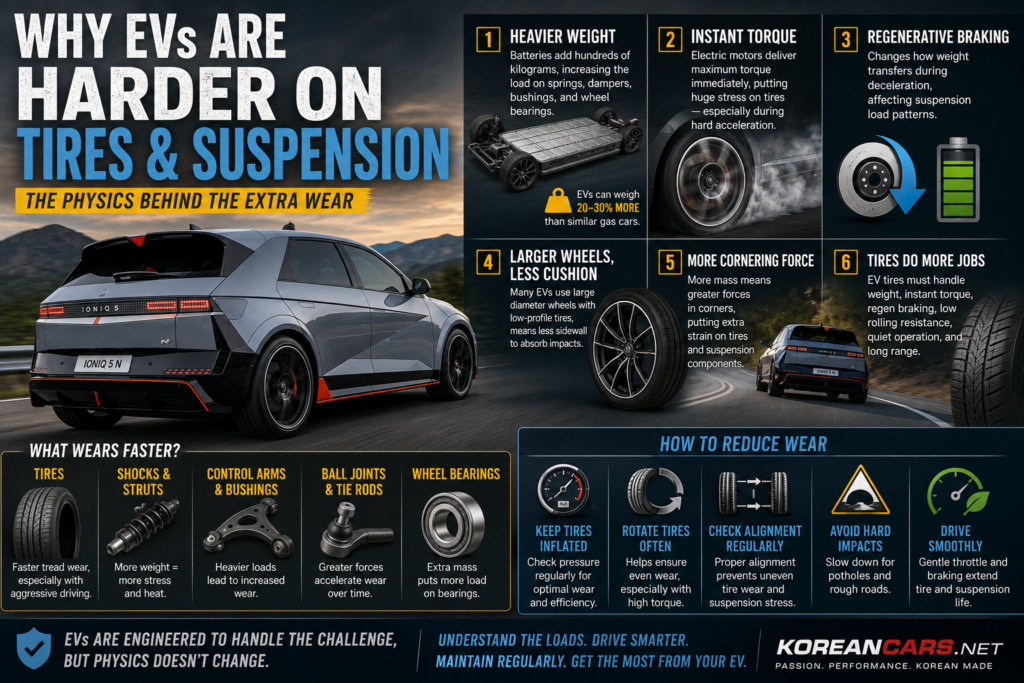
Electric vehicles have changed the automotive world. They’re quiet, incredibly quick off the line, and require far less routine maintenance than traditional gasoline-powered cars. But there’s one downside many new EV owners discover after a few years of ownership: tires and suspension components often wear out faster than expected.
This isn’t because EVs are poorly engineered. In fact, it’s largely a consequence of physics. The same features that make electric cars so enjoyable to drive also place greater demands on their tires, wheels, and suspension systems.
Let’s take a closer look at why.
1. Batteries Make EVs Much Heavier
The biggest reason is simple: batteries are heavy.
A modern EV carries hundreds of kilograms of lithium-ion battery cells beneath the floor.
For comparison:
- Hyundai Elantra N: approximately 1,500 kg
- Hyundai Ioniq 5 N: approximately 2,200 kg
- Kia EV6 GT: approximately 2,200 kg
That extra weight doesn’t disappear once the car starts moving.
Every bump, pothole, and corner forces the suspension to control significantly more mass than an equivalent gasoline-powered vehicle.
More weight means:
- Higher spring loads
- Greater stress on dampers
- Increased bushing wear
- More force on ball joints
- Higher loads on wheel bearings
Over time, those forces add up.
2. Instant Torque Punishes Tires
Electric motors deliver maximum torque almost instantly.
Unlike gasoline engines that gradually build power through the rev range, EVs provide strong acceleration the moment the accelerator is pressed.
While this feels exciting from the driver’s seat, the tires experience enormous forces.
Hard launches can cause:
- Faster tread wear
- Increased heat buildup
- Greater shoulder wear
- More wheel spin if traction is limited
Even drivers who aren’t trying to race often find themselves accelerating harder simply because the effortless torque is so enjoyable.
3. Regenerative Braking Changes Load Patterns
Regenerative braking uses the electric motor to slow the vehicle while recovering energy.
This reduces wear on traditional brake pads, but it also changes how weight transfers through the suspension during deceleration.
Although regenerative braking itself doesn’t directly damage suspension components, it contributes to different loading patterns that engineers must account for when designing the chassis.
4. Larger Wheels Mean Less Tire Cushion
Many EVs are equipped with large-diameter wheels for both appearance and efficiency.
Examples include:
- 19-inch wheels
- 20-inch wheels
- 21-inch wheels
These are often paired with low-profile tires.
Less sidewall means less ability to absorb impacts.
As a result:
- More force reaches the suspension.
- Wheels become more susceptible to damage from potholes.
- Ride comfort can decrease on rough roads.
5. Heavier Cars Generate More Cornering Force
Physics doesn’t care what powers the vehicle.
A heavier car generates greater forces when changing direction.
During aggressive cornering:
- Tires work harder.
- Suspension compresses more.
- Bushings flex further.
- Dampers absorb more energy.
Modern EVs use sophisticated suspension tuning to manage these loads, but the components are still working harder than those on a lighter vehicle.
6. Tires Are Doing Multiple Jobs
EV tires aren’t just responsible for grip.
They must also:
- Handle high vehicle weight
- Deliver instant acceleration
- Support regenerative braking
- Reduce rolling resistance
- Minimize road noise
- Maximize driving range
Balancing all of these demands is a difficult engineering challenge.
This is why many manufacturers fit EV-specific tires with reinforced sidewalls and specialized tread compounds.
7. Suspension Geometry Must Work Harder
The added battery weight changes how engineers tune suspension geometry.
Manufacturers often compensate with:
- Stiffer springs
- Larger anti-roll bars
- Stronger control arms
- Reinforced bushings
- Adaptive dampers
These upgrades help maintain handling despite the extra weight, but replacement components can be more expensive than those found on lighter vehicles.
Does This Mean EV Suspensions Are Less Reliable?
Not necessarily.
Manufacturers know these vehicles are heavier and design them accordingly.
Modern EV suspension components are generally stronger than their counterparts in comparable gasoline vehicles.
The issue isn’t poor reliability—it’s simply that heavier vehicles generate greater forces throughout their service life.
A well-engineered EV can still provide many years of dependable operation.
How Owners Can Reduce Wear
Fortunately, there are several ways to extend the life of both tires and suspension components.
Drive Smoothly
Rapid acceleration may be fun, but gentle throttle inputs can dramatically reduce tire wear.
Keep Tires Properly Inflated
Incorrect tire pressure increases heat, rolling resistance, and uneven tread wear.
Check pressures regularly, especially during seasonal temperature changes.
Rotate Tires Frequently
Because many EVs deliver significant torque through one axle, rotating the tires at the manufacturer’s recommended intervals helps promote even wear.
Maintain Proper Wheel Alignment
Heavy vehicles can wear tires surprisingly quickly if alignment is even slightly out of specification.
Regular alignment checks can save hundreds of dollars in premature tire replacement.
Slow Down for Potholes
Large wheels and low-profile tires don’t absorb impacts as well as taller sidewalls.
Reducing speed over rough roads helps protect both tires and suspension components.
The Future of EV Suspension
As battery technology evolves, future EVs are expected to become lighter.
Engineers are already exploring:
- Structural battery packs
- Lightweight composite materials
- Improved tire compounds
- Advanced adaptive suspension systems
- Active suspension technologies
These innovations should help reduce wear while improving ride quality and handling.
Final Thoughts
Electric vehicles place greater demands on tires and suspension primarily because they are heavier and deliver their performance in a fundamentally different way than traditional gasoline-powered cars. Instant torque, larger wheels, and substantial battery packs all contribute to increased loads on components that keep the vehicle planted on the road.
That doesn’t mean EVs are inherently unreliable. In fact, most are engineered specifically to cope with these challenges. However, owners should expect tire replacement to be more frequent and should pay close attention to alignment, tire pressures, and suspension maintenance to keep their vehicles performing at their best.
As battery technology continues to improve and vehicle weights decrease, the gap between electric and gasoline-powered vehicles in terms of tire and suspension wear is likely to narrow. Until then, understanding the physics behind the extra wear can help owners drive smarter, maintain their cars more effectively, and get the most from every set of tires.