0
0
 0
0
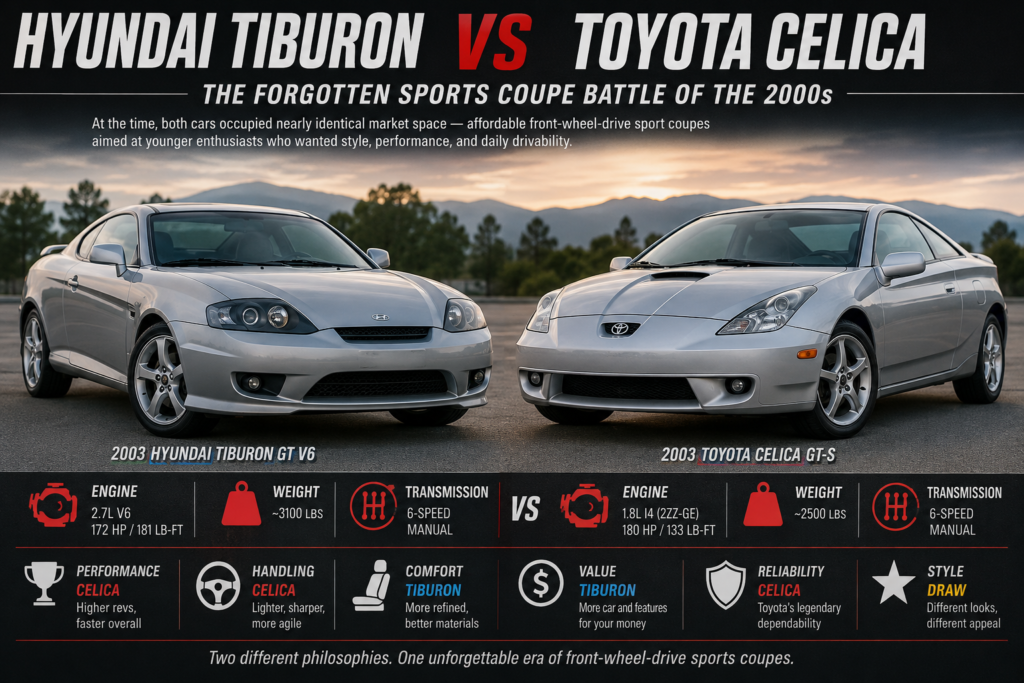
When enthusiasts look back at the early 2000s, Japanese sports compacts usually dominate the conversation. Cars like the Honda Civic Si, Acura RSX, and the legendary Toyota Celica often steal the spotlight.
But quietly entering the same arena was a challenger from South Korea: the Hyundai Tiburon.
At the time, both cars occupied nearly identical market space — affordable front-wheel-drive sport coupes aimed at younger enthusiasts who wanted style, performance, and daily drivability. Yet history has largely remembered one while forgetting the other.
So how did they actually compare when they were new?
Design Philosophy: Aggressive vs Precision
The Toyota Celica entered the 2000s with Toyota embracing sharp angular styling.
It looked futuristic, almost anime-inspired, with dramatic headlights, sharp creases, and a lightweight feel that screamed Japanese tuner culture.
Meanwhile, the Hyundai Tiburon went in a different direction.
Hyundai aimed for something more muscular and mature. The Tiburon looked wider, lower, and more exotic — many people at the time compared it visually to European coupes costing far more.
If the Celica looked like a precision instrument…
…the Tiburon looked like it wanted to punch you.
Winner: Subjective
- Celica = sharper, more tuner-oriented
- Tiburon = more muscular, exotic styling
Performance: Toyota Had the Edge
Here is where Toyota’s engineering experience showed.
| Specification | Hyundai Tiburon | Toyota Celica |
|---|---|---|
| Engine | 2.7L V6 | 1.8L Inline-4 |
| Horsepower | 172 hp | 180 hp |
| Torque | 181 lb-ft | 133 lb-ft |
| Transmission | 6-speed manual | 6-speed manual |
| Weight | ~3100 lbs | ~2500 lbs |
The Celica’s famous 2ZZ-GE Yamaha-developed engine loved high RPM.
Toyota’s VVTL-i system kicked in aggressively near redline, making the Celica feel alive when pushed hard.
The Tiburon’s V6 offered more low-end torque and a smoother powerband, making it more comfortable in daily driving.
In straight-line performance?
The Celica usually edged ahead.
Winner: Celica
Handling: Lightweight Always Wins
This category clearly favored Toyota.
The Celica weighed nearly 600 pounds less, giving it sharper turn-in and a more nimble driving experience.
The Tiburon wasn’t bad — in fact many reviewers praised its stability at highway speeds — but the heavier chassis made it feel less eager in corners.
Toyota engineered the Celica like a lightweight sports car.
Hyundai engineered the Tiburon more like a grand touring coupe.
Winner: Celica
Interior and Comfort: Hyundai Fought Back
This is where Hyundai started changing perceptions.
Early 2000s Hyundai products had a reputation problem, but the Tiburon surprised many reviewers.
Compared to the Celica, the Tiburon offered:
- Better seats
- Better ride comfort
- More premium-feeling cabin
- More sound insulation
- Better long-distance comfort
Toyota’s interior was functional but felt economy-car derived.
Hyundai wanted buyers to feel like they were getting more car for their money.
Winner: Tiburon
Price: Hyundai Was the Value King
This was Hyundai’s strongest advantage.
The Hyundai Tiburon undercut the Toyota Celica significantly.
You could often buy a fully loaded V6 Tiburon for close to the price of a mid-tier Celica.
Hyundai’s strategy was simple:
Offer more horsepower, more features, and better styling for less money.
This was classic Hyundai in the early 2000s.
Winner: Tiburon
Reliability: Toyota Dominated
This category was never close.
Toyota’s reputation for bulletproof engineering was already legendary.
The Celica’s drivetrain proved extremely durable.
The Tiburon, while not necessarily unreliable, suffered from Hyundai’s still-developing quality reputation during that era.
Common complaints included:
- Electrical issues
- Lower-quality plastics aging poorly
- Faster depreciation
- Some manual transmission wear issues
Winner: Celica
The Real Difference: Reputation
The biggest factor separating these cars was not performance.
It was brand perception.
In 2003:
- Toyota had decades of enthusiast credibility
- Hyundai was still viewed as a budget manufacturer
- Many enthusiasts simply refused to consider Korean performance cars
Ironically, the Tiburon helped lay the foundation for future cars like:
- Hyundai Genesis Coupe
- Hyundai Veloster N
- Hyundai Elantra N
Without the Tiburon, Hyundai’s performance division may never have evolved.
Final Verdict (2003 Era)
Choose the Celica if you wanted:
- Better handling
- Better reliability
- Higher revving engine
- Japanese tuner credibility
Choose the Tiburon if you wanted:
- Better styling
- More torque
- Better comfort
- Better value for money
- Something unique
History Was Unfair to the Tiburon
Today, the Toyota Celica is remembered fondly in enthusiast circles.
But the Hyundai Tiburon deserves far more credit than it gets.
It was one of the first serious attempts by Hyundai to prove South Korea could build enthusiast cars.
And in many ways…
It walked so modern Korean performance cars could run.