0
0
 0
0
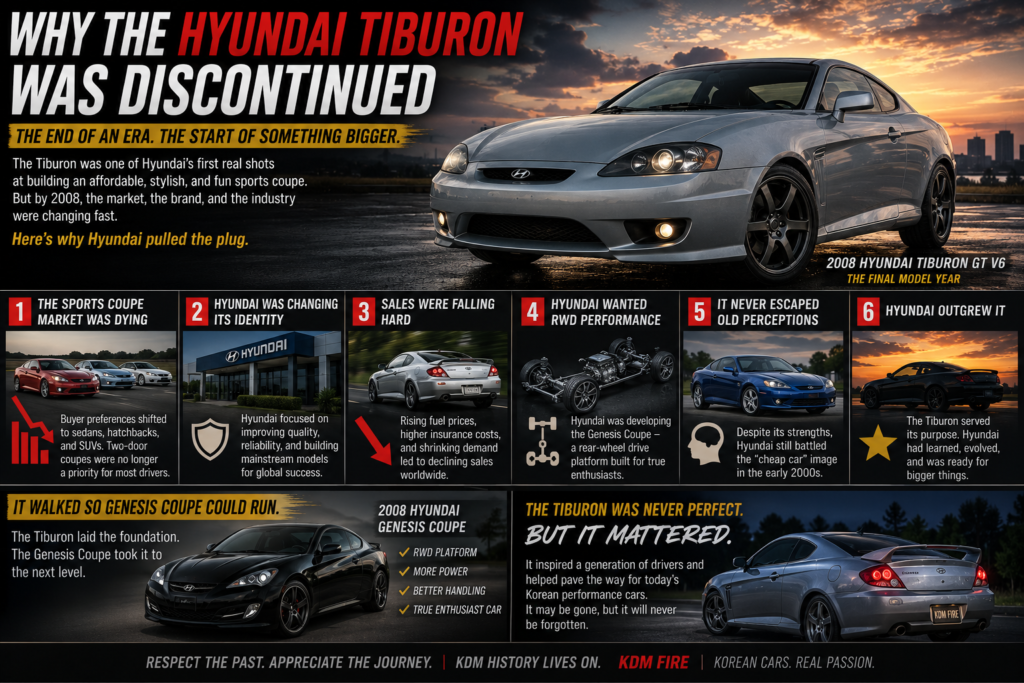
For many enthusiasts, the Hyundai Tiburon represented something important.
It was one of the first serious attempts by Hyundai Motor Company to prove South Korea could build a real enthusiast car.
Affordable.
Aggressive styling.
Manual transmission.
V6 power.
A genuine sports coupe that gave younger enthusiasts an alternative to Japanese imports.
Yet by 2008…
It disappeared.
For years many enthusiasts assumed Hyundai simply gave up on the Tiburon.
But the truth is far bigger.
The Tiburon did not die because it failed.
It died because an entire category of cars was disappearing.


1. The Entire Front-Wheel-Drive Sports Coupe Market Was Dying
This is perhaps the biggest reason people overlook.
The Tiburon was born during a very specific automotive era.
From the late 1990s into the early 2000s there was an entire market segment built around:
Affordable front-wheel-drive sports coupes for younger enthusiasts.
This market included:
- Hyundai Tiburon
- Toyota Celica
- Mitsubishi Eclipse
- Honda Prelude
- Acura RSX
For several years these cars were everywhere.
But by the mid-2000s…
The market started collapsing.
2. They All Offered Similar Performance
What made this class interesting is how closely matched many of these cars were.
| Car | Horsepower |
|---|---|
| Tiburon GT V6 | 172 hp |
| Celica GT-S | 180 hp |
| Eclipse GT V6 | 200 hp |
| RSX Type-S | 200 hp |
| Prelude SH | 200 hp |
They were all chasing the same buyer:
Young enthusiasts wanting an affordable stylish coupe.
But as time passed…
This segment stopped exciting buyers.
3. Front-Wheel Drive Performance Cars Were Falling Out of Fashion
Around 2005 something changed in enthusiast culture.
People increasingly wanted platforms that offered more performance potential.
Enthusiasts began moving toward:
- Rear-wheel drive cars
- Turbocharged platforms
- Drift culture
- Better track performance
- Cars with stronger aftermarket support
Suddenly cars like:
- Nissan 350Z
- Mazda MX-5 Miata
- Subaru WRX
- Mitsubishi Lancer Evolution
became more desirable.
Front-wheel-drive sports coupes no longer felt exciting the way they once had.
The Tiburon was not failing alone.
The whole segment was losing relevance.
4. Competitors Were Disappearing at the Same Time
This is the strongest evidence.
Look at the timeline.
- Honda Prelude → discontinued 2001
- Toyota Celica → discontinued 2006
- Acura RSX → discontinued 2006
- Hyundai Tiburon → discontinued 2008
- Mitsubishi Eclipse → essentially dead by 2011
This was not coincidence.
The entire segment was disappearing globally.
5. SUVs and Sedans Were Taking Over
The mid-2000s marked a huge change in consumer behavior.
Buyers increasingly wanted:
- Practical sedans
- Hatchbacks
- Compact SUVs
- Crossovers
Manufacturers followed the money.
Why build a niche coupe…
When SUVs sold to everybody?
This shift affected the entire industry.
Not just Hyundai.
6. Hyundai Was Reinventing Itself
At the same time, Hyundai Motor Company was transforming.
During the Tiburon era Hyundai still had a reputation for being cheap transportation.
But by 2008 Hyundai wanted to compete globally with:
- Toyota Motor Corporation
- Honda Motor Co.
- Mazda Motor Corporation
The company focused on:
- Better reliability
- Better quality
- Mainstream appeal
- Premium design
The Tiburon became less important strategically.
7. Hyundai Wanted Something Bigger
Hyundai did not abandon performance cars.
It simply changed direction.
Rather than continue building a front-wheel-drive coupe…
Hyundai created:
Hyundai Genesis Coupe
This represented a huge philosophical shift.
Instead of an affordable sporty commuter:
Hyundai now wanted:
- Rear-wheel drive
- Turbocharged engines
- Bigger V6 power
- Serious enthusiast credibility
They were aiming directly at cars like the:
Nissan 350Z
The Tiburon represented the old era.
The Genesis Coupe represented the future.
8. It Never Escaped Hyundai’s Old Reputation
One painful reality remained.
The Tiburon was actually a very good car.
But early 2000s Hyundai still carried negative perceptions.
Many enthusiasts simply saw Hyundai as:
- Cheap
- Unreliable
- Inferior to Japanese cars
- Not performance-oriented
Ironically modern enthusiasts now praise Hyundai performance cars like:
- Hyundai Elantra N
- Hyundai Veloster N
- Hyundai Ioniq 5 N
The Tiburon simply existed too early.
Final Thoughts — The Tiburon Didn’t Fail
People often say Hyundai discontinued the Tiburon because it failed.
That is not entirely true.
A better way to say it is this:
The Tiburon belonged to a class of cars that stopped existing.
It died alongside the:
- Toyota Celica
- Honda Prelude
- Acura RSX
- Mitsubishi Eclipse
It was one of the last representatives of an era when affordable sport coupes ruled the streets.
And without the Tiburon…
There may never have been:
- Hyundai Genesis Coupe
- Kia Stinger
- Hyundai Elantra N
The Tiburon didn’t fail.
An entire generation of cars disappeared with it.