0
0
 0
0
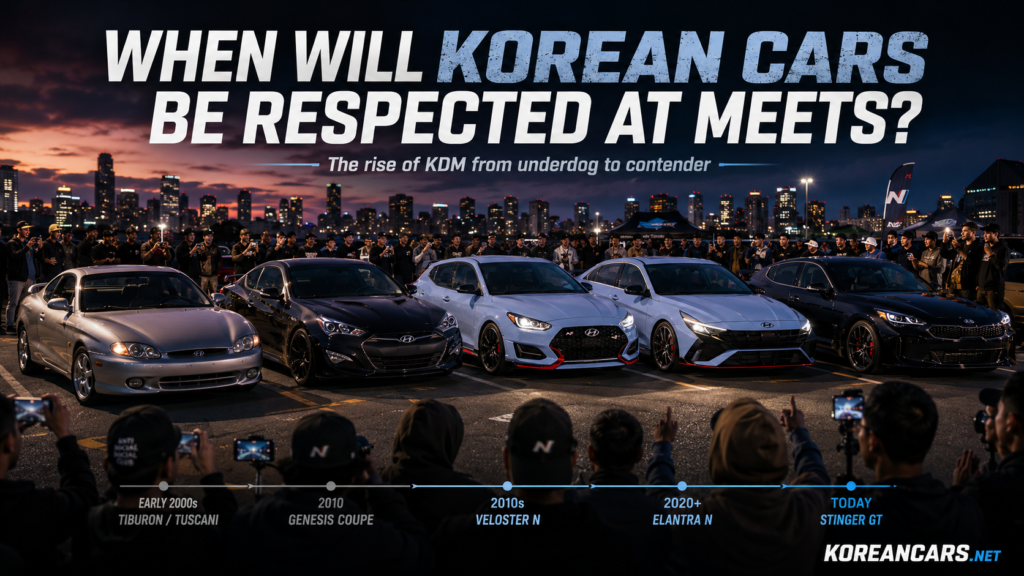
For a long time, Korean cars lived in a strange place in car culture.
Hyundai and Kia were respected by regular buyers for value, warranty, practicality, and improving quality. But at car meets, the story was different. A modified Hyundai Tiburon, Genesis Coupe, Veloster, Elantra N, or Kia Stinger could still get dismissed with the classic line:
“Yeah, but it’s still just a Hyundai.”
That attitude is changing. Slowly, but definitely.
The real question is not whether Korean performance cars will be respected. They already are in certain circles. The better question is: when will that respect become normal at street meets, local shows, and general enthusiast culture?
The answer is probably over the next 5 to 10 years, with different models earning respect at different speeds.
The Old Problem: Korean Cars Had to Prove Themselves Twice
Japanese cars had decades to build their street reputation.
Honda had VTEC culture. Toyota had the Supra, Celica, MR2, and AE86. Nissan had the Z, Silvia, Skyline, and GT-R. Mitsubishi had the Eclipse and Lancer Evolution. Subaru had the WRX and STI.
Korean brands did not have that same performance legacy in North America.
The Hyundai Tiburon was stylish and affordable, but it arrived in an era when many enthusiasts still saw Hyundai as a budget brand. JD Power describes the Tiburon as an affordable sport coupe introduced for the 1997 model year, which is exactly why many people bought it—but also why some people underestimated it.
That created the original KDM underdog identity.
Korean cars were not bad. They were just not part of the established tuner hierarchy yet.
Phase One: The Tiburon Era — Underground Respect
Timeline: Already happening now
Main cars: Hyundai Tiburon, Tuscani, early Hyundai Coupe
Type of respect: Nostalgia, rarity, clean builds, underdog appeal
The Tiburon is not going to become respected because it destroys everything on the street. It will become respected because clean examples are becoming rare, and rarity changes perception.
A clean Tiburon at a meet today gets a different reaction than it did 10 or 15 years ago. Back then, people might have seen it as a cheap used coupe. Now, enthusiasts are more likely to say:
“I haven’t seen one of those in years.”
That is how nostalgia starts.
The Tiburon’s respect curve will likely look similar to other overlooked 1990s and 2000s coupes. It will not become a universal legend overnight, but clean, tastefully modified examples will gain more attention as the cars disappear from the road.
Estimated respect timeline:
The Tiburon is entering its respect phase now. By the late 2020s and early 2030s, clean Tiburons will likely be viewed more as classic KDM enthusiast cars than cheap old Hyundais.
Phase Two: The Genesis Coupe Era — The First Serious KDM Performance Car
Timeline: 2025–2030
Main cars: Hyundai Genesis Coupe 2.0T and 3.8
Type of respect: RWD credibility, drift culture, tuner potential
The Genesis Coupe changed everything because it gave Hyundai something the Tiburon never had: rear-wheel drive.
That mattered.
The Genesis Coupe was Hyundai’s first rear-wheel-drive sports coupe, and MotorTrend reported that it was discontinued after the 2016 model year. That discontinuation may actually help its long-term reputation. When a car is no longer available, clean examples become more interesting.
The Genesis Coupe has already earned credibility in drifting, budget performance, and street builds. It has the right ingredients:
Rear-wheel drive.
Turbo four-cylinder option.
Naturally aspirated V6 option.
Manual transmission availability.
Strong aftermarket support.
Aggressive coupe styling.
The Genesis Coupe will probably be the first Korean performance car to become widely accepted as a “real” tuner platform among younger enthusiasts.
Estimated respect timeline:
By 2030, the Genesis Coupe will likely be treated much more like a legitimate modern tuner coupe, especially as clean manual examples become harder to find.
Phase Three: The Veloster N and Elantra N Era — The Reviewers Already Respect Them
Timeline: Happening now through 2030
Main cars: Veloster N, Elantra N
Type of respect: Driver’s car credibility, track capability, factory performance
The Veloster N and Elantra N are where the conversation really changed.
These cars are not just “good for a Hyundai.” They are genuinely good performance cars.
Hyundai’s N division is built around performance development from Namyang, South Korea, and Nürburgring testing, with Hyundai Canada describing its N vehicles as developed in Namyang and tested on the Nürburgring. That matters because enthusiasts respect cars that are engineered with track use in mind.
The Veloster N helped introduce North American enthusiasts to Hyundai’s modern performance personality. Car and Driver reported that Hyundai ended the Veloster N after the arrival of newer N models like the Elantra N and Kona N, but the Veloster N has already built a cult following.
The Elantra N took that formula and made it more mature. Car and Driver describes the 2026 Elantra N as fun to drive, sharp-handling, and strong enough to perform impressively at Virginia International Raceway.
This is important because magazine credibility eventually filters down to meet culture.
At first, people laugh.
Then reviewers praise the car.
Then owners start beating more expensive cars at track days.
Then people stop laughing.
Estimated respect timeline:
The Elantra N and Veloster N are already respected by people who actually drive hard. By 2030, they will likely be accepted in the same general conversation as the Civic Si, Civic Type R, GTI, Focus ST, and WRX.
Phase Four: The Kia Stinger Era — The Sleeper Respect Car
Timeline: 2026–2032
Main car: Kia Stinger GT
Type of respect: Power, luxury, highway speed, sleeper status
The Kia Stinger is one of the most important Korean performance cars ever made because it attacked a completely different category.
It was not a cheap coupe.
It was not a hot hatch.
It was not a budget project car.
It was a twin-turbo grand touring sport sedan from Kia.
Kia officially described the 2023 Stinger Tribute Limited Edition as the end of the Stinger’s six-year production run, limited to 1,000 worldwide and 440 units in the U.S. That ending may help the Stinger age well because it was already uncommon, powerful, and unusual.
The Stinger GT has the kind of performance that earns respect the simple way: by being fast. It may not have the same lightweight tuner feel as a Genesis Coupe, but it carries itself more like a Korean answer to German sport sedans.
At meets, the Stinger may not get the same attention from the stance crowd or the drift crowd, but it will gain respect from people who understand highway power, luxury, and sleeper performance.
Estimated respect timeline:
The Stinger GT will probably be more respected in the used performance market by the late 2020s and early 2030s, especially as people realize Kia may never build another car quite like it.
Phase Five: The EV Performance Era — The Ioniq 5 N Changes the Argument
Timeline: 2026–2035
Main cars: Hyundai Ioniq 5 N, Kia EV6 GT, future N EVs
Type of respect: Technology, acceleration, track-capable EV performance
The next major wave of Korean respect may not come from coupes at all.
It may come from EV performance.
The Hyundai Ioniq 5 N won the 2024 World Performance Car award, which is a major credibility signal for Hyundai’s electric performance future. Autocar also recognized the Ioniq 5 N with a Five-Star Car award in 2025, praising its performance EV character.
This matters because Korean brands are no longer only trying to catch up. In some EV categories, they are becoming leaders.
At traditional gas-powered meets, EVs may still face resistance. But younger enthusiasts are more open to speed, software, launch control, and technology. The Ioniq 5 N gives Korean brands a chance to earn respect from a completely different generation of car people.
Estimated respect timeline:
EV performance respect will be slower at old-school meets, but by 2030–2035, Korean EV performance cars may be seen as some of the most important enthusiast cars of the transition era.
The Real Timeline
Here is a realistic estimate:
2026–2028: Respect From People Who Know
Right now, Korean performance cars are already respected by informed enthusiasts.
People who know the Elantra N, Veloster N, Genesis Coupe, Stinger GT, and Ioniq 5 N understand that Korean brands are no longer a joke.
But at average local meets, there will still be old attitudes.
You may still hear:
“It’s just a Hyundai.”
“It’s just a Kia.”
“Why didn’t you buy Japanese?”
“Why not get a Mustang?”
This is the transition phase.
2028–2030: KDM Becomes a Recognized Scene
By the end of the decade, KDM will likely become more clearly recognized as its own enthusiast lane.
Not as big as JDM.
Not as old as Euro culture.
Not as dominant as American muscle.
But real.
KDM clubs, KDM sections at meets, Korean car pages, YouTube builds, and TikTok content will continue making these cars more visible.
The Genesis Coupe will probably become the backbone of this movement because it has the right tuner layout. The Elantra N will carry the modern performance credibility. The Tiburon will carry the old-school underdog nostalgia. The Stinger will represent the sleeper luxury-performance side.
2030–2035: Korean Cars Become Normal at Meets
This is when the biggest change likely happens.
By the early 2030s, the people entering car culture will have grown up seeing Hyundai N cars, Kia Stingers, Genesis performance concepts, and Korean EVs as normal parts of the enthusiast world.
They will not have the same memories of 1990s Hyundai jokes.
To them, Hyundai will not mean “cheap economy car.”
It will mean Elantra N, Ioniq 5 N, Veloster N, and maybe whatever comes next.
That generational shift is what will finally normalize Korean cars at meets.
Which Korean Cars Will Be Respected First?
1. Elantra N
This is probably the easiest modern Korean performance car to defend. It has real performance, strong reviews, track ability, and daily practicality.
2. Genesis Coupe
This will become the classic KDM tuner platform. Rear-wheel drive gives it credibility that many other Korean cars do not have.
3. Veloster N
The Veloster N will become a cult car. Its strange design may actually help it long term because it feels unique.
4. Kia Stinger GT
The Stinger GT will age into sleeper respect. It may not dominate meets visually, but people will respect what it represents.
5. Hyundai Tiburon
The Tiburon will take longer, but clean builds will gain nostalgia respect. The fewer clean ones remain, the more interesting they become.
What Will Speed Up Respect?
Korean cars will gain respect faster if owners build them properly.
That means:
Clean fitment.
Good paint.
Quality wheels.
Tasteful aero.
Proper suspension setup.
Reliable power mods.
Good engine bay presentation.
Strong community presence.
Real track, autocross, or dyno results.
The cars need ambassadors.
A clean Tiburon does more for KDM respect than ten neglected ones.
A well-built Genesis Coupe changes opinions faster than arguments online.
A properly driven Elantra N earns more respect at a track day than any badge explanation ever could.
What Will Slow It Down?
The biggest threat to KDM respect is not the cars.
It is bad builds.
Cheap parts, poor wiring, fake badges, bad fitment, unreliable turbo setups, and unfinished projects can reinforce the old stereotype that Korean cars are just cheap platforms.
That does not mean every build needs to be expensive. It means the build needs intention.
KDM culture will earn respect when it becomes clear that owners are not just modifying Korean cars because they are cheap. They are modifying them because they actually believe in the platform.
Final Prediction
Korean cars are already respected by the right people.
The broader street-meet respect will probably happen in stages:
Tiburon: nostalgic respect now through the early 2030s.
Genesis Coupe: tuner respect by 2030.
Veloster N: cult hot-hatch respect by 2030.
Elantra N: mainstream performance respect by 2028–2030.
Stinger GT: sleeper grand-tourer respect by 2030–2032.
Ioniq 5 N and future N EVs: technology/performance respect by 2030–2035.
So when will Korean cars finally be respected at meets?
In some circles, they already are.
For the wider scene, the answer is likely this: by the early 2030s, Korean performance cars will no longer feel like outsiders. They will be recognized as a real branch of enthusiast culture.
They may never replace JDM, Euro, or American muscle culture.
But they do not need to.
KDM has its own identity: underdog energy, value, sharp design, surprising performance, and a community that had to fight harder for respect.
And honestly, that might be what makes it interesting.