0
0
 0
0
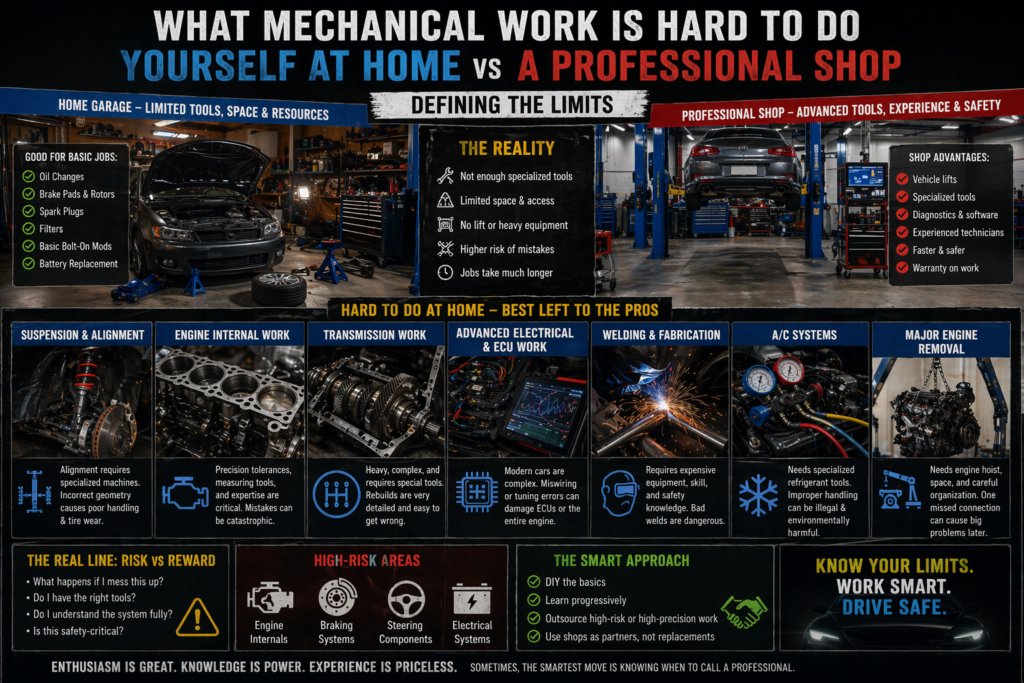
For many car enthusiasts, working on your own vehicle is part of the passion. It saves money, builds knowledge, and creates a deeper connection with your car. But there’s a line—one that separates what’s practical in a home garage from what truly requires a professional shop.
Understanding that line isn’t about discouraging DIY—it’s about working smart, staying safe, and avoiding costly mistakes.
The Reality of Home Garage Limitations


Most home setups include:
- Floor jack and jack stands
- Basic socket and wrench sets
- Limited space and lighting
- No lift or specialized equipment
This setup is perfectly fine—for certain jobs.
But modern cars are increasingly complex:
- Tight engine bays
- Advanced electronics
- Precision tolerances
And that’s where limitations start to show.
Jobs That Are Usually Safe to DIY
Before we get into the hard stuff, here’s what is generally reasonable at home:
- Oil changes
- Brake pads and rotors
- Spark plugs (depending on access)
- Air filters and cabin filters
- Basic bolt-on mods (intakes, exhausts)
- Battery replacement
These jobs are:
- Low risk
- Require basic tools
- Don’t need extreme precision
Where Things Start Getting Difficult
1. Suspension and Alignment Work


Installing coilovers or replacing control arms might seem straightforward—but:
The problem:
- You can’t properly align the car at home
- Incorrect geometry = poor handling + tire wear
- Stubborn bolts and seized components
👉 You can install parts at home—but you’ll still need a professional alignment afterward.
2. Engine Internal Work


This is where things get serious.
Examples:
- Head gasket replacement
- Piston or crankshaft work
- Full engine rebuild
Why it’s difficult:
- Requires precise torque specs
- Tight tolerances (fractions of a millimeter)
- Specialized measuring tools
- High risk of catastrophic failure if done wrong
👉 This is not just “mechanical work”—it’s precision engineering.
3. Transmission Work


Even something like a clutch replacement can be borderline.
Challenges:
- Heavy components
- Limited access without a lift
- Complex internal systems (especially automatics)
Transmission rebuilds are:
- Tool-intensive
- Knowledge-heavy
- Very unforgiving
👉 This is one of the clearest “leave it to the pros” areas.
4. Advanced Electrical and ECU Work


Modern cars are essentially computers on wheels.
DIY Risks:
- Miswiring can damage ECUs
- Sensor issues can be hard to diagnose
- Requires advanced diagnostic tools
Even tuning (like with systems such as Haltech Elite 750 ECU) requires:
- Deep understanding of AFR, timing, and boost
- Real-time data analysis
👉 One mistake here can cause engine damage or endless troubleshooting loops.
5. Welding and Fabrication


Custom builds often require fabrication.
Why it’s hard at home:
- Expensive welding equipment
- Safety risks
- Skill-dependent quality
Bad welds = structural failure risk.
6. Air Conditioning (A/C) Systems


A/C systems are often underestimated.
Challenges:
- Requires refrigerant handling equipment
- Environmental regulations
- Pressure-sensitive system
👉 Not only difficult—often illegal to DIY improperly in some regions.
7. Major Engine Removal
Pulling an engine sounds exciting—but:
Reality:
- Requires an engine hoist
- Space to work and store parts
- Labeling and tracking every connection
One missed connection = hours of troubleshooting later.
The Professional Shop Advantage


Shops have tools and resources that change everything:
Key Advantages:
- Vehicle lifts (full access underneath)
- Specialized tools and diagnostics
- Experienced technicians
- Faster turnaround time
- Accountability if something goes wrong
What takes you a weekend might take them a few hours—and with fewer mistakes.
The Real Line: Risk vs Reward
Here’s how to define your limit:
Ask Yourself:
- What happens if I mess this up?
- Do I have the right tools?
- Do I understand the system fully?
- Is this safety-critical?
High-Risk Areas:
- Engine internals
- Braking systems (beyond basic pads)
- Steering components
- Electrical systems
If failure = safety issue or major cost → consider a professional
The Smart Approach
The best enthusiasts don’t try to do everything—they choose wisely.
Ideal Strategy:
- DIY the basics
- Learn progressively
- Outsource high-risk or high-precision work
- Use shops as partners, not replacements
Conclusion
Working on your own car is one of the most rewarding parts of automotive culture—but it’s not about doing everything yourself.
It’s about knowing:
- What you can do
- What you should do
- And what you shouldn’t risk
Because sometimes, the smartest move in the garage…
👉 …is knowing when to step back.