0
0
 0
0
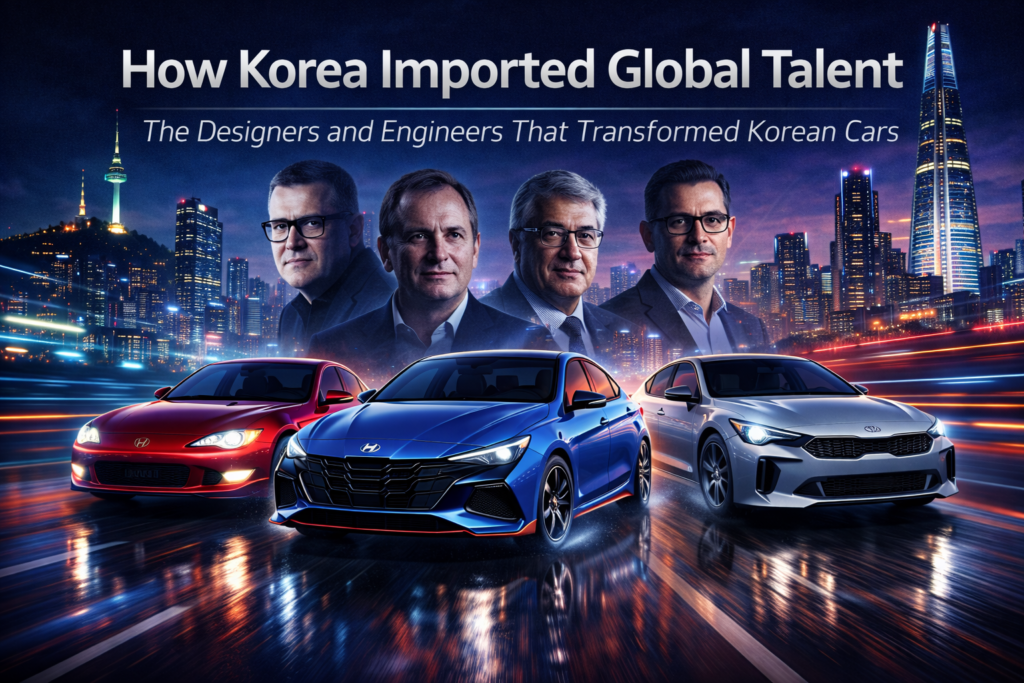
The meteoric rise of the Korean automotive industry is no accident. Once regarded as producers of economical and uninspired vehicles, brands like Hyundai and Kia have evolved into global leaders in design, performance, and innovation. A key factor behind this transformation has been Korea’s strategic recruitment of world-class automotive designers and engineers from Europe and beyond. These industry veterans reshaped Korean cars into machines that rival—and often surpass—their Western and Japanese counterparts.
From the Hyundai Tiburon to the modern N and GT performance divisions, this global infusion of talent has redefined the reputation of Korean automobiles.
Peter Schreyer: The Designer Who Reinvented Kia


Perhaps no individual has had a greater impact on Korean automotive design than Peter Schreyer, formerly of Audi and Volkswagen. Recruited by Kia in 2006, Schreyer revolutionized the brand’s identity.
Key Contributions:
- Introduced the iconic “Tiger Nose” grille, giving Kia a recognizable global design language.
- Elevated Kia’s styling to compete with premium European brands.
- Oversaw the design of standout models such as the Kia Optima and Kia Stinger.
- Became the first non-Korean president within Hyundai Motor Group.
Schreyer’s influence transformed Kia from a budget brand into a design powerhouse, earning international acclaim and multiple design awards.
Albert Biermann: The Mastermind Behind Hyundai N


To establish credibility in the high-performance segment, Hyundai recruited Albert Biermann, former head of BMW’s M Division, in 2015. His appointment marked a turning point for Korean performance engineering.
Key Contributions:
- Founded Hyundai’s N Division, named after Namyang R&D Center and the Nürburgring.
- Led the development of performance icons such as the Hyundai i30 N and Elantra N.
- Instilled European chassis tuning and track-ready engineering.
- Played a crucial role in the creation of the groundbreaking Ioniq 5 N.
Under Biermann’s leadership, Hyundai evolved from a practical automaker into a legitimate performance brand capable of competing with established sports car manufacturers.
Giorgetto Giugiaro and the Hyundai Tiburon


Long before Hyundai and Kia became global design leaders, they sought expertise from renowned Italian design houses. One of the most notable collaborations involved Giorgetto Giugiaro and Italdesign.
Key Contributions:
- Influenced early Hyundai designs, helping modernize the brand’s global image.
- Contributed to Hyundai’s European-inspired styling direction.
- Set the foundation for sportier models such as the Hyundai Tiburon (known as the Hyundai Coupe in some markets).
The Tiburon became a symbol of Hyundai’s growing ambition in the late 1990s and early 2000s, capturing the imagination of enthusiasts worldwide.
Luc Donckerwolke: Bringing Luxury and Prestige
Another influential figure in Hyundai Motor Group’s rise is Luc Donckerwolke, formerly of Lamborghini, Bentley, and Audi.
Notable Achievements:
- Played a pivotal role in shaping Hyundai’s premium design language.
- Led the design of the Genesis brand, positioning it as a luxury competitor to BMW and Mercedes-Benz.
- Helped craft iconic vehicles such as the Genesis G90 and Hyundai Ioniq series.
His presence further elevated Korea’s global automotive prestige.
Thomas Bürkle: BMW Influence at Hyundai
Before Hyundai’s modern renaissance, Thomas Bürkle, a former BMW designer, contributed to shaping Hyundai’s design philosophy in the early 2000s.
Impact:
- Helped refine Hyundai’s styling direction.
- Contributed to models that improved Hyundai’s credibility in Western markets.
- Strengthened Hyundai’s European design sensibilities.
Why Korea Recruited Global Automotive Talent
1. Accelerating Global Competitiveness
Rather than evolving slowly, Korean automakers fast-tracked their development by hiring proven industry leaders.
2. Establishing Distinct Brand Identities
Designers like Peter Schreyer created iconic visual signatures that made Korean vehicles instantly recognizable.
3. Enhancing Performance Credibility
Engineers like Albert Biermann brought motorsport expertise and precision tuning to Hyundai’s lineup.
4. Elevating Perception and Prestige
European talent lent credibility to Korean brands, shifting public perception from budget-focused to world-class.
5. Bridging East and West
By combining Korean innovation with European craftsmanship, Hyundai and Kia developed a unique global identity.
Notable Global Talent in the Korean Auto Industry
| Name | Previous Employer | Korean Brand | Key Contributions |
|---|---|---|---|
| Peter Schreyer | Audi, Volkswagen | Kia/Hyundai | Tiger Nose grille, Kia design revolution |
| Albert Biermann | BMW M Division | Hyundai | Founded Hyundai N performance division |
| Luc Donckerwolke | Lamborghini, Bentley | Hyundai/Genesis | Elevated luxury and premium design |
| Giorgetto Giugiaro | Italdesign | Hyundai | Early design influence and European styling |
| Thomas Bürkle | BMW | Hyundai | Advanced Hyundai’s global design language |
The Lasting Impact on Korean Cars
The decision to recruit world-class designers and engineers has paid off tremendously. Today, Korean automakers are respected for their:
- Cutting-edge design
- World-class reliability
- High-performance engineering
- Premium luxury offerings
- Innovative electric vehicles
Models such as the Hyundai Elantra N, Kia Stinger GT, Genesis G90, and Hyundai Ioniq 5 N stand as proof of Korea’s automotive renaissance.
Conclusion
Korea’s rise in the global automotive industry is a masterclass in strategic vision and international collaboration. By importing top-tier talent from Europe and beyond, Hyundai and Kia transformed themselves into design and performance leaders.
From the sleek lines of the Hyundai Tiburon to the track-ready precision of the Hyundai N division, these global partnerships have helped redefine what Korean cars represent: innovation, excellence, and ambition.
For enthusiasts and historians alike, this journey highlights how Korea leveraged global expertise to build a world-class automotive legacy—one that continues to shape the future of mobility.