0
0
 0
0
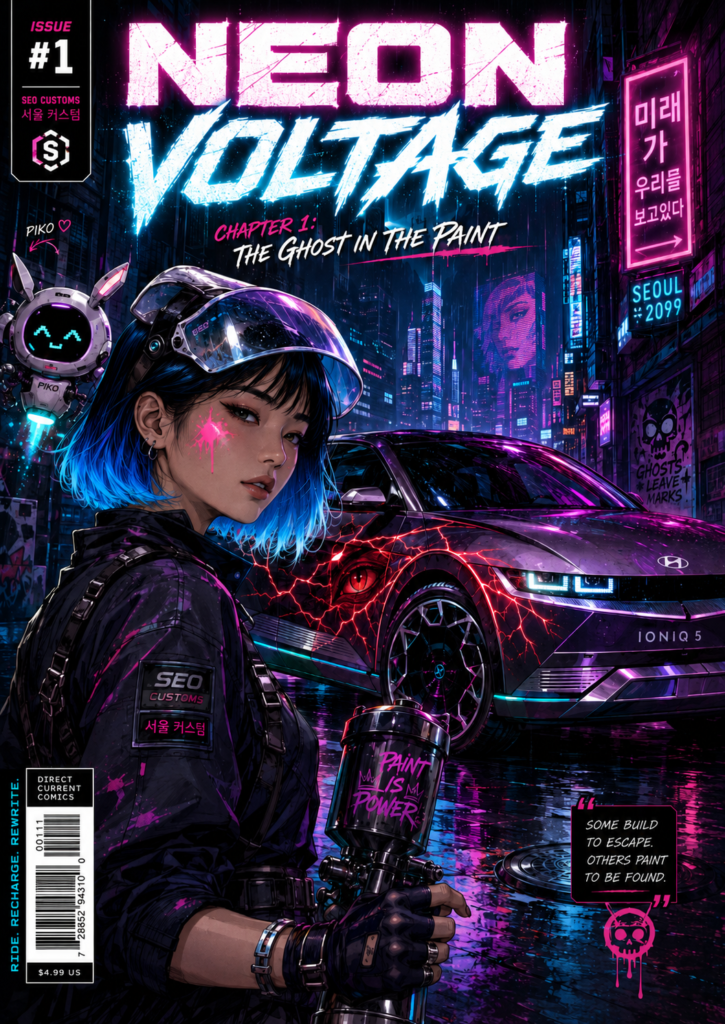
NEON VOLTAGE
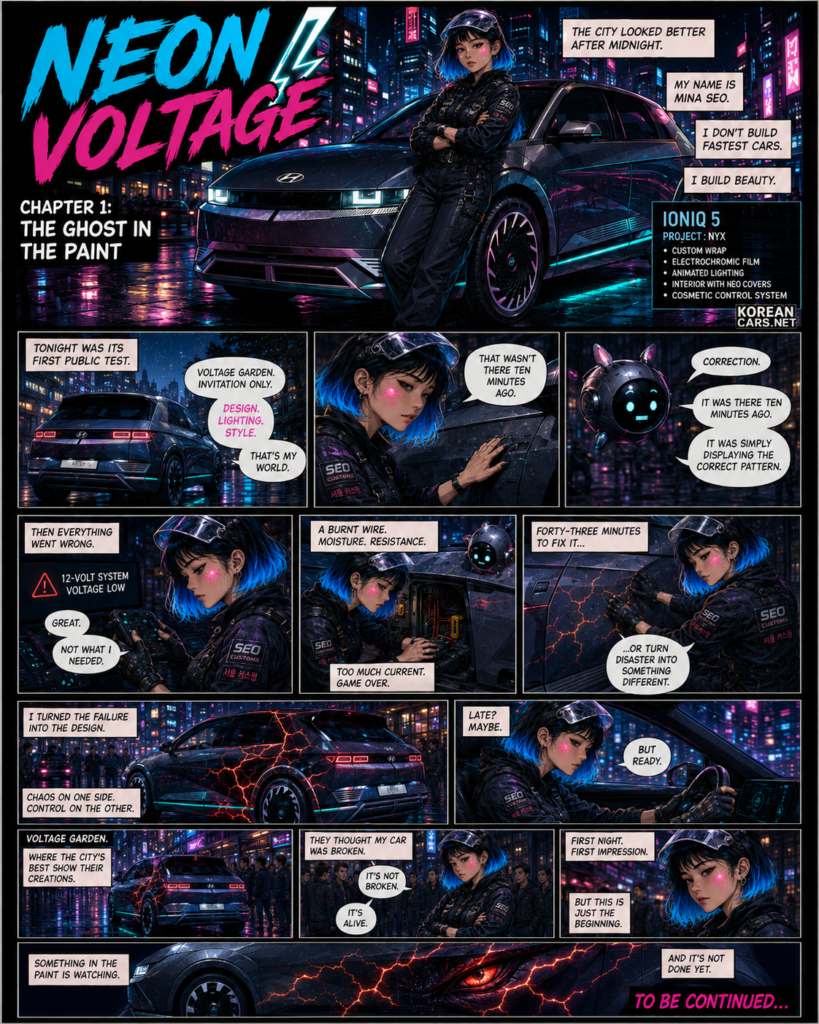
The city looked better after midnight.
During the day, the towers were just towers—grey concrete, mirrored glass and advertising screens turned pale beneath the sun. But after midnight, everything came alive. Pink light spilled across wet pavement. Animated signs flickered over narrow streets. Charging stations glowed beneath apartment buildings like rows of mechanical flowers.
Mina Seo stood beneath one of those lights, studying the reflection of her Hyundai Ioniq 5 in a rain-soaked alley.
Her hair was cut into a sharp, short bob, deep cobalt at the roots and electric cyan toward the ends. A transparent welding visor rested above her forehead. Silver rings covered three fingers on her left hand, and a small streak of fluorescent pink paint ran across her cheek.
The Ioniq looked nothing like the quiet family EV that had left the factory.
Its body was wrapped in a deep graphite film that shifted toward purple beneath direct light. The factory wheel arches had been extended with angular panels Mina had designed herself. Thin turquoise illumination traced the lower edges of the doors. The wheels wore aerodynamic covers shaped like spinning turbine blades.
But the centrepiece was still unfinished.
A section of the driver-side door remained bare.
Not scratched.
Not damaged.
Completely blank.
Mina narrowed her eyes.
“That wasn’t there ten minutes ago.”
Her assistant, a small diagnostic drone named Piko, hovered beside her shoulder. Its circular display blinked twice.
“Correction,” Piko said. “It was there ten minutes ago. It was simply displaying the correct pattern.”
“That is not a correction.”
“It is technically a correction.”
Mina tapped the door with one knuckle.
She had spent three weeks developing the car’s new exterior skin—an experimental electrochromic film capable of changing colour through a low-voltage signal. Unlike an ordinary wrap, this surface could display moving gradients, geometric patterns and pulsing lines that reacted to music.
At least, that was what it was supposed to do.
Tonight was its first public test.
In less than one hour, Mina was expected at Voltage Garden, an underground electric-car gathering held inside a decommissioned transit terminal beneath the eastern end of the city.
The event was invitation-only. The cars were judged almost entirely on design. Custom lighting, bodywork, interiors, projections and digital paint were more important than acceleration figures.
For Mina, it was the perfect event.
It was also the first time anyone outside her workshop would see the Ioniq’s new skin.
Now a growing patch on the door had turned completely colourless.
Mina opened the rear hatch. Inside were carefully organized cases containing heat guns, miniature paint sprayers, rolls of conductive film, lighting modules, adhesives and enough electrical equipment to rebuild half the car’s interior.
She connected her tablet to the cosmetic control module.
“No communication,” she muttered.
Piko rotated in the air.
“Perhaps the vehicle has developed artistic independence.”
“Vehicles do not develop artistic independence.”
“You named the car Nyx.”
“That is different.”
“You also speak to it.”
“I speak around it.”
Mina climbed into the driver’s seat.
The interior came alive in soft purple light. She had replaced the original trim with translucent panels containing thin illuminated circuits. A skyline graphic stretched across the dashboard. Tiny stars shimmered inside the headliner.
She pressed the start button.
The displays illuminated normally.
The main traction battery showed seventy-three percent.
Then every cosmetic light inside the car flashed white.
The dashboard went dark.
A second later, a warning appeared.
12-VOLT SYSTEM VOLTAGE LOW.
Mina stared at the message.
Piko floated through the open window.
“Nyx appears to be expressing artistic independence.”
“Quiet.”
The Ioniq’s large battery still held more than enough energy, but the smaller 12-volt electrical system powered the computers, control modules, locks and accessories required to wake the car.
Without it, hundreds of volts sat beneath the floor doing absolutely nothing.
Mina stepped outside and removed the rear interior panel where she had mounted the custom lighting controller.
The smell reached her immediately.
Hot plastic.
She disconnected the module.
One of the wires had partially melted.
“That shouldn’t have happened,” she said.
Piko projected the original wiring diagram against the wall.
Mina traced the circuit with her finger. The electrochromic skin, underbody lights, interior panels and animated wheel illumination all shared the same accessory controller. The system had worked perfectly on the bench.
But the bench had not been moving through heavy rain.
Water had entered one of the connectors beneath the driver-side sill. The moisture created resistance. The controller increased output to compensate, pulling more current until the circuit overheated.
The blank section on the door had been the first warning.
The damaged wire had been the second.
The dead 12-volt battery was the third.
A distant train rumbled somewhere beneath the city.
Forty-three minutes remained before Voltage Garden closed its entrance.
Mina could repair the wire, but there was no guarantee the damaged controller would survive the night. She could disconnect the entire cosmetic system and attend with a dark, unfinished car.
Or she could stay in the alley and miss the event entirely.
Her phone buzzed.
A message from the event organizer appeared.
People are asking about the colour-shifting Ioniq. Don’t be late.
Mina leaned against the car.
For months, other builders had dismissed her work as decoration.
They built faster cars.
Louder cars.
Cars that launched hard enough to throw passengers against their seats.
Mina built surfaces that moved like water. Interiors that reacted to voices. Body panels that looked different from every angle.
To some people, that was not real engineering.
It was only appearance.
Only cosmetics.
Only style.
But styling an electric car was not the same as covering an old coupe in vinyl and attaching neon tubes underneath it. Every new component had to communicate with a vehicle packed with sensitive electronics. Additional weight affected range. Poor airflow affected battery cooling. Incorrect wiring could disable the entire car.
Beauty had consequences.
Tonight, one of those consequences had left her stranded in an alley.
Mina looked again at the dead section of electrochromic film.
Then she smiled.
“Piko, disable the animated colour map.”
“Confirmed.”
“Disconnect the rear wheel illumination.”
“Confirmed.”
“Set the remaining exterior film to maximum reflectivity.”
“The left door will remain blank.”
“I know.”
She pulled a roll of silver masking film from the equipment case.
Instead of hiding the dead section, Mina began cutting around it.
She created a jagged shape across the door, extending the failure into the front fender. Then she added several smaller breaks along the body. The shapes resembled cracks in a digital screen.
From another case, she removed strips of red illuminated film and placed them beneath the edges of the graphite wrap.
When the lights activated, the car appeared to have a fractured outer shell with red energy glowing underneath it.
Piko studied the result.
“You have converted the malfunction into a design feature.”
“I’m not finished.”
Mina removed the damaged controller and bypassed it with a smaller manual lighting unit. The animated effects would no longer react to music, but the simplified circuit pulled far less current.
She sealed the wet connector, replaced the burnt wire and connected a portable booster to the 12-volt system.
The Ioniq awakened.
This time, the displays remained stable.
The exterior came alive in stages.
Graphite.
Purple.
Silver.
Then the red fractures ignited across the driver’s side.
The broken electrochromic panel no longer looked like a failure.
It looked like something trapped beneath the car’s skin was trying to escape.
Piko’s display formed a small smile.
“Nyx appears damaged.”
“That’s the idea.”
“It is visually unsettling.”
“Even better.”
Mina packed her tools into the rear hatch and entered the destination into the navigation system.
Thirty-one minutes remained.
The Ioniq moved silently from the alley.
Rain flowed across the windshield as Mina accelerated through the city. Neon advertisements stretched across the reflective bodywork, bending over the sharp angles of the car. Every time she passed beneath a streetlight, the red fractures appeared and vanished.
At the entrance to Voltage Garden, two modified electric sedans waited beneath an old concrete archway.
One had vertical doors and holographic advertisements moving across its windows. The other sat almost impossibly low, its body glowing in shifting shades of gold.
The gatekeeper stepped toward Mina’s window.
“You’re late.”
“I’m early enough.”
He looked at the damaged pattern along the side of her Ioniq.
“What happened to the wrap?”
“Nothing.”
“It looks broken.”
Mina lowered her visor over her eyes.
“It’s supposed to.”
The gate opened.
Voltage Garden filled the abandoned terminal with light.
Dozens of electric vehicles surrounded the old platforms. Music vibrated through concrete walls. Projection systems painted moving images across the ceiling. People gathered around cars with illuminated suspension components, transparent hoods, sculpted interiors and wheels that displayed animations as they turned.
As Mina drove between them, conversations stopped.
The graphite skin reflected every light in the terminal. The silver sections flashed like exposed metal. Red fractures burned across the driver’s side while the passenger side remained smooth and pristine.
Two personalities in one car.
Control and chaos.
Perfection and failure.
Mina parked beneath the central platform.
A crowd formed almost immediately.
Someone asked how the damaged effect had been programmed.
Another asked whether the red glow represented heat escaping from the battery.
A photographer crouched beside the front wheel.
The organizer approached slowly, studying every section of the car.
“You changed the design,” he said.
“The design changed itself.”
“Is the asymmetric effect intentional?”
“It is now.”
He smiled.
“I’ve seen thirty cars tonight trying to look flawless. Yours is the first one that looks like it survived something.”
Mina glanced at Nyx.
The car’s red fractures pulsed gently beneath the terminal lights.
For the first time that night, she stopped seeing the burnt wire, the wet connector and the blank panel.
She saw the finished design.
Not despite the malfunction.
Because of it.
The organizer pointed toward the elevated display area at the centre of the terminal.
“We kept the final position open for you.”
Mina folded her arms.
“I thought I was late.”
“You were.”
He looked back at the glowing Ioniq.
“But apparently the future had technical difficulties.”
Mina drove Nyx onto the platform.
As the lights dimmed, the car became a dark silhouette surrounded by red cracks. Cameras rose throughout the crowd.
Piko hovered beside Mina.
“Will you tell them the design was accidental?”
“No.”
“That may be dishonest.”
Mina watched the fractured pattern glow beneath the surface.
“It wasn’t accidental.”
“The electrical failure was accidental.”
“The failure was.”
She smiled as the first camera flashes reflected in her blue-and-cyan hair.
“The design was a decision.”
Far beneath the platform, hidden inside the Ioniq’s disconnected cosmetic controller, a damaged indicator light blinked once.
Then again.
A signal moved through the module even though it was no longer connected to power.
Across the driver-side door, the blank electrochromic panel briefly displayed a shape Mina had never programmed.
A narrow red eye.
Watching from inside the paint.
To Be Continued…