0
 0
Today, somebody visiting South Korea can encounter the word Hyundai almost everywhere.
There are Hyundai cars.
Hyundai department stores.
Hyundai elevators.
Hyundai construction projects.
Hyundai ships.
Hyundai insurance.
Hyundai apartments.
Hyundai hotels.
Yet many of these businesses have surprisingly little to do with one another.
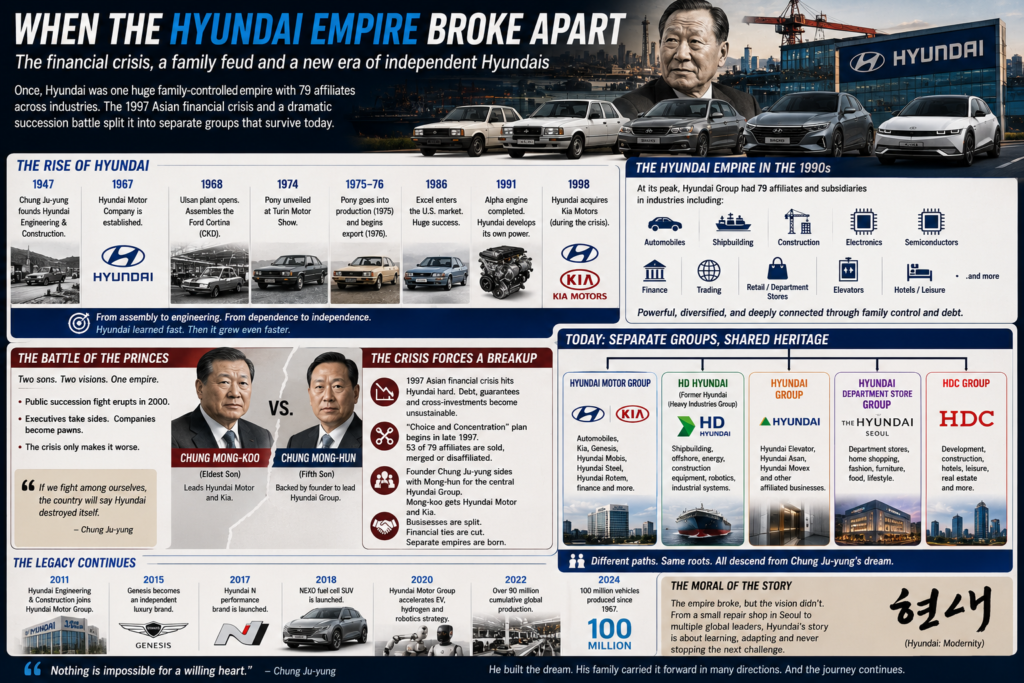
A Hyundai automobile is produced within Hyundai Motor Group.
A Hyundai department store belongs to the completely separate Hyundai Department Store Group.
Much of the shipbuilding empire formerly known as Hyundai Heavy Industries Group is now HD Hyundai.
There is still an organization actually called Hyundai Group, but it does not manufacture Hyundai cars. Its current businesses include Hyundai Elevator, Hyundai Asan and Hyundai Movex.
And then there is HDC Group, descended from another branch of the original Hyundai empire and closely associated with Hyundai Development Company.
This apparently confusing situation makes much more sense once one understands one of the most dramatic periods in Korean corporate history.
There used to be one enormous Hyundai empire.
Then it broke apart.
And the story of that breakup involves almost everything that defined South Korea’s chaebol era:
Debt.
Family control.
Government intervention.
Sibling rivalry.
Economic crisis.
Corporate restructuring.
North Korea.
And a founder trying to determine which of his sons should inherit one of the largest industrial organizations Korea had ever created.
Hyundai Was Originally Much More Than Hyundai Motor
The Hyundai described in the previous chapter of this history began with Chung Ju-yung’s construction business.
Hyundai Engineering & Construction was established in 1947.
Hyundai Motor Company followed in 1967.
Hyundai Heavy Industries emerged during the great Korean shipbuilding expansion of the 1970s.
Over the following decades, Chung Ju-yung continued creating, acquiring and expanding businesses.
The result was the classic Korean chaebol: a large collection of companies linked through ownership relationships, family control, financing and shared management.
By the 1990s Hyundai was involved in automobiles, shipbuilding, construction, electronics, semiconductors, finance, retail, trading and numerous other industries. Hyundai Research Institute’s own retrospective says that when restructuring began, the broader organization contained 79 affiliates and subsidiaries.
The important thing to understand is that Hyundai Motor Company was therefore originally just one part of Hyundai.
Today we naturally associate the Hyundai name with automobiles.
In the 1980s and 1990s, the Hyundai name represented something closer to an industrial kingdom.
Why Korea Created Companies Like Hyundai in the First Place
The enormous size of Hyundai was not accidental.
During South Korea’s rapid industrialization, the government encouraged selected private businesses to develop industries that the country considered strategically important.
Large conglomerates could mobilize capital quickly.
One business could support another.
A construction company could develop infrastructure.
A trading company could arrange exports.
A shipbuilder could generate foreign currency.
An automobile company could create an enormous domestic supplier network.
This approach helped transform South Korea extraordinarily quickly.
But it created a weakness.
The companies inside a chaebol could become deeply interconnected.
One affiliate could guarantee another affiliate’s debt.
Profitable operations could support weaker ones.
Borrowing could finance aggressive expansion.
The entire organization could continue growing as long as banks continued lending and the Korean economy continued expanding.
Then came 1997.
The Asian Financial Crisis Changes Everything
The Asian financial crisis hit South Korea brutally.
Capital disappeared.
Currencies collapsed.
Highly leveraged Korean companies suddenly discovered that debts accumulated during years of rapid expansion could become existential threats.
South Korea ultimately entered an IMF-supported stabilization and restructuring programme, and the government began placing far greater pressure on the chaebol system.
Hyundai survived.
Other enormous Korean groups did not.
Daewoo, one of Hyundai’s great industrial rivals, ultimately collapsed.
But survival did not mean Hyundai could continue operating exactly as it had before.
Contemporary reporting described Hyundai and other chaebols as having been badly damaged by the 1997–98 crisis and under pressure from the Korean government, creditors and the IMF to reform their structures.
Hyundai’s answer was something it called:
Choice and Concentration.
Choice and Concentration
At the end of 1997, Hyundai began major restructuring.
Its own research institute later described the strategy as concentrating resources around core competitive businesses.
The scale was enormous.
Hyundai recorded that 53 of its 79 affiliates and subsidiaries were eliminated or reorganized through mergers, sales and disaffiliations. The remaining businesses were centered around automobiles, electronics, heavy industry, construction and finance.
This is important because the Hyundai breakup is sometimes presented almost entirely as a story about fighting among Chung Ju-yung’s sons.
The family fight mattered enormously.
But Hyundai was already under powerful economic pressure to become smaller, more transparent and less interconnected.
Indeed, Hyundai planned to reorganize its remaining businesses into five smaller groups operating under independent management systems.
The old chaebol was beginning to dismantle itself.
Then the family succession battle made everything considerably more dramatic.
The Founder Had a Problem: Who Inherits Hyundai?
By the late 1990s Chung Ju-yung was in his eighties.
He had created Hyundai.
But Hyundai had become far too enormous for succession to be simple.
Several members of the Chung family already controlled or managed important areas of the business.
The most important conflict would develop between two of Chung Ju-yung’s sons.
Chung Mong-koo was his eldest surviving son and increasingly associated with Hyundai’s automotive businesses.
Chung Mong-hun, the fifth son, had become particularly important within the central Hyundai organization and in the founder’s ambitious projects involving North Korea.
The dispute became so public that Korean media gave it an almost Shakespearean name:
The Battle of the Princes
The struggle erupted openly in early 2000.
Both brothers appeared to believe that they had a legitimate claim to succeed their father as leader of the wider Hyundai empire.
The conflict became much more than an ordinary disagreement over management.
Executives were appointed and removed.
Competing factions formed.
Corporate boards became part of the struggle.
And Korean newspapers began treating the internal politics of Hyundai almost like the politics of a royal family.
Contemporary reporting described two weeks of open conflict between Mong-koo and Mong-hun before their father intervened.
Chung Ju-yung Chooses Mong-hun
In March 2000, the elderly founder made his choice public.
He backed Chung Mong-hun to succeed him at the central Hyundai Group.
That was significant because Korean family-business tradition might have suggested that the eldest surviving son, Mong-koo, would inherit the dominant position.
Instead, Mong-hun became the chosen heir to the central group.
Mong-koo would concentrate on the automotive companies:
Hyundai Motor.
And the recently acquired:
Kia Motors.
At first this looked like a division of responsibilities.
In practice, it became the beginning of separate kingdoms.
Why the Cars Were So Important
The automobile division was an extraordinary prize.
Hyundai Motor was one of the healthier and more internationally competitive parts of the old conglomerate.
Hyundai had also acquired control of Kia following Kia’s financial collapse during the Asian crisis.
That meant whoever controlled the automotive division potentially controlled the foundations of an enormous independent industrial organization.
Automobiles were connected to:
Steel.
Parts manufacturing.
Logistics.
Rail equipment.
Technology.
International factories.
Financing.
And thousands of suppliers.
Mong-koo was therefore not receiving a consolation prize for losing control of the central Hyundai organization.
He was receiving the machinery from which he could build another chaebol.
And that is precisely what happened.
The Financial Crisis Becomes a Hyundai Cash Crisis
At almost exactly the same time that the brothers were fighting over succession, parts of Hyundai were experiencing severe financial pressure.
This made the family feud especially dangerous.
In May 2000, Hyundai’s founding family agreed to sell roughly $3 billion in assets while responding to pressure from creditors and the government to reduce direct family involvement in day-to-day management. Contemporary reports described concern over Hyundai’s liquidity and noted that analysts questioned who actually possessed decision-making authority while the family battle continued.
To banks lending Hyundai enormous sums of money, this was not entertaining family drama.
It was a corporate-governance risk.
The crisis therefore accelerated something that might otherwise have taken many more years:
The different Hyundai businesses needed to become genuinely independent.
Hyundai Motor Leaves the Empire
The automotive business went first.
Hyundai Research Institute’s 2001 account says Hyundai Motor and its ten affiliates were disaffiliated from the Hyundai Business Group in August 2000.
Other historical accounts date the formal separation to around August–September 2000, reflecting different administrative points in the separation process.
What matters is the result.
Hyundai Motor was no longer simply the automobile division of the old Hyundai Group.
It had become the centre of a separate corporate group.
Chung Mong-koo now had his automotive kingdom.
That kingdom would eventually become today’s:
Hyundai Motor Group
This is the organization that now contains the automotive businesses most people outside Korea associate with Hyundai.
Hyundai Motor Company.
Kia.
Genesis.
Hyundai Mobis.
Hyundai Rotem.
Hyundai Steel.
Hyundai Engineering & Construction and numerous other industrial and technology businesses would eventually become part of the modern Group as well.
Hyundai Engineering & Construction itself joined Hyundai Motor Group in 2011, decades after having served as Chung Ju-yung’s original corporate foundation.
That created a strange historical loop.
The automobile company that had once been merely a division of Chung Ju-yung’s construction empire eventually grew powerful enough to bring the founder’s original construction company into its corporate group.
Mong-hun Retains the Original Hyundai Group
Chung Mong-hun inherited the central Hyundai Group identity, but what remained was very different from the old empire.
His branch became particularly associated with shipping, finance, construction interests and the founder’s highly personal programme of economic cooperation with North Korea.
One of the most famous pieces was Hyundai Asan.
Chung Ju-yung had been born in what became North Korea and maintained an intense personal interest in Korean reunification and North-South economic cooperation.
Mong-hun became the son most closely associated with continuing that mission.
Projects included Mount Kumgang tourism and later involvement surrounding the Kaesong industrial initiative.
That gave the remnant Hyundai Group a very different identity from Mong-koo’s increasingly international automotive group.
Then Hyundai Electronics Leaves
Another giant piece of the old empire was electronics and semiconductors.
Hyundai Electronics had grown aggressively and participated in the Korean semiconductor industry’s consolidation during the financial crisis.
But it too was scheduled for independence.
Hyundai Research Institute’s 2001 restructuring document explicitly identified Hyundai Electronics as one of the major businesses being separated from the group.
Hyundai Electronics ultimately became Hynix Semiconductor.
And years later, Hynix would be acquired by an entirely different Korean chaebol and become:
SK hynix.
The Hyundai name disappeared from the semiconductor company.
This is a useful reminder that not every piece of the old Hyundai empire continued carrying the family name.
The Shipbuilding Empire Goes Its Own Way
Then there was Hyundai Heavy Industries.
Shipbuilding had been one of Chung Ju-yung’s greatest industrial achievements.
The famous Ulsan shipyard helped turn South Korea into one of the dominant shipbuilding nations on Earth.
Hyundai Research Institute was already describing Hyundai Heavy Industries as a candidate for separation in 2001 as the remaining cross-unit financial relationships were dismantled.
The heavy-industry branch subsequently developed as an independent group associated with another of Chung Ju-yung’s sons, Chung Mong-joon.
The organization later became known as Hyundai Heavy Industries Group.
Today its broader corporate identity is:
HD Hyundai
HD Hyundai’s official history traces its roots to Hyundai’s shipbuilding operation begun in 1972 and describes its subsequent expansion into shipbuilding, energy, construction equipment, electrical systems, robotics and other industrial sectors.
Despite the shared history, HD Hyundai and Hyundai Motor Group are not the same company.
One builds enormous ships and industrial systems.
The other builds Hyundai, Kia and Genesis automobiles.
They share ancestry.
Not corporate control.
Hyundai Department Store Had Already Started Leaving
Another branch escaped the old structure even earlier.
Hyundai Department Store’s own official corporate history records that it split from Hyundai Group in April 1999.
That business was associated with Chung Mong-keun, another son of Chung Ju-yung.
It developed into today’s Hyundai Department Store Group, with interests extending beyond traditional department stores into areas including food, fashion, furniture, home shopping and other consumer businesses.
Again:
Hyundai Department Store is not part of Hyundai Motor Group.
Buying something at The Hyundai Seoul does not financially mean buying something from the company that makes an Elantra N.
The names share family history.
The businesses are separate.
HDC Came From Yet Another Hyundai Branch
The family tree becomes even more complicated with Hyundai Development Company.
This branch is particularly interesting to car enthusiasts because of Chung Se-yung, Chung Ju-yung’s younger brother.
Chung Se-yung was one of the most important people in the history of Hyundai Motor Company.
He helped establish Hyundai Motor, led its early automotive development and became closely identified with the creation of the Pony.
In 1999, however, he moved into Hyundai Development Company, which became the basis for today’s HDC Group. HDC’s own corporate material records Chung Se-yung’s leadership of Hyundai Motor and his later move to Hyundai Development Company, where his family branch continued.
This created yet another independent corporate descendant of the Hyundai empire.
So even the family member most directly connected with building Hyundai’s original automobile operation ended up outside today’s Hyundai Motor Group.
The Old Hyundai Was Becoming a Family Tree of Corporations
By the early 2000s, the corporate map increasingly looked something like this:
Original Hyundai empire
↓
Hyundai Motor Group
Automobiles, Kia, parts, steel and related industrial businesses
Associated with Chung Mong-koo and later Euisun Chung.
Hyundai Group
The surviving group carrying the original Hyundai Group name, eventually centred around businesses such as Hyundai Elevator and Hyundai Asan. Its current official affiliate list includes Hyundai Elevator, Hyundai Asan, Hyundai Movex and several smaller operations.
Hyundai Heavy Industries Group → HD Hyundai
Shipbuilding, energy, industrial machinery and related businesses.
Hyundai Department Store Group
Retail and consumer-oriented businesses.
HDC Group
Construction, property development and related businesses.
And still other formerly connected operations either became independent, changed ownership or lost the Hyundai name.
It was less like one corporation being divided neatly into two halves and more like an enormous industrial tree breaking into separate trunks.
Chung Ju-yung Watches His Empire Disappear
There is a certain tragedy to the timing.
Chung Ju-yung had spent most of his adult life assembling Hyundai.
Within only a few years at the end of his life, much of that integrated empire was dismantled.
Yet the breakup was not necessarily a complete rejection of the founder’s work.
In some ways it was the consequence of Hyundai becoming too successful and too large to operate permanently as one tightly interconnected family-controlled organization.
The businesses had matured.
Hyundai Motor could survive independently.
Hyundai Heavy Industries could survive independently.
The department-store operation could survive independently.
They no longer required one giant corporate parent in the way they might have during Korea’s earlier industrialization.
The children were leaving the house.
The Founder Dies in 2001
Chung Ju-yung died in March 2001.
By then the process was irreversible.
The automotive group had already separated.
The department-store operation had separated.
Electronics and heavy industry were being pushed toward independence.
And the financial relationships that once bound the chaebol together were being dismantled.
Historical accounts record further major separations during 2001, including Hyundai Engineering & Construction and what had become Hynix.
The integrated Hyundai conglomerate of the 1980s and early 1990s was effectively gone.
Another Tragedy Hits Hyundai Group
The story did not become calmer after Chung Ju-yung’s death.
Chung Mong-hun remained heavily involved with Hyundai’s North Korean projects.
Those projects eventually became entangled in the political controversy surrounding payments connected with the 2000 inter-Korean summit.
In August 2003, while facing prosecution and intense pressure connected with that scandal, Mong-hun died by suicide.
His widow, Hyun Jeong-eun, subsequently took leadership of the remaining Hyundai Group.
That created an extraordinary outcome.
The original corporate group carrying Chung Ju-yung’s Hyundai name survived—but it was no longer the largest Hyundai descendant.
The automotive branch had become dramatically larger.
The shipbuilding branch had become an enormous independent industrial group.
The remnant Hyundai Group was a comparatively smaller organization.
That remains true today.
So Which Hyundai Is the “Real” Hyundai?
The answer depends on what is meant by real.
Historically?
They all descend in some way from Chung Ju-yung’s industrial empire.
Legally and corporately?
They are separate organizations.
Which one actually retains the name Hyundai Group?
The organization currently headed under the Hyundai Group banner—the group containing Hyundai Elevator and Hyundai Asan.
Which Hyundai is the automaker?
Hyundai Motor Group.
It is a separate chaebol.
Which Hyundai builds ships?
Primarily HD Hyundai and its shipbuilding companies.
Which Hyundai operates department stores?
Hyundai Department Store Group.
Which branch is associated with IPARK and major property development?
HDC Group.
The confusion comes from the fact that several descendants retained a word that originally belonged to their common corporate ancestry.
Why Didn’t Everyone Stop Using the Hyundai Name?
Because Hyundai had become enormously valuable.
The Korean word 현대—hyeondae—essentially carries the meaning of modernity or “modern era.”
By the time the conglomerate fragmented, Hyundai was one of the most recognizable corporate identities in South Korea.
The individual successor businesses also had legitimate historical connections to that identity.
Hyundai Heavy Industries really had been Hyundai.
Hyundai Department Store really had been Hyundai.
Hyundai Development Company really had emerged from Hyundai.
Hyundai Motor obviously had been Hyundai.
The breakup therefore produced something unusual:
Several independent companies could truthfully claim Hyundai heritage.
The Breakup May Have Helped Hyundai Motor
For car enthusiasts, perhaps the most interesting question is whether Hyundai Motor Company would have become as successful if the old conglomerate had remained intact.
We cannot know.
But independence gave the automotive organization something extremely valuable:
Focus.
Mong-koo did not have to run shipbuilding, electronics, department stores and every other part of the old Hyundai empire simultaneously.
He could concentrate on:
Hyundai Motor.
Kia.
Automotive components.
Steel.
Vehicle engineering.
Global factories.
Quality.
The modern Hyundai Motor Group consequently became a much more vertically integrated automobile-focused industrial group.
That focus coincided with the period in which Hyundai made some of the greatest improvements in its history.
Quality increased.
The 10-year/100,000-mile U.S. powertrain warranty attacked the company’s reliability reputation.
Kia was rebuilt.
International manufacturing expanded.
Hyundai Mobis grew into an important technology supplier.
Genesis eventually became an independent luxury brand.
Hyundai N emerged.
Electric vehicles followed.
The old Hyundai empire became smaller pieces.
But one of those pieces became much better at building cars.
Kia Makes the Irony Even Greater
There is an interesting irony in the timing.
The Asian financial crisis helped break Hyundai Group apart.
The same crisis caused Kia’s independent corporate structure to collapse.
Hyundai acquired Kia in 1998.
Then, almost immediately afterward, Hyundai’s own automotive division separated from the original Hyundai Group.
So the crisis simultaneously produced two apparently opposite developments:
Kia moved into Hyundai’s automotive orbit.
While:
Hyundai Motor moved out of the old Hyundai conglomerate.
Those two movements created the foundation of today’s Hyundai Motor Group.
The detailed story of how Hyundai came to control Kia deserves its own chapter because it involved a competitive acquisition process, Kia’s collapse, government-supervised restructuring and a relationship that is much more complicated than simply saying “Hyundai bought Kia.”
Hyundai Engineering & Construction Eventually Comes Home—but to a Different Hyundai
There is one final twist that beautifully illustrates the entire story.
Remember where everything began.
Hyundai Engineering & Construction.
It was Chung Ju-yung’s foundational company.
Hyundai Motor itself was originally created out of the industrial ecosystem Chung had built around construction.
After the financial crisis, Hyundai Engineering & Construction fell into serious financial difficulty and moved outside the family-controlled old Hyundai structure.
Then, in 2011, it joined Hyundai Motor Group.
Think about the reversal.
Originally:
Hyundai Construction → creates Hyundai Motor.
Decades later:
Hyundai Motor Group → acquires Hyundai Construction.
The child had grown larger than the parent.
The Hyundai Breakup Was Really the End of One Korean Economic Era
The collapse of the unified Hyundai empire reflected changes taking place across South Korea.
The original chaebol model had been enormously effective during rapid industrialization.
Korea needed factories immediately.
It needed highways.
Ships.
Steel.
Cars.
Electronics.
Exports.
Huge family-controlled conglomerates could move quickly and take enormous risks.
But by the late 1990s, the same structure created serious problems.
Too much debt.
Too many cross-guarantees.
Too little transparency.
Too much family influence over publicly traded companies.
Too many unrelated businesses being managed as parts of one empire.
The financial crisis forced South Korea to confront those weaknesses.
Hyundai became one of the clearest examples of the transition.
Its industrial empire did not disappear.
It became specialized successor empires.
The Battle of the Princes Was Both Cause and Symptom
It would therefore be too simple to say:
Hyundai broke up because Chung Ju-yung’s sons fought.
The restructuring was already economically necessary.
And it would be equally incomplete to say:
Hyundai broke up only because of the Asian financial crisis.
The family struggle profoundly influenced who controlled the resulting pieces.
The financial crisis created the pressure.
Corporate restructuring created the mechanism.
The succession battle determined much of the human geography afterward.
Together they destroyed the possibility of reconstructing the old Hyundai empire.
Strangely, the Breakup Worked
From a historical perspective, one of the most fascinating aspects is that many of the fragments became successful independently.
Hyundai Motor Group became one of the world’s dominant automotive groups.
HD Hyundai remains a major force in shipbuilding and heavy industry.
Hyundai Department Store Group became one of Korea’s major retail organizations.
HDC became a significant property and construction group.
The remaining Hyundai Group continues in businesses including elevators, logistics technology, hospitality and its historical North Korea-related enterprise.
The breakup therefore did not simply destroy Hyundai.
It multiplied Hyundai.
Why This Matters to Korean-Car History
For somebody interested primarily in Korean cars, all of this corporate drama might initially seem far removed from the Elantra, Tiburon, Stinger or Genesis Coupe.
It is actually central to understanding them.
Hyundai Motor Group’s independence helped transform Hyundai from one division inside an enormous Korean conglomerate into the centre of an automotive-focused industrial system.
And the Kia acquisition gave that new group something the original Hyundai Motor Company had never possessed:
A second global automotive brand.
From there came increasingly integrated engineering.
Shared platforms.
Shared powertrains.
Hyundai Mobis technology.
Hyundai Steel.
Global research centres.
Genesis.
N.
Electrification.
And eventually the modern Hyundai–Kia automotive ecosystem.
The company that builds today’s Hyundai cars is therefore not simply the automotive department of Chung Ju-yung’s old Hyundai empire.
It is one of the independent civilizations that emerged from its ruins.
The Hyundai Name Survived Because the Empire Was Bigger Than the Company
That is ultimately why Hyundai can be confusing today.
The original company became so important to Korean industrial history that its name outlived its corporate unity.
Hyundai Motor Group inherited the cars.
HD Hyundai inherited much of the shipbuilding and heavy-industrial legacy.
Hyundai Department Store Group inherited a retail branch.
HDC inherited another construction and property branch.
The remaining Hyundai Group retained the historical group name and part of Chung Mong-hun’s corporate legacy.
They are related historically.
They are connected through the enormous Chung family tree.
But they are not one corporation waiting behind the scenes.
The old Hyundai empire is gone.
What remains are its descendants.
And strangely, the breakup that looked like a crisis at the beginning of the 2000s may have been one of the reasons several of those descendants became stronger.
For Hyundai Motor in particular, separation created the organization that could concentrate overwhelmingly on automobiles—and ultimately build Hyundai, Kia and Genesis into the global automotive group we know today.
The founder built one Hyundai.
The financial crisis, corporate reform and his own family transformed it into many.
And the next part of the story is perhaps the most important one for Korean-car enthusiasts:
How did a bankrupt Kia become part of the newly independent Hyundai automotive empire—and how did the two former Korean rivals learn to operate together without becoming the same brand?