0
0
 0
0
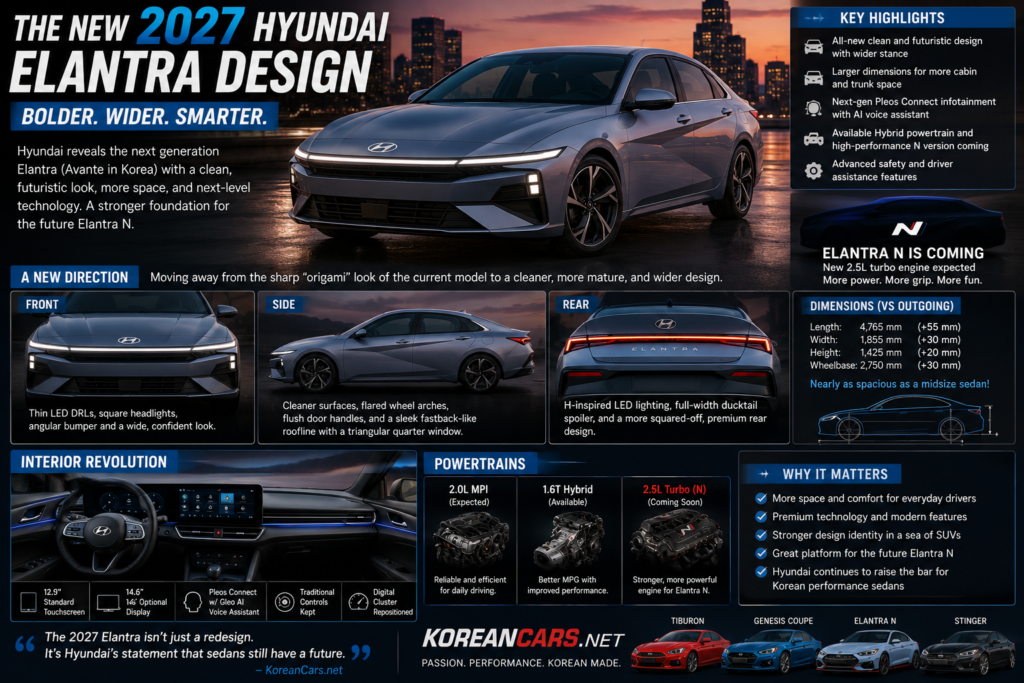
Hyundai has never been afraid to take risks with the Elantra. Every few generations, the car seems to reinvent itself rather than simply evolve. The 2027 Hyundai Elantra continues that tradition with a full redesign that moves the compact sedan away from the sharp “origami” creases of the current model and toward a cleaner, wider, more futuristic look.
In South Korea, the Elantra is sold as the Hyundai Avante, and Hyundai revealed the eighth-generation Avante at the 2026 Busan Mobility Show. Since the Avante is the Korean-market version of the Elantra, it gives us a strong preview of what the 2027 Elantra will look like when it reaches North America. Kelley Blue Book reports that a North American-specific Elantra debut is still expected later, with U.S. showrooms likely seeing the car next year. (Kbb.com)
For Korean car enthusiasts, this redesign matters. The Elantra is no longer just an affordable commuter sedan. Thanks to the Elantra N, the model has become part of Hyundai’s performance identity. That means every new Elantra design now carries two responsibilities: it has to appeal to regular compact-sedan buyers, but it also has to provide a strong foundation for the next performance version.
A Move Away From the Current “Parametric” Look
The current Elantra made a huge statement when it arrived for the 2021 model year. It had dramatic body creases, sharp triangular surfacing, and a very angular side profile. Some people loved it. Others thought it was too busy.
The 2027 design appears to be more mature.
Kelley Blue Book describes the new Avante as shedding the previous car’s “origami bodywork” for cleaner lines and a more retro-futuristic look. The side profile also moves away from Hyundai’s previous “Parametric Dynamics” shaping, replacing the complicated creases with a smoother and more timeless appearance. (Kbb.com)
That is probably the most important design change. The new Elantra still looks futuristic, but it does not seem as visually chaotic as the outgoing model.
Instead of relying on random slashes and sharp triangles, the 2027 car looks wider, flatter, and more planted.
Wider, Longer, and More Grown-Up
The new Elantra is not just restyled. It is physically larger.
Motor1 reports that the new Avante measures 4,765 mm long, 1,855 mm wide, and 1,425 mm tall, with a 2,750 mm wheelbase. Compared with the outgoing model, that makes it 55 mm longer, 30 mm wider, and 30 mm longer in wheelbase. Hyundai has even described it as nearly as spacious as a midsize sedan. (Motor1.com)
That extra width is important visually.
One of the biggest criticisms of some compact cars is that they can look tall and narrow. The new Elantra appears to fight that by stretching the body outward and giving the car more road presence.
The flared wheel arches also help. Motor1 notes that the car has surprisingly flared wheel arches, flush door handles, and a new triangular quarter window behind the rear doors. (Motor1.com)
That makes the car look more substantial, almost like Hyundai is trying to push the Elantra closer to a mini fastback sport sedan rather than a basic economy car.
The Front End: More High-Tech and More Serious
The front of the 2027 Elantra is one of the biggest changes.
The current Elantra has a sharp, low nose with angular headlights and a large grille. The new car looks more squared-off and more premium. Spy reports from Car and Driver described the next-generation Elantra as having thin LED lighting elements and a front light signature with a horizontal strip and outer LED elements. (Car and Driver)
CarsDirect describes the Korean-market preview as having razor-thin daytime running lights, square headlights, slim grilles, and an angular protruding front bumper. (CarsDirect)
This creates a very different personality.
The outgoing Elantra looked aggressive in a sharp, almost insect-like way. The 2027 model looks more technical and controlled. It still has edges, but the front end feels more organized.
For the future Elantra N, this could be a strong starting point. A wider front fascia, squared lighting, and sharper lower bumper areas could easily support a more aggressive N bumper, larger intakes, red trim, and a sportier grille treatment.
The Side Profile: Cleaner, But Still Unique
The side view may be the most interesting part of the new design.
The 2027 Elantra appears to keep a low, coupe-like sedan profile, but now adds a more formal roofline and a small triangular rear quarter window. Car and Driver noted that the new car has an unusual C-pillar design with a body-colored section, a black strip, and a small triangular quarter window behind it. (Car and Driver)
This is a bold choice.
Some people may love it because it gives the car a more premium fastback shape. Others may need time to adjust because it breaks from the traditional compact sedan greenhouse.
The new side profile also helps make the car look larger. The flatter roofline, longer wheelbase, and stronger rear quarter area give the Elantra a more grown-up stance.
For a compact sedan, that is a smart move. Sedans have to fight harder than crossovers for attention, and this design gives the Elantra a more upscale presence.
The Rear: Ducktail Energy and H-Style Lighting
The rear design also gets a major update.
Motor1 reports that the headlights and taillights create an “H” motif, while the rear features a large ducktail spoiler stretching across the width of the car. (Motor1.com)
That built-in ducktail is one of the most enthusiast-friendly design elements on the car. Even on the regular model, it gives the rear end a sportier shape without needing an aftermarket spoiler.
Kelley Blue Book notes that the rear keeps some of the current Elantra’s trunk-lid shape but makes it more squared-off with fewer creases. It also describes vertical LED lights at the outer edges and horizontal LED strips across the trunk. (Kbb.com)
This should give the car a strong nighttime identity. Hyundai has become very focused on lighting signatures, and the 2027 Elantra looks like it will continue that trend.
Interior: The Biggest Upgrade May Be Inside
The exterior gets the attention, but the interior may be where the 2027 Elantra changes most dramatically.
Motor1 reports that the new interior uses Hyundai’s next-generation Android-based Pleos infotainment system, with a standard 12.9-inch touchscreen and an optional 14.6-inch display. It also notes that Hyundai kept traditional switchgear below the screen, which is good news for people who dislike fully touchscreen-controlled cabins. (Motor1.com)
Kelley Blue Book reports that the new system is called Pleos Connect and is backed by Hyundai’s Gleo AI voice assistant. It also notes that the instrument cluster is now smaller and positioned closer to the base of the windshield, while the steering wheel adopts Hyundai’s newer Morse-code “H” logo design. (Kbb.com)
This is important because Hyundai seems to be moving the Elantra from “value compact” toward “software-defined compact sedan.”
That does not mean everyone will love it. Some enthusiasts may prefer the current driver-focused cockpit layout. But from a mainstream buyer perspective, the larger screen, AI assistant, digital interface, ambient lighting, and cleaner dashboard design will likely make the car feel much more expensive than before.
More Premium, But Hopefully Not Too Soft
The danger with making the Elantra more mature is that Hyundai could make it too soft.
The Elantra has become interesting partly because it is not just another anonymous compact sedan. The Elantra N gave the platform credibility. Even regular Elantras have had a more aggressive identity than many competitors.
The 2027 redesign walks a fine line.
On one hand, it looks more refined.
On the other hand, it still has flared fenders, angular lighting, a wide stance, sharp edges, and a ducktail rear.
That balance is important. Hyundai needs the regular Elantra to appeal to families, commuters, and hybrid buyers, but the brand also needs the design to support a future N model.
If the base car already looks wider and more planted, the N version could look genuinely serious.
What About the 2027 Elantra N?
For Korean car enthusiasts, this is the big question.
The standard Elantra design is interesting, but the performance version is what many of us are waiting for.
Kelley Blue Book reports that a full Elantra N is still on the way, with a new 2.5-liter turbocharged four-cylinder expected to replace the current 2.0-liter engine, though details such as manual-transmission availability remain unconfirmed. (Kbb.com)
Motor1 also notes that a high-performance N version has already been announced, although regular versions are expected to arrive first. (Motor1.com)
If that happens, the next Elantra N could be a major step forward. The wider body, longer wheelbase, flared arches, and more premium interior could make it feel more serious than the current car. The challenge will be keeping the raw, playful, slightly unhinged character that made the current Elantra N special.
A more mature Elantra N would be good.
A boring Elantra N would not.
Hopefully, Hyundai understands the difference.
Is the New Design Better?
Based on what has been revealed so far, the 2027 Elantra design looks like a strong evolution.
It seems to improve several areas:
- Wider stance
- Cleaner side profile
- More premium interior
- Better technology
- More mature front-end design
- Stronger lighting identity
- More practical cabin space
- Better foundation for a future N model
But there are also possible concerns:
- The new design may look less wild than the outgoing car.
- The larger body could mean more weight.
- The interior may rely more heavily on screens.
- Some enthusiasts may miss the current car’s more aggressive cockpit.
- The final North American version may differ from the Korean Avante.
Still, the overall direction makes sense. Hyundai is trying to keep sedans relevant in a market dominated by crossovers. To do that, the Elantra cannot just be cheap transportation. It has to feel modern, stylish, efficient, and interesting.
The 2027 redesign appears to understand that.
Final Thoughts
The 2027 Hyundai Elantra design represents a more grown-up chapter for one of Hyundai’s most important cars.
The outgoing Elantra was bold, sharp, and controversial. The new one looks wider, cleaner, smarter, and more premium. It trades some of the current car’s chaotic energy for a more refined shape while still keeping enough aggression to remain interesting.
For regular buyers, the bigger cabin, improved infotainment, and more mature styling should make the Elantra feel like a stronger compact sedan. For enthusiasts, the real excitement is what this platform could become once Hyundai gives it the N treatment.
If the next Elantra N builds on this wider, more planted design with the right engine, suspension, exhaust, and manual or DCT options, Hyundai could have another serious performance sedan on its hands.
The 2027 Elantra is not just a redesign.
It is Hyundai reminding everyone that the compact sedan still has a future — and that Korean car design is not done taking risks.