0
0
 0
0
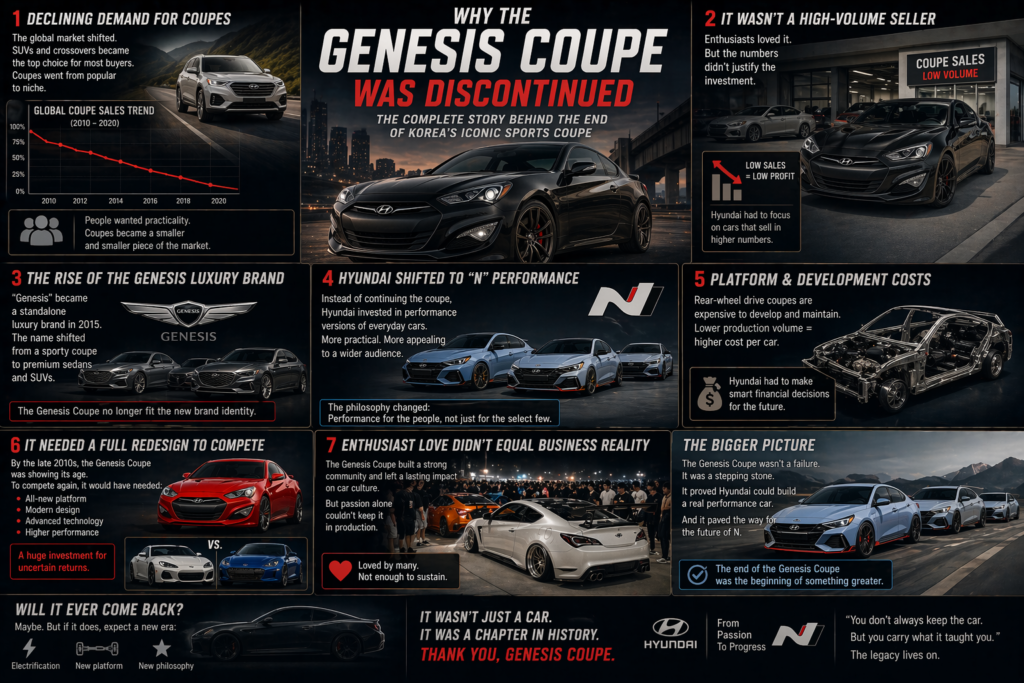
The Hyundai Genesis Coupe holds a special place in KDM history. It was bold, rear-wheel drive, tuner-friendly—and for many enthusiasts, it felt like Korea’s true entry into the sports coupe world.
So why did Hyundai kill it?
👉 The answer isn’t just one reason—it’s a combination of market shifts, strategy changes, and evolving priorities.
📉 1. Declining Demand for Coupes


By the mid-2010s, the global market was changing fast.
What Happened:
- Buyers shifted toward SUVs and crossovers
- Practicality became more important than style
- 2-door coupes lost mainstream appeal
Even iconic coupes from other brands were being discontinued.
👉 The Genesis Coupe was caught in a shrinking segment.
💰 2. It Wasn’t a High-Volume Seller


While respected by enthusiasts, the Genesis Coupe:
- Didn’t sell in large numbers
- Attracted a niche audience
- Wasn’t a major profit driver
For Hyundai, the question became:
👉 Why invest heavily in a low-volume car when SUVs and sedans sell more?
🏢 3. The Rise of the Genesis Luxury Brand


Around the same time, Hyundai made a major strategic move:
👉 Launching Genesis as a standalone luxury brand
Impact:
- “Genesis” shifted from sporty coupe branding
- Became associated with luxury sedans and SUVs
- Focus moved away from performance coupes
👉 The Genesis Coupe no longer fit the new brand identity
🔄 4. Hyundai Shifted to “N” Performance Instead


Instead of continuing the coupe line, Hyundai chose a different path:
👉 Build performance into everyday cars
Enter:
- Hyundai Elantra N
- Hyundai Veloster N
Why This Strategy Works:
- Broader audience
- More practical cars
- Lower production risk
- Strong performance identity
👉 Hyundai didn’t abandon performance—they redefined it
⚙️ 5. Platform and Development Costs


Rear-wheel drive coupes are expensive to maintain:
- Dedicated platform
- Specialized engineering
- Lower economies of scale
For a niche car like the Genesis Coupe:
👉 The cost-to-return ratio wasn’t favorable
🧠 6. It Needed a Full Redesign to Compete


By the late 2010s, the Genesis Coupe was aging.
To stay competitive, it would have needed:
- A full redesign
- New platform
- Updated tech and interior
- More power and refinement
That’s a massive investment.
👉 Hyundai chose to invest elsewhere.
🔥 7. Enthusiast Love Didn’t Translate to Business Reality


The Genesis Coupe had:
- Strong enthusiast support
- Active tuning community
- Cultural impact
But:
👉 Enthusiast love ≠ mass-market demand
This is a common story in the car world.
🏁 The Bigger Picture
The discontinuation wasn’t a failure—it was a transition.
Hyundai:
- Learned from the Genesis Coupe
- Built credibility
- Used that knowledge to evolve
Without it, we likely wouldn’t have:
- Hyundai Elantra N
- Hyundai Ioniq 5 N
🤔 Will It Ever Come Back?
There are always rumors.
But if it does return, expect:
- Electrification
- New platform
- Different philosophy
👉 Not a direct continuation—but a reinvention
Conclusion
The Hyundai Genesis Coupe was discontinued not because it failed—but because the world around it changed.
- Market demand shifted
- Hyundai’s strategy evolved
- New opportunities emerged
It served its purpose:
👉 Proving that Korea could build a real performance car.
And in doing so…
👉 It paved the way for everything that came after.