0
0
 0
0

The Genesis returned to the garage at walking speed.
Markus kept the engine barely above idle, feeding power through the new clutch as gently as possible. Each time the drivetrain came under load, a dull knock travelled through the floor.
Thump.
He released the throttle.
Silence.
He pressed it again.
Thump.
The sound was not loud enough to frighten anyone standing outside the car, but Markus felt it through the seat, the shifter and the soles of his boots.
A mechanical warning did not need to shout.
It only needed to repeat itself.
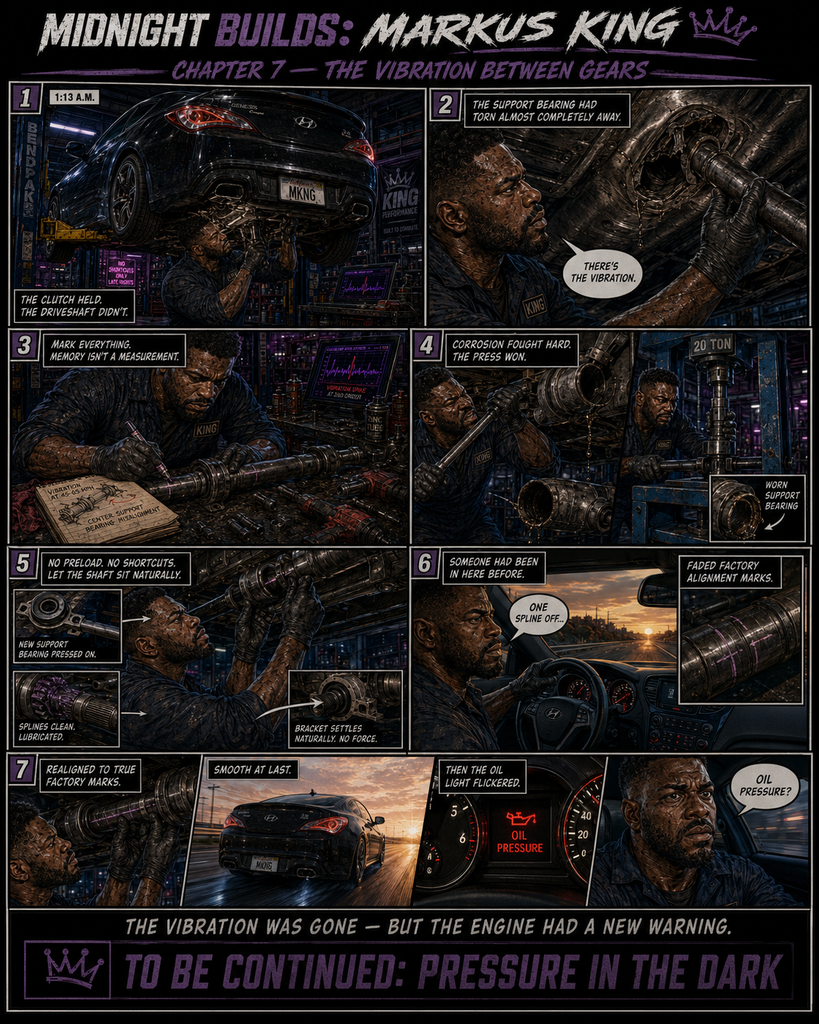
Markus guided the Genesis onto the lift and shut it down. The garage clock read 1:13 a.m.
The new clutch had held every pound of torque the engine produced. The transmission had shifted cleanly. The limited-slip differential had driven both rear wheels evenly.
Yet the car had still limped home.
Markus raised it into the fluorescent light.
The two-piece driveshaft stretched from the transmission toward the differential. Near its centre, a rubber-isolated support bearing suspended the shaft beneath the chassis.
At least, it was supposed to.
The rubber surrounding the bearing had torn almost completely away. The shaft remained inside the bracket, but it sagged low and sat slightly to one side.
Markus pushed upward on it.
The driveshaft moved.
Too far.
He rotated it by hand.
The bearing felt rough.
“There’s the vibration,” he said.
But the knock concerned him more.
A worn support bearing could produce humming, shuddering and vibration. A torn mount allowed the driveshaft to move under torque. If it moved far enough, the shaft could strike the tunnel, damage a joint or place abnormal stress on the transmission and differential.
The stronger clutch had not destroyed the support.
It had simply stopped absorbing the torque that now travelled directly into it.
Markus inspected the surrounding metal.
A bright polished mark ran along the driveshaft tunnel.
The shaft had already made contact.
He lowered the car and opened his laptop.
The factory diagram showed the two-piece shaft, centre bearing, mounting bracket and alignment marks. A replacement support bearing could be purchased separately, but replacing it required separating the driveshaft, removing the old bearing and pressing a new one into position.
The driveshaft was balanced as an assembly.
Reassembling its two sections in the wrong orientation could create a vibration even with a perfect new bearing.
Markus enlarged the diagram.
Small arrows indicated the original alignment points.
He looked back toward the car.
Rust, grease and years of road grime covered the shaft.
Any factory marks might already be invisible.
He reached for a paint marker.
Before removing a single bolt, Markus drew his own line across both driveshaft sections. He added a second mark across the flange connecting the shaft to the differential.
One line recorded rotational alignment.
The other recorded installation orientation.
Memory was not a measurement.
The exhaust system blocked access to the driveshaft.
Again.
Markus stared at the fasteners he had fought only days earlier during the clutch replacement.
The newly disturbed nuts came loose more easily this time, but the exhaust remained awkward and heavy. He supported it with a stand, disconnected the centre section and lowered it carefully.
The heat shields came next.
With them removed, the entire driveshaft was exposed.
Markus checked the front connection near the transmission. He examined the rear flange, the universal joints and the support bearing bracket.
The shaft showed no visible bend.
The joints moved without obvious binding.
The centre bearing remained the main failure.
He placed the transmission in neutral and marked the position of every fastener. Then he loosened the rear flange bolts.
The first three released normally.
The fourth refused.
Markus repositioned himself and tried again.
The wrench slipped.
His knuckles struck the underside of the car.
He pulled his hand back.
A thin line of blood appeared through the grease.
Markus wrapped the cut, changed tools and returned beneath the Genesis.
The bolt had been installed facing an area with barely enough clearance for a socket. Each attempt placed the tool at a slight angle.
That was how fasteners became rounded.
Markus rotated the driveshaft until the bolt reached a more accessible position. He cleaned the head, seated the socket completely and struck the wrench once with a dead-blow hammer.
The bolt moved.
“Angle before force.”
He removed the remaining hardware and supported the driveshaft.
Once the centre bracket was unbolted, the weight of the entire assembly settled into his hands.
He lowered it slowly.
The torn bearing rubber separated completely.
The centre of the driveshaft dropped several centimetres.
Markus carried the assembly to the workbench.
Without the chassis hiding it, the damage looked worse.
The rubber support had cracked in multiple places before finally tearing. Small fragments remained trapped around the bracket. The bearing itself produced a dry scraping sound when spun.
This had not begun during the clutch test.
It had been deteriorating for years.
The old clutch had allowed enough slip to soften the torque pulses reaching the driveshaft. The new clutch delivered them without apology.
Markus studied the shaft.
The car was not punishing him for upgrading it.
It was revealing the truth about everything he had not yet upgraded.
Separating the driveshaft required removing the centre joint.
Before doing so, Markus extended his paint marks across every connected surface. He also measured the exposed length of the splined section and photographed the order of washers, dust shields and spacers.
The assembly looked straightforward.
That was when mistakes were most likely.
He removed the retaining hardware and attempted to slide the two sections apart.
They did not move.
Corrosion had joined the splines more effectively than any bolt.
Markus applied penetrating fluid and waited.
He placed the assembly in a padded vise and tapped around the joint.
Nothing.
He heated the outer section carefully, keeping the temperature away from areas that could be damaged.
The joint shifted slightly.
Markus added more penetrating fluid.
A dark rust-coloured line emerged from the seam.
He worked the shaft back and forth.
Millimetre by millimetre, the splines began to separate.
Then they released suddenly.
The rear section slid backward and nearly struck the floor.
Markus caught it against his leg.
“Easy.”
He laid both pieces onto the bench.
The splines were intact but coated in dried grease and surface corrosion. He cleaned them until each tooth was visible.
The bearing sat behind a metal shield on the front section.
Markus removed the retaining ring and positioned the shaft in the press.
The bearing had likely remained in place since the car left the factory. It resisted the first application of pressure.
The gauge climbed.
Two tonnes.
Three.
Four.
The bearing did not move.
Markus checked the supports beneath the shaft. Pressing against the wrong surface could bend the driveshaft or damage the joint.
He repositioned the assembly so the load passed through the inner bearing race.
The press reached five tonnes.
A sharp crack echoed through the garage.
The bearing moved.
Not much.
But enough.
Markus continued slowly until the worn support slid off the shaft.
The surface beneath it showed a ring of corrosion.
He cleaned the area and checked it for damage.
No deep grooves.
No distortion.
The replacement bearing could be installed.
Markus compared the new part with the original.
The dimensions matched.
The mounting bracket matched.
The rubber felt significantly firmer, partly because it was new and partly because the old support had softened after years of heat and movement.
A firmer mount would control the driveshaft more precisely.
It could also transmit more noise into the cabin.
Every decision changed the car in more than one way.
Markus lubricated the seating surface lightly and pressed the new bearing into place using the correct-sized driver.
The bearing moved smoothly.
No cracking.
No excessive force.
When it reached the proper position, he installed the shield and retaining hardware.
Then he turned his attention to the splined joint.
He applied fresh grease and aligned the paint marks.
The two shaft sections slid together.
Markus stopped before tightening anything.
The alignment marks matched, but the centre joint allowed the shaft length to change slightly. Installing the support bearing under tension could shorten its life. The bearing bracket needed to sit naturally beneath the chassis—not pulled forward or pushed backward to meet the bolt holes.
He would set that position during installation.
The driveshaft went back beneath the Genesis shortly after 4:00 a.m.
Markus raised the front section toward the transmission, supported the centre bearing loosely and connected the rear flange to the differential.
He threaded every fastener by hand.
Nothing was tightened yet.
He rotated the driveshaft and confirmed that the alignment marks remained correct.
Then he examined the centre support bracket.
Its holes sat slightly behind the threaded mounting points in the chassis.
Only a few millimetres.
He could pull the bracket forward and install the bolts.
That would preload the rubber.
Markus loosened the splined joint and allowed the driveshaft length to settle naturally. The bracket moved into position without force.
He tightened the centre joint.
Then the support bracket.
Then the flange bolts in an even sequence.
Before reinstalling the exhaust, Markus rotated the driveshaft by hand.
It turned smoothly.
The centre bearing remained straight.
The shaft no longer sagged toward the tunnel.
He measured the clearance around it.
No contact.
No visible misalignment.
Markus reinstalled the heat shields and exhaust, lowered the car and prepared for the test drive.
But when he started the engine, a new sound entered the garage.
A faint metallic ticking.
Markus listened from the driver’s seat.
The rhythm increased with engine speed.
He shut the Genesis off.
The sound had not existed before the driveshaft work.
He raised the car again.
A heat shield near the exhaust had been installed slightly out of position. Its edge rested against the pipe, allowing engine vibration to produce the ticking.
Markus loosened it, centred the shield and increased the clearance.
He restarted the engine.
The ticking was gone.
It would have been easy to assume the new bearing was defective.
It would have been easy to disassemble hours of work searching for a problem created by one misaligned piece of sheet metal.
Diagnosis began with the last thing touched.
Markus lowered the car again.
“Now we drive.”
The Genesis rolled onto the street as morning approached.
Markus accelerated gently through first gear.
No knock.
Second gear.
No vibration.
Third.
The drivetrain felt tighter than before. The new support bearing held the driveshaft on its intended axis, eliminating the loose movement Markus had grown accustomed to without realizing it.
He reached sixty kilometres per hour and held the speed steady.
A faint vibration appeared through the seat.
Markus frowned.
It was not the heavy shudder from before.
This one was smoother and faster.
He increased speed.
The vibration became more noticeable.
He slowed.
It faded.
A driveshaft vibration tied to road speed usually indicated balance, alignment or joint angle rather than engine operation.
Markus turned toward the industrial district.
At seventy kilometres per hour, the vibration returned.
At eighty, it grew stronger.
He placed the transmission in neutral and allowed the car to coast.
The vibration remained.
That eliminated the clutch and reduced the likelihood of an engine-related cause.
Something rotating with vehicle speed remained incorrect.
Markus returned to the garage.
The new bearing was installed properly.
The shaft marks aligned.
The mounting bracket sat naturally.
The flange matched its original orientation.
He had followed every step.
Yet the car disagreed.
Markus raised it and rotated the driveshaft slowly.
His paint marks matched perfectly.
Then he noticed a second, faded line beneath the grime.
A factory mark.
It did not align with his own.
Markus stared at it.
His marks preserved the driveshaft exactly as he had found it.
But someone had removed the shaft before.
It had already been assembled incorrectly.
The deteriorated rubber support had allowed enough movement to mask part of the imbalance. The new bearing now held the shaft rigidly, making the incorrect phasing impossible to ignore.
Markus cleaned the joint completely.
Additional factory marks appeared.
The original alignment was one spline away from its current position.
One spline.
A small rotational error between the front and rear sections could alter how the joints operated relative to each other. Instead of cancelling their speed variations, they could compound them.
Markus separated the joint again.
He rotated the rear shaft one spline.
The factory marks aligned.
His fresh paint marks no longer did.
For a moment, he hesitated.
His marks represented certainty.
The factory marks represented history.
One of them had to be wrong.
Markus studied the wear pattern on the splines and compared the yoke orientation at both ends.
The factory position produced matching joint alignment.
His original position did not.
Someone had serviced the driveshaft, missed the marks and returned the car to the road with a subtle imbalance.
The old bearing had absorbed the consequences until its rubber tore apart.
Markus reassembled the shaft using the factory alignment.
Then he repeated the entire installation.
The sun had begun colouring the horizon when Markus left the garage for the second test drive.
Forty kilometres per hour.
Smooth.
Sixty.
Smooth.
Seventy.
Nothing.
Eighty.
The Genesis remained composed.
Markus continued onto the highway.
The engine settled into a quiet cruise. The steering wheel remained still. The seat no longer carried a faint tremor from the rotating shaft.
For years, a vibration had lived inside the car.
Not strong enough to demand repair.
Not obvious enough to identify.
It had hidden beneath exhaust noise, stiff suspension and the normal roughness of a modified coupe.
Now it was gone.
The Genesis felt different—not faster, but more complete.
Markus exited the highway and returned to the industrial road.
He stopped beneath the same row of streetlights that had exposed the clutch and the driveshaft support.
The car idled.
He selected first gear.
The clutch engaged sharply.
The Genesis moved.
Second gear.
Boost began to build.
Third.
Markus pressed the throttle farther.
Torque passed through the new clutch, into the transmission, along the correctly aligned driveshaft and through the limited-slip differential.
No flare.
No knock.
No vibration.
The car accelerated with a clean, uninterrupted pull.
Markus shifted again.
The drivetrain remained stable.
For the first time since the build began, nothing protested.
He slowed and turned back toward the garage.
Then the oil-pressure warning light flickered.
Once.
Gone.
Markus looked at the dashboard.
The engine sounded normal.
He reduced speed.
The light remained off.
At the next corner, he braked firmly.
The warning light flickered again.
Markus’s satisfaction disappeared.
A loose electrical connection could cause a false warning.
A failing sensor could do the same.
But oil pressure was not something a mechanic assumed was fine because the engine still sounded healthy.
Markus shut the engine off immediately and coasted into an empty parking lot.
He stepped out and opened the hood.
The dipstick showed oil.
The engine bay showed no obvious leak.
He looked back at the dashboard through the windshield.
The drivetrain had finally stopped shaking.
Now the engine was asking the next question.
And this time, the cost of guessing could be everything.
To be continued…
Next Chapter: Pressure in the Dark