0
0
 0
0
The early 2000s gave us many memorable sport coupes.
Cars like the:
- Toyota Celica
- Acura RSX
- Mitsubishi Eclipse
- Honda Prelude
all helped define an era when affordable coupes dominated enthusiast culture.
Yet among them was one car whose styling often gets overlooked today.
The Hyundai Tiburon.
Even now, over twenty years later, many people still stop and ask:
“Wait… Hyundai made that?”
And that reaction says something important.
Because despite Hyundai’s budget reputation at the time…
The Tiburon’s design was genuinely brilliant.
Not because it was flashy.
But because Hyundai managed to create a shape that still feels modern decades later.


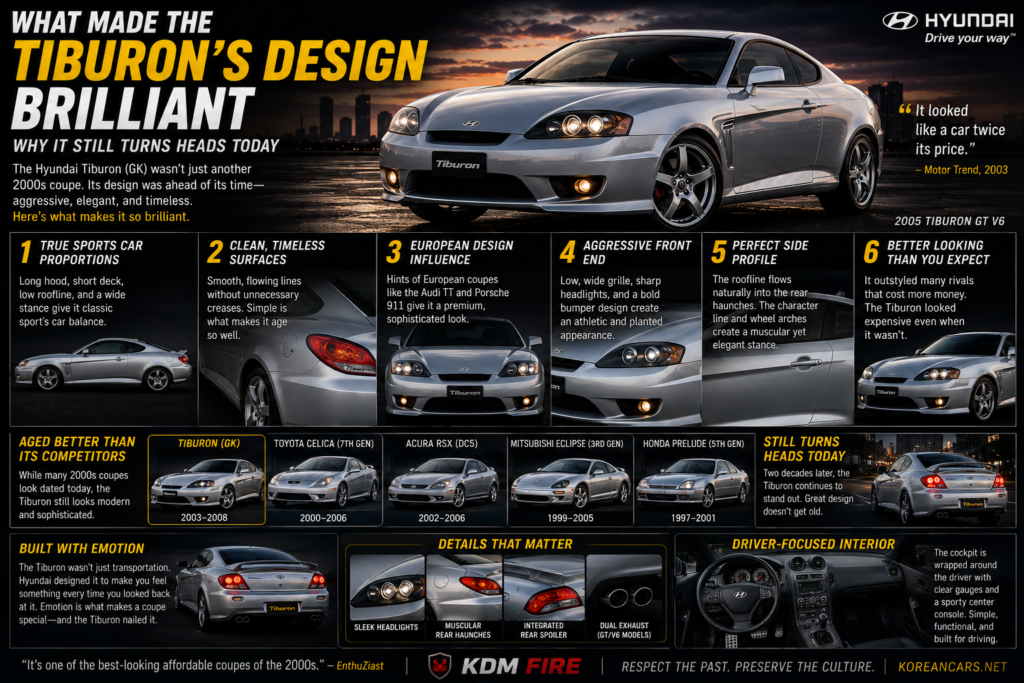
1. It Had True Sports Car Proportions
One reason the Tiburon still looks good today is simple:
The proportions were right.
Many affordable coupes of the era had awkward economy-car roots.
The Tiburon did not feel like a regular commuter car with two doors added.
Its shape had:
- Long hood proportions
- Low roofline
- Wide shoulder stance
- Short rear deck
- A naturally aggressive silhouette
Viewed from the side, the car had proportions closer to expensive coupes than budget cars.
This immediately gave it presence.
2. Hyundai Avoided Overdesign
Look at many early 2000s cars.
Designers often went too far.
The Toyota Celica had sharp exaggerated angles.
The Mitsubishi Eclipse used extreme curves.
Many manufacturers were chasing futuristic styling trends.
The Tiburon took a different approach.
It remained clean.
Balanced.
Simple.
There were no unnecessary body lines fighting for attention.
This is one reason it aged so well.
The design was restrained.
3. It Borrowed European Design Language
One reason many people were shocked seeing the Tiburon for the first time:
It did not look like a Hyundai.
In fact many enthusiasts at the time compared it visually to European coupes.
There were clear influences from cars like:
- Audi TT
- Porsche 911
- Ferrari 456
The smooth curves and muscular body gave it a far more premium appearance than expected.
This helped separate it from Japanese rivals.
The Tiburon looked expensive.
Even when it wasn’t.
4. The Front End Looked Aggressive Without Trying Too Hard
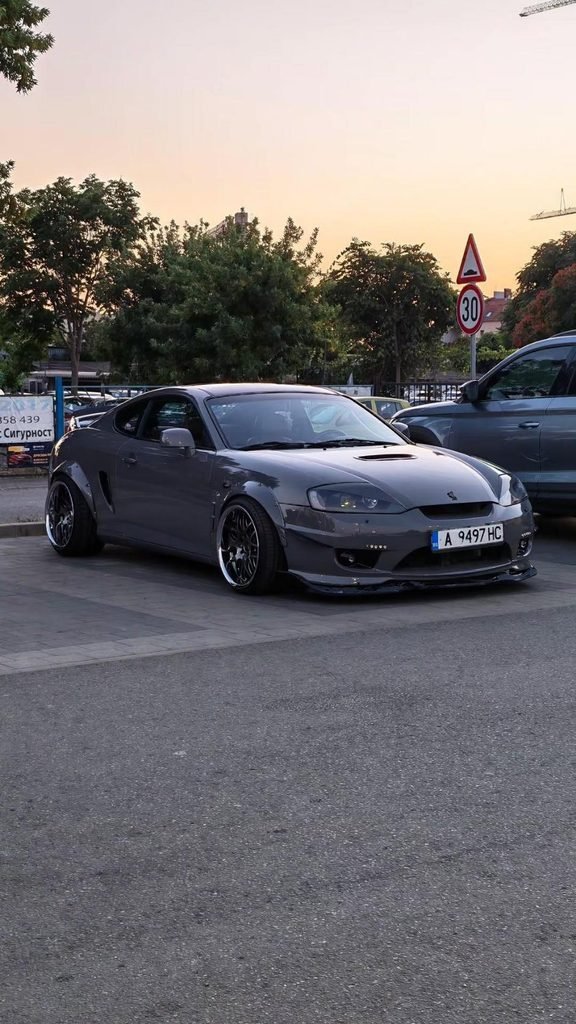
The front fascia is arguably one of the strongest design elements.
Unlike economy cars of the era…
The Tiburon immediately communicated performance.
Key details included:
- Low wide grille opening
- Sharp headlight placement
- Sculpted hood lines
- Broad lower bumper stance
- Minimal visual clutter
It looked serious.
It looked planted.
It looked fast even when parked.
Many cars need giant wings and aggressive body kits to feel sporty.
The Tiburon achieved this from the factory.
5. The Side Profile Is Nearly Perfect
This may be the strongest argument.
Look at the Tiburon from the side.
Everything flows naturally.
The roofline moves smoothly into the rear quarter panel.
The doors are long and clean.
The wheel arches are muscular without looking exaggerated.
There is no visual awkwardness.
Even today…
The side profile still looks contemporary.
This is rare.
Especially for affordable cars from the early 2000s.
Great design ages slowly.
And the Tiburon proves it.
6. It Looked Better Than Cars More Expensive Than It
One of Hyundai’s biggest successes:
The Tiburon often looked better than competitors costing more money.
Compared to rivals:
Toyota Celica
- More angular
- More aggressive
- Less elegant
Acura RSX
- Cleaner design
- But more conservative
Mitsubishi Eclipse
- Very curvy
- More exaggerated styling
The Tiburon found balance.
It looked sporty without feeling cartoonish.
7. Hyundai Understood Emotional Design
This is something often forgotten.
The Tiburon was not built simply as transportation.
Hyundai wanted buyers to feel something.
The company understood an important lesson:
People do not buy sports coupes because they need them.
They buy them because they create emotion.
The Tiburon’s design created:
- Desire
- Identity
- Individuality
- Pride of ownership
And for Hyundai in the early 2000s…
This was revolutionary.
8. It Still Looks Modern Twenty Years Later
The biggest proof of brilliant design?
Time.
Many early 2000s cars now feel obviously dated.
But the Tiburon still surprises people.
Park one today beside modern traffic.
People still notice it.
Why?
Because the design does not scream:
“I am from 2003.”
Instead it simply looks…
Good.
That is the mark of timeless design.
Final Thoughts — Hyundai Accidentally Built a Future Classic
The Hyundai Tiburon was never the fastest sports coupe.
It was never the most powerful.
It was never the most respected.
But design?
That is where Hyundai truly succeeded.
The Tiburon proved Korea could create a car that was not just functional…
…but beautiful.
And even now, decades later…
It still turns heads in a way many modern cars cannot.
Not because it is rare.
But because the design was simply ahead of its time.
Sometimes great automotive design is not about being loud.
It is about creating shapes people still admire twenty years later.
And the Tiburon did exactly that.