0
 0
The Hyundai NEXO is an unusual automobile because understanding it requires looking much farther back than the year printed on its registration.
The first NEXO appeared in 2018.
But the project that ultimately created it began 20 years earlier.
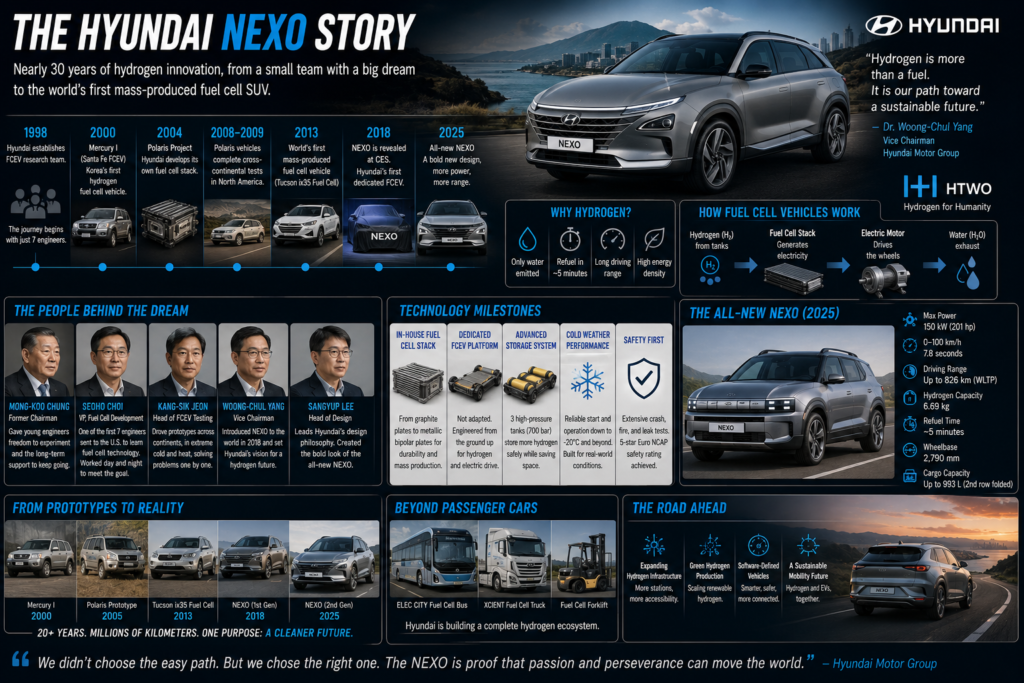
In 1998, Hyundai Motor established a dedicated fuel-cell development team. South Korea was still dealing with the aftermath of the Asian financial crisis, Hyundai was nowhere near its present global position, and hydrogen-powered passenger cars were experimental machines rather than realistic showroom products.
Yet Hyundai began developing one anyway.
That decision eventually produced the Santa Fe-based Mercury experimental vehicles, the independently developed Polaris fuel-cell stack, the Tucson/ix35 Fuel Cell, the NEXO and an entire Hyundai Motor Group hydrogen business extending into trucks, buses, industrial equipment and hydrogen production.
The NEXO therefore is not simply Hyundai’s hydrogen SUV.
It is the road-going result of one of the longest technology programmes in Korean automotive history.
Why Hyundai Chose Hydrogen in 1998
Today, zero-emission vehicles are central to practically every major manufacturer’s product strategy.
That was not the environment Hyundai encountered in 1998.
Battery-electric cars were extremely limited. Fuel cells were expensive experimental technology. Hydrogen stations barely existed. There was no guarantee that any meaningful consumer market would develop.
Hyundai nevertheless established a dedicated FCEV research team that year. According to Hyundai’s own historical account, the company initially lacked enough fuel-cell knowledge to develop the entire system independently, so it looked for an experienced technology partner.
It found one in the United States:
UTC Power.
United Technologies Corporation had extensive fuel-cell experience, including technology associated with NASA space programmes. Hyundai and UTC launched what became known as the Mercury Project.
The objective was much greater than installing a novel power source into an existing SUV.
Hyundai wanted to learn how an entire hydrogen-electric vehicle worked.
Seven Korean Engineers Go to America
One of the most interesting parts of the NEXO story is how small Hyundai’s earliest hydrogen effort appears compared with today’s enormous research operation.
Hyundai says it dispatched seven engineers to the United States to work with UTC on the Mercury programme.
The team had an aggressive development target.
Seoho Choi, one of the first-generation Hyundai fuel-cell engineers who later became a vice president, recalled that the team aimed to complete a functioning FCEV within roughly six months.
The development arrangement became almost continuous.
Hyundai’s engineers reportedly maintained Korean-style working hours while stationed in America, effectively working overnight. Their American counterparts worked during the day.
One team would finish.
The other would begin.
Development could therefore continue around the clock.
It is difficult to imagine a greater contrast with the polished NEXO displays seen today at international motor shows.
Behind the modern SUV was originally a handful of engineers trying to make unfamiliar technology operate reliably enough to put into a car.
Mercury I: A Hydrogen Santa Fe
The first major result appeared in 2000.
Called Mercury I, the experimental vehicle used the Hyundai Santa Fe as its base.
It became South Korea’s first hydrogen fuel-cell vehicle and represented Hyundai’s first serious attempt at integrating hydrogen storage, fuel-cell generation, electric propulsion and vehicle control into one usable package.
Mercury I subsequently participated in the 2001 Michelin Challenge Bibendum, an international event focused on cleaner vehicle technologies, where Hyundai’s prototype received recognition.
Later Mercury development moved onto the Tucson platform. Hyundai says Mercury II eventually used an 80-kW fuel-cell system, offered approximately 337 kilometres of range and demonstrated cold starting at temperatures down to roughly -20°C.
Cold-weather operation was particularly important.
A fuel-cell vehicle that works beautifully in a laboratory but refuses to start during a Korean winter is not a viable car.
Solving that problem would remain an important part of Hyundai’s fuel-cell development for decades.
Hyundai Realizes It Cannot Depend on Someone Else’s Fuel Cell
The UTC partnership gave Hyundai experience.
But it also created a strategic problem.
If Hyundai intended eventually to mass-produce fuel-cell vehicles, one of the vehicle’s most important components could not remain a technological black box supplied by somebody else.
Hyundai needed its own fuel-cell stack.
That realization created a parallel development effort known as the Polaris Project.
A fuel-cell stack performs the electrochemical reaction that combines hydrogen with oxygen to generate electricity. That electricity powers the vehicle’s electric motor, while water is produced at the vehicle as the primary reaction by-product.
Developing the stack internally was vastly harder than purchasing one.
Hyundai engineers lacked an existing commercial Hyundai unit that they could simply improve. Early development involved acquiring individual materials, assembling stacks layer by layer and repeatedly experimenting with humidity, gas flow and thermal management.
The engineers were building their own understanding at the same time they were building their hardware.
Polaris and Hyundai’s First In-House Stack
The Polaris programme reached a critical milestone in 2004, when Hyundai completed a vehicle equipped with its own fuel-cell stack.
That was only part of the problem.
The prototype used graphite-based bipolar plates. They could function technically, but they were poorly suited to inexpensive high-volume vehicle manufacturing.
Hyundai therefore began developing metallic bipolar plates that could eventually be manufactured through processes better suited to automotive production.
This distinction is central to the NEXO story.
Creating one hydrogen prototype is a scientific achievement.
Creating thousands of fuel-cell stacks that can be repeatedly manufactured at automotive quality standards is an industrial achievement.
Hyundai wanted the second.
Mong-Koo Chung and the Permission to Experiment
One executive repeatedly associated with Hyundai’s willingness to continue the programme is former Hyundai Motor Group Chairman Mong-Koo Chung.
Hyundai’s retrospective on the programme records Chung encouraging young engineers to experiment rather than obsess about immediately producing identical prototypes cheaply. His message was essentially that development teams should be allowed to build different solutions and learn from them rather than allowing short-term cost considerations to stop experimentation.
That attitude mattered because hydrogen was not an obvious profit centre.
The programme survived the Asian financial crisis, the 2008–2009 global financial crisis and an automotive industry increasingly shifting its attention toward battery-electric vehicles.
At several points, abandoning the programme would probably have been the easier business decision.
Hyundai continued.
The Mabuk Research Center
In 2005, Hyundai established what is now associated with its Mabuk eco-friendly technology research operations, giving fuel-cell engineering a larger dedicated development base.
The symbolism is interesting.
The same broader Hyundai research environment associated with the company’s earlier effort to develop its own Alpha gasoline engine was now being used to reduce Hyundai’s dependence on outside suppliers in another critical powertrain technology.
The pattern was familiar.
Hyundai’s development history repeatedly moved from:
Buy the technology.
to
Understand the technology.
to
Develop it internally.
to
Mass-produce it.
Hydrogen followed essentially the same path.
The Engineers Took the Cars Everywhere
Developing a fuel-cell stack was only useful if the resulting vehicle survived in reality.
That meant testing.
And early hydrogen prototypes were not always cooperative.
Kang-Sik Jeon, who led Hyundai’s FCEV performance-testing team, recalled travelling through the United States and Europe with experimental vehicles during the late 2000s while constantly worrying that they might fail to start or stall during public demonstrations.
Those failures were useful.
Every difficult cold start, unexpected shutdown and system fault provided another engineering problem to solve.
Hyundai’s Polaris vehicles subsequently completed North American cross-continental demonstrations in 2008 and 2009, adding real-world experience beyond laboratory testing.
By 2010, Hyundai’s accumulated fuel-cell development fleet had travelled approximately two million kilometres.
The research programme was becoming an automotive programme.
2013: Hyundai Takes the Huge Step Into Production
Then came the breakthrough.
In 2013, Hyundai began series production of the Tucson ix35 Fuel Cell.
Hyundai describes it as the world’s first mass-produced fuel-cell electric vehicle. The production model used Hyundai’s own 100-kW fuel-cell system and high-pressure hydrogen storage.
This was important for an obvious reason.
Toyota, Honda and other manufacturers had also been doing advanced fuel-cell work.
But Hyundai had crossed the line from prototypes into organized production.
The hydrogen automobile had moved out of the laboratory.
The ix35 Fuel Cell, however, still carried an important compromise.
It was fundamentally based on a vehicle designed to accommodate conventional powertrains.
Hydrogen hardware had to fit into an existing SUV architecture.
Hyundai’s next vehicle would solve that differently.
From Tucson Fuel Cell to a Purpose-Built Hydrogen Car
The eventual NEXO was significant because Hyundai stopped treating hydrogen propulsion as something that had to be packaged inside an ordinary gasoline-car platform.
It would receive a dedicated fuel-cell vehicle architecture.
That meant engineers could decide where the stack, battery, electric motor and hydrogen tanks belonged rather than adapting those components around a vehicle originally engineered for an internal-combustion engine. Hyundai said the dedicated layout improved weight, packaging, power-to-weight ratio, cabin room and fuel-cell-system integration compared with the Tucson Fuel Cell.
The transition began becoming visible publicly through Hyundai’s concept vehicles.
The 2014 Intrado explored a new hydrogen drivetrain and lightweight construction, while the FE Fuel Cell Concept, unveiled in 2017, previewed the design and technology direction much more directly associated with NEXO.
FE stood for Future Eco.
The concept promised a lighter, more power-dense fuel-cell system and showed the direction Hyundai intended its next dedicated hydrogen SUV to take.
One year later, the production version arrived.
2018: NEXO Is Revealed at CES
Hyundai chose the 2018 Consumer Electronics Show in Las Vegas to reveal the name and technology of its new fuel-cell flagship.
That venue itself said something important.
The NEXO was being presented not simply as another SUV, but as a technological showcase.
Hyundai Vice Chairman Dr. Woong-Chul Yang introduced the vehicle as the culmination of the company’s fuel-cell technology and described hydrogen as an important component of a more sustainable future.
NEXO became Hyundai’s first dedicated production fuel-cell passenger vehicle and its second commercially available generation after the Tucson/ix35 FCEV.
Twenty years had passed since those seven Hyundai engineers had travelled to America.
How the Original NEXO Worked
The NEXO was an electric vehicle.
That distinction is sometimes misunderstood.
Hydrogen did not burn inside an engine.
Instead, compressed hydrogen was stored in tanks onboard the vehicle. The fuel-cell stack combined hydrogen with oxygen from the atmosphere to generate electricity. That electricity then powered an electric motor.
A battery acted as an energy buffer and also stored recovered energy from regenerative braking.
So in simplified form:
Hydrogen + oxygen → electricity → electric motor → wheels
The first NEXO employed three hydrogen tanks and a 120-kW-class fuel-cell system; Hyundai’s Korean specification cited approximately 609 kilometres of range, while figures varied according to each market’s test cycle.
The important practical difference compared with a battery EV was refuelling time.
Instead of waiting for a large traction battery to recharge, hydrogen could be added to the high-pressure tanks in roughly the time associated with a conventional fuel stop when a suitable 700-bar station was available. Modern FCEVs typically require around five minutes to refuel.
That remains one of hydrogen’s most attractive characteristics.
NEXO Was Also an Autonomous-Driving Technology Showcase
Hyundai deliberately gave the original NEXO technologies that had little directly to do with hydrogen.
It debuted Hyundai’s Lane Following Assist technology and combined it with Highway Driving Assist. It offered camera-based blind-spot monitoring and Remote Smart Parking Assist, which could move the vehicle into or out of certain parking spaces without the driver physically sitting inside.
That made NEXO an interesting preview of two different technological futures simultaneously.
One concerned how the car obtained energy.
The other concerned how much of the driving task computers could perform.
For Hyundai, NEXO became something closer to an engineering flagship than simply another alternative-powertrain model.
The NEXO Also Had to Prove Hydrogen Was Safe
Hydrogen creates a psychological problem that battery vehicles do not encounter in exactly the same way.
People hear:
High-pressure hydrogen tanks.
And some immediately imagine an explosion.
Consequently, Hyundai devoted considerable engineering attention to tank integrity and crash protection.
The first-generation NEXO achieved the maximum five-star Euro NCAP result, while Hyundai has documented separate hydrogen-storage testing involving impact, fire and other extreme conditions.
This was critical to commercialization.
Hydrogen vehicles could not merely be safe.
Customers had to believe they were safe.
Korea Became the NEXO’s Natural Home
If NEXO struggled to become an ordinary sight in much of the world, its strongest environment emerged at home.
South Korea invested in hydrogen vehicles and refuelling infrastructure as part of a broader national hydrogen strategy.
The effect was substantial.
By 2022, the International Energy Agency reported that more than half of the world’s fuel-cell passenger cars were operating in Korea, and that roughly two-thirds of the additional fuel-cell cars entering service globally that year were Korean. The IEA specifically attributed part of that growth to Korea’s policy support and Hyundai’s position in fuel-cell vehicles.
The NEXO therefore became something that it rarely managed elsewhere:
A hydrogen car that ordinary motorists could actually encounter on the road.
But NEXO Exposed Hydrogen’s Biggest Problem
The technological story is impressive.
The infrastructure story is much more difficult.
A battery-electric vehicle can, at least theoretically, recharge anywhere electricity can be supplied.
An FCEV requires a specialized high-pressure hydrogen station supported by a hydrogen production and distribution network.
The U.S. Department of Energy continues to identify the availability of reasonably priced hydrogen and suitable refuelling stations as one of the primary barriers to widespread FCEV adoption.
That creates the classic chicken-and-egg problem.
People hesitate to buy hydrogen cars because there are not enough stations.
Companies hesitate to build stations because there are not enough hydrogen cars.
The NEXO could solve problems inside the vehicle.
Hyundai could not solve the entire infrastructure problem by itself.
Hydrogen Is Also Only as Clean as the Hydrogen
There is another important qualification to the idea of the NEXO as an environmentally clean vehicle.
At the tailpipe, an FCEV does not emit conventional combustion pollutants; the electrochemical process produces water and heat.
But hydrogen has to come from somewhere.
The International Energy Agency reported that global hydrogen production has remained overwhelmingly dependent on fossil fuels, while genuinely low-emissions hydrogen still accounts for only a small portion of worldwide production.
That means two visually identical NEXOs can effectively have very different upstream carbon footprints depending on how their hydrogen was produced.
Hydrogen made using renewable-powered electrolysis has a very different lifecycle profile from hydrogen created from unabated fossil fuels.
The NEXO solves the vehicle side of the problem.
A complete hydrogen economy has to solve the energy side too.
Hyundai Refuses to Abandon the Idea
This is where the NEXO story becomes particularly interesting.
While many manufacturers concentrated almost entirely on battery-electric passenger cars, Hyundai continued developing both technologies.
The company expanded hydrogen systems beyond passenger vehicles into ELEC CITY buses and XCIENT fuel-cell trucks, and in 2020 Hyundai Motor Group established HTWO as the identity for its broader hydrogen and fuel-cell business.
For Hyundai, hydrogen gradually stopped being simply a type of car.
It became an energy ecosystem.
That broader strategy helps explain why development of another NEXO continued even when the market for hydrogen passenger vehicles remained tiny compared with battery EVs.
INITIUM: A New Beginning
In October 2024 Hyundai revealed a concept called INITIUM.
The Latin-derived name referred to a beginning or first step, and the concept previewed both Hyundai’s next hydrogen vehicle and an entirely new design language called Art of Steel.
This time, Hyundai’s famous design leadership was more visible.
SangYup Lee, Executive Vice President and head of Hyundai and Genesis Global Design, presented INITIUM and described Art of Steel as a way of exploiting the natural formability and strength of steel rather than disguising the material.
The difference from the original NEXO was dramatic.
The 2018 vehicle was smooth, aerodynamic and almost deliberately gentle in appearance.
INITIUM was upright and architectural.
Squared wheel arches, substantial body sections and four-dot lighting gave it a tougher identity.
The production NEXO would retain much of it.
2025: The All-New NEXO Arrives
Hyundai unveiled the completely redesigned NEXO in April 2025, seven years after the original vehicle appeared.
Instead of abandoning hydrogen as battery-electric vehicles became dominant, Hyundai had spent the intervening years producing a substantially improved fuel-cell system.
The all-new NEXO increased its total power-system capability, with a new electric motor delivering up to 150 kW. Acceleration from 0–100 km/h improved from approximately 9.2 seconds in the previous NEXO to 7.8 seconds.
Hydrogen capacity rose from approximately 6.33 kg to 6.69 kg while Hyundai managed to improve interior packaging.
On 18-inch wheels, Hyundai quotes as much as 826 kilometres of WLTP range, with refuelling taking roughly five minutes under appropriate conditions.
The fuel-cell stack also received improvements to low-temperature operation, durability and anti-freezing behaviour—modern solutions to some of the same winter problems Hyundai’s first-generation engineers had been fighting more than two decades earlier.
The Design Finally Gives Hydrogen Its Own Identity
The second-generation NEXO also demonstrates how Hyundai’s position has changed.
The first Hyundai fuel-cell vehicles had been existing SUVs adapted around unfamiliar technology.
The new NEXO is unapologetically its own thing.
Its four-dot lighting motif connects visually with Hyundai’s HTWO hydrogen identity. Art of Steel gives the body a heavier and more architectural appearance, and Hyundai increased the vehicle’s dimensions and cargo capacity to make it function as a genuine family SUV rather than simply a technology demonstration.
That development says something important.
Hydrogen is no longer being hidden inside an ordinary Hyundai.
Hyundai wants the NEXO to visually represent hydrogen.
The People Behind NEXO Are Really Several Generations of Engineers
Unlike a famous sports car, the NEXO cannot realistically be credited to one chief engineer.
It is the cumulative work of several generations.
There was Mong-Koo Chung, whose leadership allowed costly experimentation to continue when commercial success was uncertain.
There was Seoho Choi and the original Hyundai engineers who went abroad when the company lacked its own fuel-cell knowledge.
There was Kang-Sik Jeon and the test teams who drove unreliable early prototypes across countries until the technology stopped behaving like an experiment.
There was Dr. Woong-Chul Yang, representing the engineering leadership that brought the first production NEXO onto the world stage in 2018.
There is now SangYup Lee and Hyundai’s modern design organization, giving the latest generation an identity separate from conventional Hyundai SUVs.
And behind every one of those public names are hundreds of engineers working on membranes, compressors, hydrogen tanks, cooling, electrical systems, software, crash structures and manufacturing.
The NEXO is less the creation of one genius than the accumulated knowledge of an organization that refused to stop working on the same difficult idea.
What Makes NEXO Important Even If Hydrogen Cars Never Dominate
It is possible that battery-electric vehicles will ultimately dominate ordinary passenger transportation.
It is also possible that hydrogen’s strongest future will lie elsewhere: heavy trucks, buses, construction equipment, power generation, shipping, industrial energy storage or other applications in which rapid refuelling and high energy requirements become particularly valuable.
The IEA has repeatedly pointed toward high-utilization fleets, freight and transport corridors as areas where hydrogen may have stronger opportunities.
If that happens, the NEXO will still have served an important purpose.
Passenger cars forced Hyundai to make fuel cells:
Smaller.
Quieter.
Safer.
Cheaper.
More durable.
Better in winter.
Mass manufacturable.
And acceptable to ordinary customers.
Technology developed for the NEXO can migrate elsewhere within Hyundai Motor Group’s hydrogen ecosystem.
That may ultimately become the car’s most important legacy.
From Seven Engineers to an Entire Hydrogen Industry
There is something particularly Korean about that progression.
In 1998, Hyundai did not possess world-leading fuel-cell technology.
It sent engineers abroad to learn.
Then Hyundai decided that learning was not sufficient.
It developed its own stack.
Then it developed a mass-production process.
Then it put the system into the Tucson.
Then it created a dedicated vehicle.
Then Korea developed into the world’s largest national market for fuel-cell passenger cars.
Then Hyundai expanded the technology into trucks and buses.
And now the company has created another generation of NEXO instead of allowing the experiment to quietly disappear.
That trajectory resembles Hyundai’s broader history.
The company repeatedly entered technologies in which it was initially dependent on foreign expertise, learned aggressively and then attempted to internalize the capability.
The NEXO may be one of the purest examples of that philosophy.
The NEXO Is Really a Story About Persistence
The easiest way to describe the Hyundai NEXO is:
A hydrogen-powered Korean SUV.
Technically, that is correct.
Historically, it misses almost everything interesting.
The NEXO is the descendant of a project begun during economic uncertainty in 1998.
It comes from seven engineers working opposite shifts with an American fuel-cell company.
It comes from prototypes that sometimes refused to start.
It comes from Hyundai engineers manually assembling experimental stacks because they did not yet have anything appropriate to copy.
It comes from replacing graphite components with metal ones because prototypes eventually had to become products.
It comes from continuing through recessions and an industry increasingly obsessed with batteries.
And it comes from a corporate decision that hydrogen was important enough to keep developing even before anyone could prove that doing so would make money.
Almost three decades later, the all-new NEXO still faces the same enormous question:
Will the hydrogen infrastructure finally arrive around the car?
Nobody yet knows the answer.
But Hyundai has already answered a different question.
Could a Korean manufacturer take fuel-cell technology from a small experimental research programme all the way to a second generation of dedicated mass-production hydrogen vehicles?
The NEXO proves that it could.
And whether hydrogen ultimately becomes a dominant passenger-car fuel or a specialized part of the future energy system, the NEXO will remain one of the strangest and most ambitious chapters in Hyundai history.