An engine rebuild is one of the biggest decisions a car owner can make. It is not like replacing spark plugs, installing new brakes, or upgrading suspension. Rebuilding an engine means opening the heart of the car, inspecting its internal parts, and restoring it so it can run properly again.
For some cars, an engine rebuild makes perfect sense. For others, it may not be worth the cost, time, or risk.
This is especially true for older enthusiast cars like the Hyundai Tiburon, Genesis Coupe, Veloster Turbo, Kia Forte Koup, Kia Stinger, and other Korean performance platforms. Some owners are emotionally attached to their cars. Others want more power. Some are trying to keep a rare platform alive. And some are simply trying to avoid buying a new vehicle.
So when does it actually make sense to rebuild an engine?
Let’s break it down.
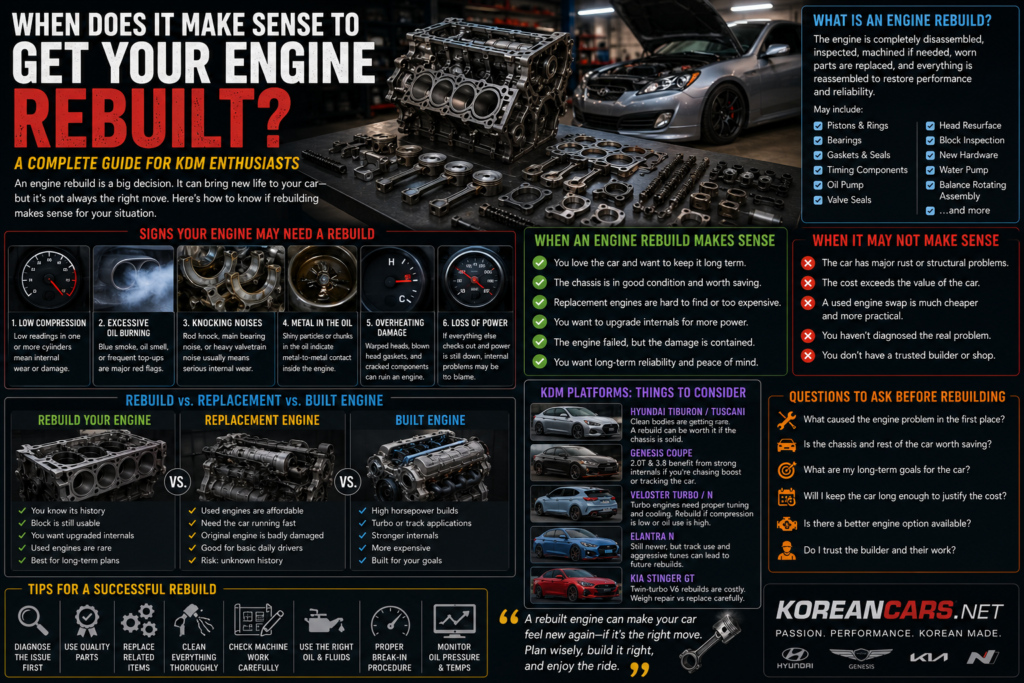
What Is an Engine Rebuild?
An engine rebuild involves disassembling the engine, inspecting internal components, replacing worn parts, machining surfaces when needed, and reassembling the engine to restore compression, oil control, and reliability.
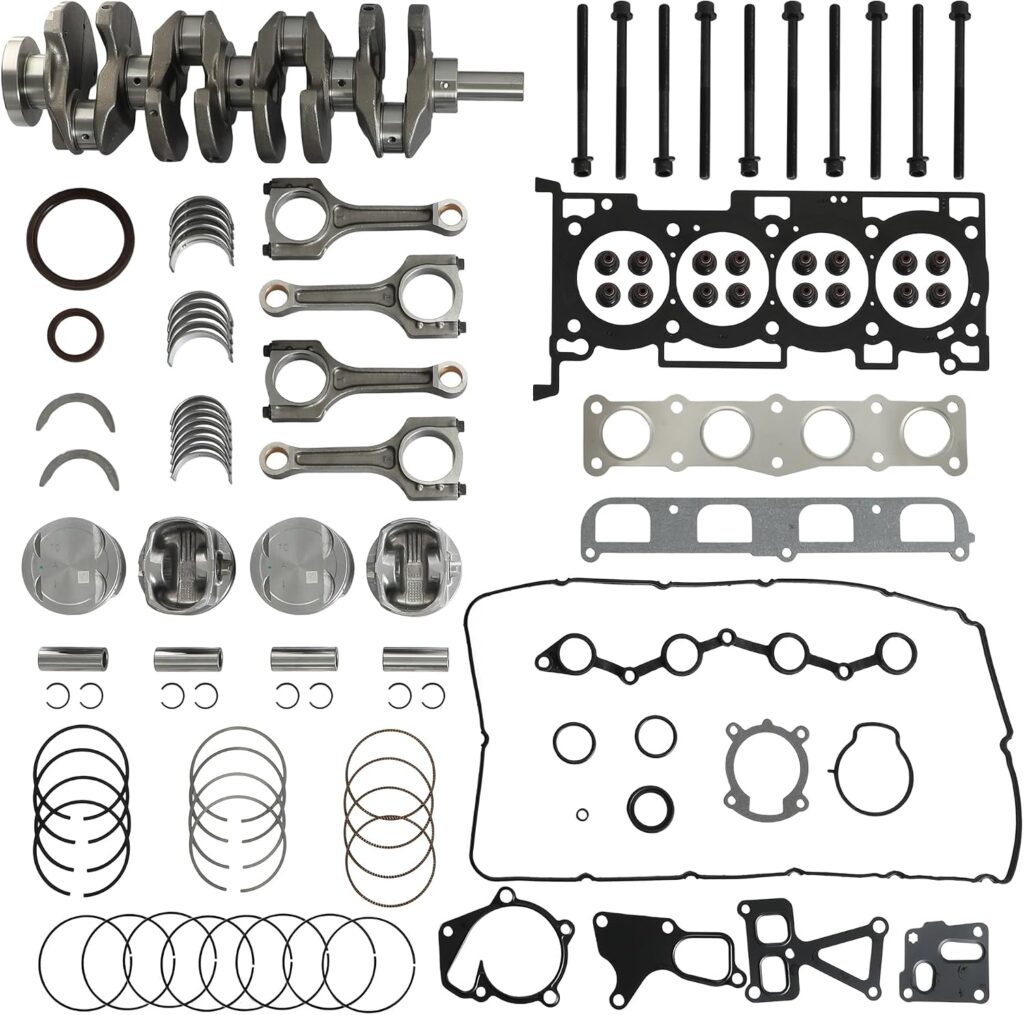
A rebuild may include replacing:
- Pistons
- Piston rings
- Bearings
- Gaskets
- Seals
- Timing components
- Oil pump
- Water pump
- Valve seals
- Valvetrain components
- Head bolts or studs
- Worn hardware
A more serious rebuild may also involve machining the block, resurfacing the cylinder head, honing cylinders, replacing valves, balancing rotating parts, or upgrading internal components.
In simple terms, a rebuild is about giving the engine a second life.
Signs Your Engine May Need a Rebuild
1. Low Compression
Compression is one of the most important indicators of engine health.
If one or more cylinders have low compression, the engine may have problems with:
- Worn piston rings
- Damaged valves
- Head gasket failure
- Cylinder wall wear
- Cracked piston
- Valve sealing issues
A compression test or leak-down test can help determine whether the problem is inside the engine.
If compression is low across multiple cylinders, a rebuild may become a serious option.
2. Excessive Oil Burning
Some oil consumption is normal in certain engines, especially as they age. But if your car is burning oil heavily, producing blue smoke, or needing frequent top-ups, there may be internal wear.
Common causes include:
- Worn piston rings
- Worn valve stem seals
- Cylinder wall wear
- Turbo seal issues
- PCV system problems
Before assuming the engine needs rebuilding, simpler causes should be checked first. But if the engine is burning oil because of worn rings or cylinder wear, a rebuild may be needed.
3. Rod Knock or Bearing Noise
A deep knocking sound from the bottom of the engine is one of the most serious warning signs.
Rod knock usually means the connecting rod bearings are worn or damaged. If ignored, the engine can fail completely.
At this stage, the choices are usually:
- Rebuild the engine
- Replace the engine
- Sell or part out the car
If the crankshaft, rods, or block are damaged badly enough, a replacement engine may be cheaper than rebuilding the original.
4. Metal Shavings in the Oil
Metal in the oil is never a good sign.
Small amounts of fine material can appear from normal wear, but visible glitter, chunks, or heavy metallic debris may indicate serious internal damage.
Possible causes include:
- Bearing failure
- Camshaft wear
- Timing component failure
- Piston damage
- Oil starvation
- Internal scoring
If metal is circulating through the engine, the damage may spread quickly. A rebuild may be necessary, but only after determining whether the block and major components are still usable.
5. Persistent Overheating Damage
Overheating can destroy an engine.
A single mild overheating event may not ruin anything, but repeated or severe overheating can cause:
- Warped cylinder head
- Blown head gasket
- Cracked head
- Cracked block
- Damaged piston rings
- Scored cylinders
If the engine has overheated badly and now has compression issues, coolant mixing with oil, or white exhaust smoke, a rebuild may be needed.
6. Loss of Power That Cannot Be Fixed Externally
Not every power loss means the engine needs rebuilding.
Before blaming the engine internals, check:
- Spark plugs
- Ignition coils
- Fuel pressure
- Injectors
- Vacuum leaks
- Boost leaks
- Exhaust restrictions
- Dirty throttle body
- Clogged catalytic converter
- Bad sensors
- ECU tuning issues
However, if all external systems are healthy and the engine still has poor compression, excessive blow-by, or internal noise, the problem may be mechanical.
When an Engine Rebuild Makes Sense
1. You Love the Car and Want to Keep It Long Term
This is one of the biggest reasons enthusiasts rebuild engines.
The car may not make financial sense on paper, but it matters to you.
Maybe it is your first project car.
Maybe it is a rare trim.
Maybe it has sentimental value.
Maybe you have already invested in suspension, brakes, wheels, paint, interior, or tuning.
Maybe you simply cannot replace the feeling it gives you.
For owners of older Korean cars like the Hyundai Tiburon or Genesis, this is especially relevant. Clean examples are getting harder to find. If the chassis is rust-free and the rest of the car is solid, rebuilding the engine may be worth it.
2. The Chassis Is in Good Condition
Before rebuilding an engine, look at the whole car.
A rebuild makes more sense if the car has:
- Minimal rust
- Good frame condition
- Clean body
- Healthy transmission
- Decent interior
- Good suspension mounting points
- No major electrical issues
- A title and history worth preserving
An engine can be rebuilt. A badly rusted structure is much harder to justify.
If the body is clean, the car may deserve a rebuilt engine.
If the body is falling apart, the rebuild may become throwing money into a car that has bigger problems.
3. Replacement Engines Are Hard to Find
Sometimes swapping in a used engine is cheaper than rebuilding.
But that depends on availability.
For older or less common Korean platforms, good used engines may be hard to find. Even when you find one, you may not know its true condition.
A used engine can have:
- Unknown mileage
- Hidden oil consumption
- Poor maintenance history
- Previous overheating
- Internal wear
- Compression issues
- Timing problems
If used engines are rare, overpriced, or risky, rebuilding your known engine may be the better choice.
4. You Want to Upgrade the Engine Internals
A rebuild becomes more appealing if you are planning a performance build.
For example, if you want to add boost, increase boost, or build a stronger engine, you may already need to open the motor.
A performance rebuild may include:
- Forged pistons
- Forged rods
- Upgraded bearings
- ARP-style hardware
- MLS head gasket
- Upgraded valve springs
- Stronger oil pump
- Better cooling support
- Balanced rotating assembly
This can make sense for turbocharged builds, track cars, or high-horsepower projects.
For example, a turbo Hyundai Tiburon, Genesis Coupe 2.0T, or modified Veloster Turbo may eventually reach a point where stock internals become the weak link.
5. The Engine Failed, but the Damage Is Contained
Not every engine failure destroys the whole motor.
Sometimes the damage is limited enough that rebuilding makes sense.
Examples include:
- Worn rings
- Head gasket failure
- Valve seal issues
- Timing component failure caught early
- Bearing wear caught before major crank damage
- Cylinder head issues with a healthy block
The earlier you catch a problem, the more likely a rebuild will be reasonable.
Driving a damaged engine until it completely fails can turn a rebuildable engine into scrap.
6. You Want Reliability More Than Maximum Power
A rebuild does not have to be about racing.
Sometimes the goal is simply restoring the car to dependable condition.
A mild reliability-focused rebuild may be ideal for a car you plan to daily drive, road trip, or keep for years.
This kind of rebuild focuses on:
- Fresh gaskets
- Good compression
- Proper oil pressure
- Clean cooling system
- Healthy timing components
- Strong sealing
- Factory-like drivability
For an older project car, this can make the car feel trustworthy again.
When an Engine Rebuild May Not Make Sense
1. The Car Has Major Rust or Structural Problems
If the frame, floors, subframes, or suspension mounting points are badly rusted, rebuilding the engine may not be the smartest move.
A strong engine in a dying chassis does not solve the real problem.
Always inspect the body before committing to an engine rebuild.
2. The Cost Exceeds the Value of the Car
Car enthusiasts do not always make decisions based only on resale value, but cost still matters.
If the rebuild costs more than the entire car is worth, ask yourself:
- Am I keeping this car long term?
- Is the chassis clean enough?
- Is this car rare enough?
- Do I have emotional attachment?
- Would another car be a better platform?
- Can I afford unexpected costs?
Sometimes the rebuild is worth it emotionally. Sometimes it is not.
Be honest with yourself before spending the money.
3. A Used Engine Swap Is Much Cheaper
If good used engines are common and affordable, replacing the engine may be the better option.
A used engine swap can be faster and cheaper than a full rebuild.
However, the risk is uncertainty. A used engine may run well now but still have hidden issues later.
The best choice depends on the platform, parts availability, labor cost, and your long-term plans.
4. You Are Only Trying to Avoid Maintenance
A rebuild should not be used as a substitute for proper diagnosis.
Many engine problems are caused by external systems.
Before rebuilding, check:
- Ignition system
- Fuel system
- Sensors
- Vacuum leaks
- PCV system
- Cooling system
- Timing belt or chain condition
- Turbocharger condition
- Exhaust restrictions
- ECU tune
- Grounds and wiring
Do not rebuild an engine because of a problem that could have been fixed with a sensor, gasket, coil, or hose.
5. You Do Not Have a Trusted Shop or Builder
An engine rebuild is only as good as the person doing it.
A poor rebuild can be worse than no rebuild at all.
Bad rebuilds can lead to:
- Oil leaks
- Low compression
- Bearing failure
- Overheating
- Improper clearances
- Wrong torque specs
- Timing issues
- Premature failure
If you cannot find a trustworthy engine builder, it may be safer to wait, research, or consider a replacement engine.
Rebuild vs. Replacement Engine
This is one of the biggest decisions.
Rebuild Your Current Engine
Best when:
- You know the engine’s history
- The block is usable
- You want upgraded internals
- Used engines are rare
- You want long-term reliability
- The car has sentimental value
Install a Used Engine
Best when:
- Used engines are affordable
- You need the car running quickly
- Your original engine is badly damaged
- You are not chasing high power
- The car is a basic daily driver
Install a Built Engine
Best when:
- You want serious horsepower
- You are boosting the car
- You track the car
- You need stronger internals
- You are committed to the platform
There is no universal answer. The right choice depends on the car and your goals.
Special Considerations for Modified Cars
Modified cars need extra thought.
If your engine failed after modifications, ask why.
Possible causes include:
- Poor tuning
- Running too lean
- Too much boost
- Bad fuel
- Weak cooling system
- Oil starvation
- Detonation
- Incorrect spark plugs
- Improper maintenance
- Bad installation work
Rebuilding the engine without fixing the cause of failure may lead to another failure.
For turbo builds, the tune is everything. A built engine can still fail quickly if the fuel, timing, boost control, and cooling are not handled properly.
Engine Rebuilds for Korean Cars
Hyundai Tiburon
A Tiburon rebuild makes the most sense if the body is clean and the owner wants to keep the car long term.
For naturally aspirated builds, a stock-style rebuild can restore reliability. For turbo builds, stronger internals may be worth considering depending on the power goal.
Since clean Tiburons are becoming harder to find, saving a good chassis can be worthwhile.
Genesis Coupe
The Genesis Coupe has stronger performance potential, especially because it is rear-wheel drive.
A rebuild may make sense for:
- High-mileage 2.0T engines
- Modified turbo builds
- 3.8 V6 engines with internal wear
- Drift or track cars
- Owners chasing more power
Because the Genesis Coupe has a strong enthusiast following, a well-built engine can support the long-term value of the car.
Veloster Turbo and Veloster N
These cars rely heavily on turbocharged performance.
A rebuild may be worth considering if there is compression loss, oil consumption, or damage from poor tuning.
For the Veloster N, owners should be especially careful with aggressive tuning, heat, and track use. A proper rebuild should match the intended power level and driving style.
Elantra N
The Elantra N is still modern enough that many cars are not yet at the typical rebuild stage.
However, heavily tracked or heavily tuned examples may eventually need internal work. For now, most owners should focus on maintenance, cooling, oil quality, and responsible tuning.
Kia Stinger GT
The Stinger GT’s twin-turbo V6 is powerful and more complex than older KDM engines.
A rebuild may be expensive, so proper diagnosis is critical. In many cases, owners may compare rebuilding against replacing the engine or repairing specific components.
Because the Stinger is a higher-value car, a rebuild may make financial sense if the rest of the vehicle is clean and well-maintained.
Questions to Ask Before Rebuilding
Before committing, ask yourself:
What caused the engine problem?
If you do not fix the cause, the rebuilt engine may fail again.
Is the chassis worth saving?
A clean body makes a rebuild more logical.
What is my long-term plan?
Daily driver, show car, track car, weekend cruiser, or high-horsepower build?
Will I keep the car long enough to justify the cost?
A rebuild makes more sense if you plan to enjoy the car for years.
Is there a better engine option?
Sometimes a swap or replacement engine is smarter.
Do I trust the builder?
This may be the most important question of all.
How to Make a Rebuild Worth It
If you decide to rebuild, do it properly.
Good practices include:
- Diagnose the failure first
- Use quality parts
- Replace related wear items
- Clean everything thoroughly
- Check machine work carefully
- Follow proper break-in procedure
- Use the correct oil
- Avoid aggressive driving too soon
- Retune the car if modified
- Monitor oil pressure, temperature, AFR, and knock if applicable
A rebuild is not just a repair. It is a process.
The details matter.
Final Thoughts
An engine rebuild makes sense when the car is worth saving, the chassis is solid, the owner has a long-term plan, and the engine damage can be repaired properly.
It makes less sense when the car has major rust, the rebuild cost is unrealistic, a replacement engine is a better option, or the problem has not been properly diagnosed.
For Korean car enthusiasts, engine rebuilds can be especially meaningful. Cars like the Hyundai Tiburon, Tuscani, Genesis Coupe, Veloster N, Elantra N, and Kia Stinger are part of a growing KDM performance culture. As some of these platforms age, rebuilding engines may become part of keeping them alive.
Sometimes the smartest move is to walk away.
Sometimes the smartest move is to swap in another engine.
And sometimes, if the car really matters to you, the right move is to rebuild it stronger than before.
The key is knowing the difference.