0
 0
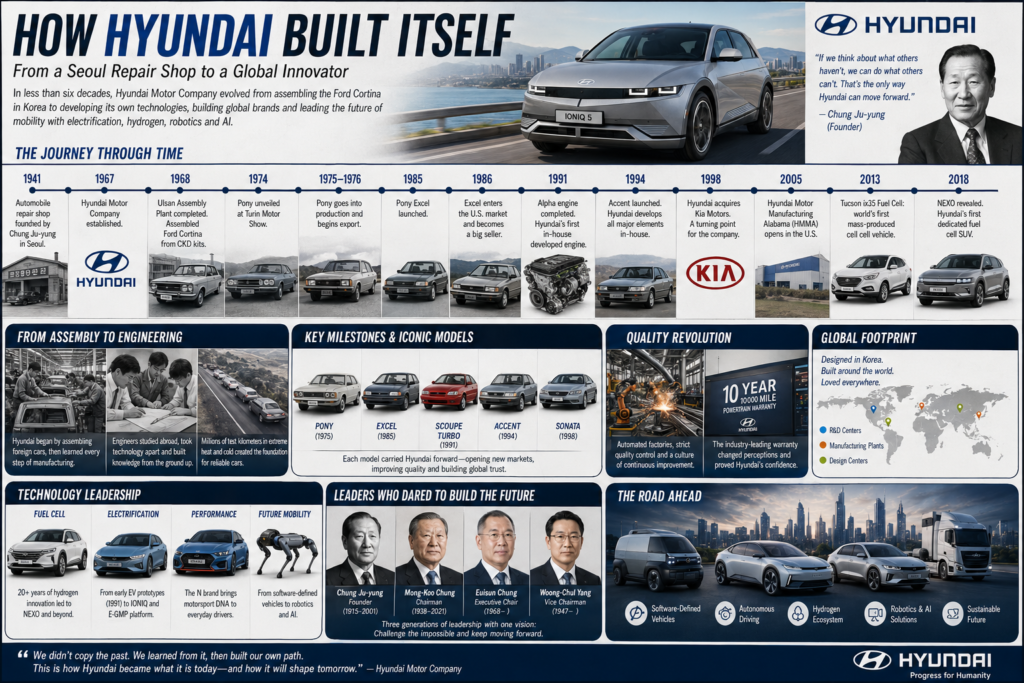
There is an easy way to misunderstand Hyundai’s history.
Look at Hyundai today and the company appears to have always been an enormous industrial organization.
It builds millions of vehicles.
It develops gasoline engines, hybrid systems, electric motors, batteries and hydrogen fuel cells.
It operates research centres on several continents.
Its N division competes in motorsport.
Genesis challenges luxury manufacturers.
IONIQ competes at the forefront of electric-car technology.
And Hyundai Motor Group is now investing in autonomous driving, software-defined vehicles, robotics and artificial intelligence. In 2025 Hyundai Motor Company alone sold approximately 4.1 million vehicles worldwide, while Hyundai Motor Group describes itself as the world’s third-largest automotive group by sales volume.
But none of that was inevitable.
When Hyundai Motor Company was founded in 1967, South Korea did not possess anything resembling the mature automobile industry of Japan, Germany or the United States.
Hyundai did not have generations of engine designers.
It did not have an internationally respected styling department.
It did not have a huge domestic supplier network.
It did not even begin by producing its own automobile.
Its first major task was assembling somebody else’s Ford.
The remarkable part of Hyundai’s history is therefore not simply how large the company eventually became.
It is how quickly Hyundai learned.
Again and again, the company entered an area in which it lacked expertise, borrowed knowledge from somewhere else, absorbed it, developed internal capability and eventually attempted to surpass the companies from which it had originally learned.
That cycle may be the single best way to understand Hyundai.
Before Hyundai Motor There Was Chung Ju-yung
The automotive story begins with Chung Ju-yung, one of the most consequential industrial figures in modern South Korean history.
Chung was born into a farming family in what is now North Korea. Hyundai’s own historical account describes a young man repeatedly leaving home in search of opportunities, working in construction and as a labourer before eventually entering the rice business in Seoul.
His first substantial connection with automobiles came in 1941, when he established an automobile repair business in Seoul.
The repair operation apparently developed a reputation for completing work quickly. Chung later remembered taking approximately five days to perform jobs that competitors might take substantially longer to finish.
That small garage was not Hyundai Motor Company.
But it established an important pattern.
Chung was fascinated by industries in which speed, organization and problem solving could compensate for limited resources.
In 1947, he established Hyundai Engineering & Construction. The company participated in rebuilding South Korea’s infrastructure during the postwar period, including roads and large construction projects.
The connection between construction and automobiles was obvious to Chung.
Hyundai’s official heritage material recalls his view that if roads represented a country’s veins, automobiles were the blood travelling through them.
The construction company had helped build the infrastructure.
Now Chung wanted Hyundai to manufacture the machines that would use it.
1967: Hyundai Motor Company Is Born
Hyundai Motor Company was incorporated in 1967.
Its Ulsan assembly plant followed in 1968.
Today, Ulsan is one of the world’s great automotive manufacturing complexes.
At the beginning, however, Hyundai’s role was much less glamorous.
It assembled the Ford Cortina.
Ford supplied vehicles in CKD—or Complete Knock Down—form. Components manufactured elsewhere could be shipped to Korea, assembled locally and sold as finished automobiles.
It gave Hyundai immediate access to automobile manufacturing without requiring the Korean company to develop an entire vehicle itself.
And it taught Hyundai an enormous amount.
The Ulsan facility moved from construction to automobile production with extraordinary speed, and the Cortina became Hyundai’s first mass-produced vehicle.
But the arrangement also taught Hyundai something potentially more important:
Assembly was not independence.
The Ford Cortina Taught Hyundai What It Could Not Control
Building a foreign manufacturer’s car created limitations that became increasingly frustrating.
If Hyundai discovered that a component was poorly suited to Korean roads, it could not simply redesign the vehicle.
If the car developed a recurring problem, Hyundai did not necessarily own the engineering needed to correct it.
Major design decisions remained controlled elsewhere.
Hyundai Motor Group’s own account of this period says Chung Ju-yung concluded that assembling imported vehicles might be easier in the short term but would never turn Hyundai into a genuine automobile manufacturer.
That distinction became fundamental.
There are at least four stages in building an automobile industry:
Assemble someone else’s car.
Manufacture someone else’s design.
Design your own car using outside technology.
Develop the entire vehicle yourself.
Hyundai would spend the next several decades moving through those stages remarkably quickly.
The Decision to Build a Korean Car
In 1973 Hyundai formally began establishing a process for developing its own automobile.
The challenge was enormous.
South Korea lacked much of the industrial ecosystem necessary to create a complete modern passenger car.
Hyundai therefore used international expertise strategically rather than pretending it possessed knowledge it did not have.
Former Austin Morris managing director George Turnbull was recruited to help organize the vehicle-development programme.
He in turn brought European automotive specialists into the project.
For exterior design, Hyundai went to Italy and worked with Giorgetto Giugiaro and Italdesign.
For important mechanical architecture, Hyundai used Mitsubishi technology. The Mitsubishi Lancer provided a technological foundation for portions of the chassis and powertrain.
This was not technological independence yet.
It was technological education.
And Hyundai approached it like a student determined eventually to stop needing the teacher.
The Pony Was More Than Hyundai’s First Car
The resulting vehicle was the Hyundai Pony.
It appeared publicly at the 1974 Turin Motor Show, with production beginning during 1975 and commercial sales associated with the 1976 model period.
The Pony’s styling was unmistakably Giugiaro.
Its basic mechanical architecture reflected Mitsubishi knowledge.
European engineers helped Hyundai establish development procedures.
But something extremely important was happening behind the scenes.
Hyundai employees were learning how automobile design actually worked.
Hyundai dispatched personnel to Italdesign to study body design and blueprint preparation. Engineers disassembled components, documented systems and developed the ability to reproduce and modify automotive hardware themselves.
Even more significant was localization.
Hyundai says approximately 90 percent of the Pony’s parts were domestically produced, compared with only about 21 percent localization during the first year of Cortina production.
That meant the Pony was helping build something much bigger than Hyundai Motor Company.
It was helping build a Korean automotive supplier industry.
Companies had to learn to manufacture:
Suspension components.
Electrical systems.
Glass.
Interior parts.
Body panels.
Braking components.
Fasteners.
Rubber components.
Stampings.
Castings.
Thousands of individual pieces required by modern automobile production.
The Pony therefore represented industrial development as much as automotive development.
Hyundai Immediately Looked Beyond Korea
The Korean domestic market was too small to support Chung’s ambitions.
The Pony therefore became an export product almost immediately.
Hyundai began exporting the car during 1976, including shipments to countries in South America, Africa and the Middle East. The Pony’s export to Ecuador represented Korea’s first passenger-car export.
European exports followed.
Then came a particularly important market for Hyundai:
Canada.
Hyundai established its Canadian subsidiary in 1983, and the Pony 2 became an early Korean entry into the North American automotive market.
Canada mattered because the original Pony could be sold there before Hyundai had a vehicle capable of complying with the United States’ more demanding emissions and certification requirements.
It gave the Korean manufacturer practical experience with North American customers, winters, dealerships and operating conditions.
The next Hyundai would attack the United States directly.
The Excel Turns Hyundai Into an International Manufacturer
The Pony Excel, introduced in 1985, represented another major technological step.
Unlike the rear-wheel-drive Pony, the new car used front-wheel drive.
It was developed specifically as a global export vehicle.
Japanese technology continued to influence the platform and powertrain, while Giugiaro again contributed styling, but Hyundai itself had developed substantially greater vehicle-engineering capability by this point.
Hyundai subjected the car to demanding North American testing and established technical capabilities needed to meet U.S. emissions requirements.
In January 1986 it received U.S. EPA certification.
The Excel entered the United States in 1986, becoming Hyundai’s first U.S.-market automobile.
The initial reaction was extraordinary.
Its low price and generous equipment attracted enormous attention.
Hyundai sold more than 100,000 Excels within roughly seven months of its U.S. introduction and approximately 168,882 during its first year.
By 1987, Hyundai reported 263,610 annual U.S. sales for the Pony Excel, placing it first among imported compact cars.
For a company that had been assembling Ford Cortinas less than twenty years earlier, this was an astonishing rise.
But Hyundai was about to discover that rapid growth could create its own problems.
Hyundai Grew Faster Than Its Reputation Could Survive
The Excel opened America to Hyundai.
It also contributed to one of the most difficult periods in the company’s history.
Hyundai’s primary competitive weapons were price and equipment.
Customers who could not afford a Toyota or Honda could buy a new Hyundai for considerably less.
But as large numbers of early Hyundais aged in North America, complaints about durability and quality accumulated.
By the late 1990s Hyundai had developed a reputation in the United States that was extremely difficult to escape.
Cheap.
Disposable.
Poor resale value.
Questionable reliability.
Hyundai Motor Group’s own retrospective acknowledges that by approximately 1998, Hyundai faced criticism for failing to match Japanese manufacturers’ quality.
This period is important because Hyundai could have responded in two ways.
It could have accepted its identity as a permanent budget manufacturer.
Or it could try to change what the company actually was.
Hyundai chose the harder option.
But before the quality revolution could succeed, it needed greater technological independence.
The Alpha Engine Was Hyundai’s Declaration of Independence
For years, Hyundai had progressively learned to design bodies, chassis and complete vehicles.
But engines remained one of the most difficult technologies to internalize.
An automobile manufacturer that cannot develop its own powertrain remains dependent on somebody else for one of the most strategically important components in the car.
Hyundai established an engine-development department in 1983 and began what became known as the Alpha Project.
British engineering consultancy Ricardo assisted with early concept development, but Hyundai had to solve enormous practical problems involving metallurgy, machining, casting, combustion, durability and production.
Approximately 300 prototype engines and 150 test vehicles were produced during development.
Testing took prototypes into Arizona heat and Ontario cold, with Hyundai reporting approximately 4.2 million kilometres of durability testing before the production engine was ready.
The result arrived in 1991.
The Alpha became Hyundai’s first internally developed production engine.
Its importance goes far beyond specifications.
The knowledge accumulated through Alpha eventually contributed to later Hyundai engine families including Beta, Delta, Gamma, Theta and Lambda.
Developing an engine also improved surrounding Korean capabilities in casting, machining, materials and manufacturing.
Once again, the car was developing the industry around it.
The Scoupe Turbo Became an Unexpected Technology Showcase
For Korean performance-car history, one detail of the Alpha programme is particularly interesting.
Hyundai offered a turbocharged version.
The Scoupe Turbo used an Alpha-family turbo engine and became one of the earliest demonstrations that Hyundai’s internally developed powertrain could be used for something more interesting than inexpensive transportation.
This was decades before Hyundai N.
But the basic idea was already visible.
Technological independence gave Hyundai freedom.
Once the company controlled the engine, it could decide what kind of vehicle that engine should create.
The Accent Completed the First Great Hyundai Transformation
By the time the Accent arrived in 1994, Hyundai had crossed another important line.
Hyundai Motor Group describes the Accent as the point at which Hyundai had developed all of the car’s major underlying elements—including platform, engine and design—with its own capabilities.
Only about eighteen years separated the Pony and Accent.
Consider what changed during those eighteen years.
Hyundai went from:
Using Mitsubishi mechanical architecture…
to developing its own engines.
Using Italian studios to establish styling expertise…
to operating internal design departments.
Learning how to build automotive components…
to creating an increasingly sophisticated domestic supplier industry.
Assembling imported cars…
to engineering an entire vehicle.
That transition is arguably more important to Hyundai history than any individual sales milestone.
Hyundai had stopped being primarily an assembler that manufactured automobiles.
It had become an automaker.
Namyang Gave Hyundai an Engineering Brain
As Hyundai’s ambitions increased, the company needed a development centre capable of integrating increasingly complex programmes.
The Namyang Technology Research Center was inaugurated in 1996.
Namyang would eventually become one of the central institutions of Hyundai Motor Group engineering.
Powertrains.
Chassis.
Crash safety.
Electronics.
Vehicle dynamics.
Prototypes.
High-performance development.
Future mobility.
Much of Hyundai’s modern technical identity would eventually pass through Namyang.
Years later, even Hyundai’s performance sub-brand would use the letter N partly to represent Namyang, pairing the Korean engineering centre with Germany’s Nürburgring.
Hyundai Starts Building a Global Industrial Network
The next phase involved becoming something larger than a Korean company exporting Korean-built automobiles.
Hyundai increasingly wanted to manufacture vehicles close to the customers buying them.
The company expanded its overseas research and manufacturing footprint during the 1990s.
A European technical centre was established in Germany.
A Turkish manufacturing operation followed.
Hyundai opened an Indian plant in 1998.
This strategy eventually became one of Hyundai’s defining strengths.
Instead of designing every vehicle exclusively around Korean requirements and shipping identical products everywhere, Hyundai increasingly developed regional expertise.
European teams could tune cars for European roads.
Indian operations could develop products around Indian customer requirements.
North American engineers could conduct durability testing in North American climates.
The company was slowly becoming multinational not simply in where it sold cars, but in where it thought about cars.
1998 Changed Hyundai Forever
Then came the Asian financial crisis.
The crisis destabilized major South Korean companies and contributed directly to the collapse of Kia as an independent automaker.
In 1998 Hyundai acquired Kia Motors, creating the foundation of the automotive group that exists today.
That event deserves its own article because calling it simply a “merger” hides a much more complicated story involving bankruptcy, government-supervised restructuring, competing bids and the eventual relationship between two companies that continue operating as separate brands.
The same is true of the broader Hyundai conglomerate.
The old Hyundai Group eventually fractured into separate corporate groups, with Hyundai Motor moving onto its own path.
Those stories are intentionally left mostly outside this article.
What matters here is that around the turn of the millennium Hyundai Motor Company entered a new phase.
It now had enormous scale.
What it still needed was respect.
Mong-Koo Chung Makes Quality an Obsession
The transformation of Hyundai’s quality reputation is closely associated with Mong-Koo Chung, son of founder Chung Ju-yung.
By the late 1990s and early 2000s, Hyundai could no longer rely upon price alone.
The company began attacking defects systematically.
Manufacturing became more automated.
Quality data was collected more aggressively.
Problems detected at the end of production were documented and fed back into manufacturing and engineering processes.
Hyundai’s retrospective of this period describes an organization-wide quality campaign that ultimately brought the company’s quality much closer to established Japanese and American manufacturers.
The most famous marketing expression of the strategy came in the United States:
10 years / 100,000 miles of powertrain coverage.
It was partly a warranty.
But psychologically it was something more powerful.
Hyundai was effectively telling skeptical American customers:
If you think our cars are going to fail, we will assume the financial risk.
The warranty forced Hyundai’s manufacturing organization and Hyundai’s marketing organization to make the same promise.
Quality could no longer be an aspiration.
Bad quality would become expensive.
By the early 2000s, outside assessments were increasingly recognizing the improvement, even while Hyundai’s residual brand reputation lagged behind what its newer vehicles had become.
That gap between actual quality and perceived quality would take years to close.
The Cheap-Car Company Builds an American Factory
One of the clearest signals that Hyundai intended to become a permanent North American manufacturer came in 2005, when it established its Alabama production plant.
The same period also saw Hyundai expand its North American proving and technical operations.
Producing cars in America changed Hyundai’s relationship with the market.
Hyundai was no longer simply an exporter arriving at American ports.
It employed American manufacturing workers.
It operated engineering facilities.
It built vehicles specifically around North American demand.
Similar localization strategies expanded elsewhere.
Hyundai’s development model was becoming:
Design globally.
Engineer regionally where useful.
Manufacture close to major markets.
Share technology across an increasingly integrated global organization.
Hyundai Eventually Realized Engineering Was Not Enough
Fixing quality solved one problem.
It did not automatically make Hyundai desirable.
A reliable appliance can still be an appliance.
During the 2000s and 2010s, Hyundai Motor Group began treating design as strategic technology.
The Group increasingly recruited internationally experienced designers while expanding internal studios around the world.
Peter Schreyer, initially recruited by Kia in 2006, eventually became President and Chief Design Officer of Hyundai Motor Group in 2013, giving him responsibility extending across Hyundai, Kia and Genesis. Luc Donckerwolke joined the Group in 2016 after senior design positions at European luxury manufacturers and later became the Group’s Chief Design Officer and Chief Creative Officer.
Their influence represented another evolution in Hyundai’s learning strategy.
The company was no longer hiring foreign expertise simply to teach Koreans how to create a basic automobile.
Now Hyundai was recruiting global talent to help develop an internationally recognizable creative culture inside a Korean industrial organization.
The goal had changed from:
Can Hyundai design its own car?
to:
Can Hyundai produce design other manufacturers want to follow?
Genesis Was Hyundai Testing the Ceiling
Hyundai’s ambitions became particularly clear through Genesis.
The Genesis name initially appeared on premium Hyundai models, but in 2015 Hyundai launched Genesis as a standalone global luxury brand.
This was a remarkably ambitious move for a manufacturer whose badge had once been associated primarily with inexpensive transportation.
Luxury buyers do not purchase according to specifications alone.
They purchase history.
Identity.
Design.
Dealer experience.
Prestige.
Craftsmanship.
Hyundai therefore had to attempt something much harder than building an expensive sedan.
It had to persuade buyers that Korean engineering could carry luxury status.
Genesis deserves its own detailed history, but within Hyundai’s broader development it represented an important psychological transition.
Hyundai no longer wanted merely to catch Toyota.
It was willing to challenge Lexus.
BMW.
Mercedes-Benz.
Audi.
Then Hyundai Decided It Wanted Enthusiasts
Another stereotype remained.
Hyundai could make practical cars.
Perhaps it could make luxury cars.
But could it make a car enthusiasts genuinely wanted to drive?
Hyundai began organizing dedicated high-performance development around 2012 at Namyang.
It returned to the World Rally Championship with the i20 programme and established Hyundai Motorsport in Europe.
Then at the 2015 Frankfurt Motor Show, Hyundai formally introduced the N performance brand.
The first production N model, the i30 N, arrived in 2017.
It was followed by vehicles including the Veloster N, i20 N, Kona N and Elantra N.
The letter N connected two locations:
Namyang, where Hyundai develops cars.
And the Nürburgring, where Hyundai tests them.
That pairing tells the story remarkably well.
Korean engineering did not need to isolate itself from foreign knowledge to demonstrate independence.
Hyundai had learned to use Korea as the organizational centre while treating the entire world as its engineering laboratory.
Motorsport Became an Engineering Department
Hyundai’s return to the World Rally Championship was not simply a branding exercise.
Motorsport created an environment in which suspension, aerodynamics, thermal management, drivetrain durability and software could be subjected to extreme loads.
Hyundai re-entered WRC competition in 2014.
By 2019 it had won the WRC Manufacturers’ Championship, repeating the achievement in 2020.
N vehicles also competed at the Nürburgring and in international touring-car racing.
For enthusiasts, the cultural impact may have been even larger.
A generation that remembered Hyundai primarily as a cheap-car brand was suddenly watching Elantra Ns, Veloster Ns and i30 Ns being compared seriously with established European and Japanese performance cars.
The brand had crossed another psychological boundary.
Hyundai Was Experimenting With Electric Cars Before the EV Boom
Hyundai’s modern electrification push can appear sudden if viewed only through vehicles such as the IONIQ 5.
It was not.
Hyundai produced a Sonata electric prototype in 1991.
During the 1990s it experimented with electric vehicles, hybrids and eventually fuel cells.
Fuel-cell research became particularly significant.
By 2000 Hyundai had produced a fuel-cell Santa Fe research vehicle.
In 2013 Hyundai began production of the ix35/Tucson Fuel Cell, which it describes as the world’s first mass-produced fuel-cell electric vehicle.
The dedicated NEXO followed in 2018.
Meanwhile battery electrification accelerated.
The original IONIQ arrived in 2016 with hybrid, plug-in-hybrid and electric variants.
In 2020 Hyundai announced that IONIQ would become a dedicated EV family and unveiled Hyundai Motor Group’s E-GMP dedicated electric platform.
The IONIQ 5 followed.
Then IONIQ 6.
Then IONIQ 5 N.
Hyundai was no longer adapting electric propulsion to vehicles originally conceived around combustion engines.
It was building cars around electricity from the beginning.
The IONIQ 5 Brings Hyundai Back to the Pony
There is something fitting about the design of the IONIQ 5.
Its angular surfaces and pixel-inspired details deliberately reference Hyundai’s early Pony-era design vocabulary.
Hyundai even used the restored Pony Coupe concept and its modern reinterpretations as part of a broader effort to rediscover the company’s own design heritage.
For decades Hyundai had been trying to escape its past.
Then something changed.
The past had become worth celebrating.
That may be one of the clearest signs that Hyundai’s identity had matured.
A company insecure about its origins copies established prestige.
A confident company can take a Korean economy car from the 1970s and transform its visual memory into the basis of a futuristic EV.
One Hundred Million Vehicles
On September 30, 2024, Hyundai Motor Company reached 100 million vehicles of cumulative global production, only 57 years after the company was founded.
The company had reached one million cumulative units in 1986.
Ten million in 1996.
Fifty million in 2013.
Eighty million in 2019.
Ninety million in 2022.
And 100 million in 2024.
The ceremonial 100,000,001st vehicle was an IONIQ 5.
That makes for an almost perfect historical bookend.
The early Hyundai began by assembling the Ford Cortina.
The modern Hyundai celebrated 100 million vehicles with an electric car riding on technology developed within Hyundai Motor Group.
Hyundai Is Now Trying to Stop Being Just a Car Company
Perhaps the strangest chapter is the one happening now.
Hyundai increasingly describes its future not simply in automotive terms but in terms of mobility, software, robotics and artificial intelligence.
The Group has invested in software-defined vehicle architecture.
It owns Boston Dynamics.
It is developing autonomous-driving technology.
It is integrating AI into manufacturing.
It continues to develop hydrogen.
And in 2026 Executive Chair Euisun Chung described Hyundai Motor Group as evolving beyond traditional automotive manufacturing toward becoming a Physical AI solution company spanning intelligent vehicles, robots, factories and eventually larger connected infrastructure.
At CES 2026 the Group presented an AI robotics strategy built around Boston Dynamics and future industrial deployment of humanoid Atlas robots, alongside smart factories and autonomous mobility systems.
Hyundai Motor Company’s own 2026 strategy similarly places software, autonomous driving, AI, robotics, electrification and hydrogen among its major future investment areas.
That seems extremely far removed from the Cortina.
Yet the underlying Hyundai strategy looks remarkably familiar.
Hyundai’s Real Skill May Be Learning
Look at Hyundai’s history as a sequence.
Construction
Hyundai learned how to execute enormous industrial projects.
Vehicle assembly
Ford taught Hyundai how automobiles could be mass produced.
First Korean model
Mitsubishi, Italdesign and European engineers provided technology that Hyundai did not yet possess.
Components and suppliers
The Pony helped Korea develop local manufacturing capability.
Engines
Hyundai initially relied upon foreign powertrains, then created Alpha and progressively expanded its own engine families.
Design
Hyundai initially outsourced styling expertise, then built global studios and recruited international leaders into its own organization.
Quality
Hyundai studied the manufacturing discipline of stronger Japanese competitors, then institutionalized its own quality systems.
Performance
It entered international motorsport, learned under extreme conditions and transferred the knowledge into N production cars.
Electrification
Early experimental EV and fuel-cell programmes became dedicated production platforms.
Software and AI
Hyundai is now partnering with and acquiring expertise from technology companies while attempting to internalize another new generation of capability.
The pattern repeats.
Enter.
Learn.
Internalize.
Scale.
Compete.
Then start again in the next technology.
That Is Why Hyundai’s Foreign Influence Should Not Be Hidden
There is occasionally a temptation when telling Korean automotive history to make the early industry sound more independent than it really was.
That actually makes Hyundai’s achievement less impressive.
The Pony used Mitsubishi technology.
Giugiaro designed it.
European engineers helped establish development procedures.
Ricardo participated in the early Alpha engine programme.
Hyundai’s later design and performance transformation incorporated executives and engineers from some of Europe’s most respected manufacturers.
None of this makes Hyundai less Korean.
It illustrates how Korea industrialized.
Hyundai’s achievement was not magically inventing every technology internally.
It was absorbing international expertise with extraordinary speed and gradually turning outside knowledge into internal capability.
Japan had followed similar patterns earlier.
China would later do so on an even larger scale.
Industrial development rarely occurs in isolation.
What matters is whether the learning remains permanently external.
Hyundai repeatedly made sure that it did not.
Three Generations of Chung Leadership
Hyundai’s corporate development can also be understood through three generations of leadership.
Chung Ju-yung: Build What Korea Does Not Yet Have
The founder’s era was characterized by industrial creation.
Roads.
Factories.
Ships.
Cars.
The assumption was that something being difficult was not a sufficient reason for Korea not to attempt it.
Hyundai Motor Company emerged from that mentality.
Mong-Koo Chung: Make It Good Enough to Compete
Mong-Koo Chung inherited a Hyundai that had already become globally large but remained vulnerable to criticism over quality and brand perception.
His era emphasized manufacturing discipline, quality improvement, international production expansion and the industrial integration that eventually allowed Hyundai Motor Group to operate at enormous scale.
Euisun Chung: Make Hyundai Something More Than an Automaker
Under Executive Chair Euisun Chung, the company has pushed further into electrification, Genesis, N, hydrogen, autonomous driving, robotics and AI.
He became Chairman of Hyundai Motor Group in 2020.
The goal is no longer simply to make Hyundai competitive with the world’s traditional automobile manufacturers.
Increasingly, the Group wants to redefine what an automobile manufacturer becomes when cars turn into connected computers, robots enter factories and mobility becomes part of a larger artificial-intelligence ecosystem.
Hyundai’s Development Mirrors South Korea’s Development
There is another reason Hyundai occupies such an important place in Korean history.
The company’s transformation parallels South Korea’s own.
Postwar Korea was poor.
Industrial infrastructure was limited.
Foreign technology was essential.
Manufacturing initially relied heavily upon cost advantages and imported knowledge.
Then domestic engineering capability grew.
Export industries expanded.
Korean companies moved from contract manufacturing into proprietary products.
Then into globally recognized brands.
Then into advanced technology.
Hyundai’s automobiles are almost a physical timeline of that transformation.
A Cortina assembled from imported components.
A Pony engineered through international collaboration.
An Excel exported aggressively on price.
An Accent built increasingly with Hyundai’s own technology.
A Sonata competing with established global sedans.
A Genesis challenging luxury marques.
An Elantra N competing with enthusiast cars.
An IONIQ 5 built on a dedicated electric platform.
A NEXO carrying decades of Korean fuel-cell development.
And now autonomous vehicles and robots running software that Hyundai hopes increasingly to control itself.
Few companies provide such a visible record of a country’s industrial ascent.
From “Can Korea Build a Car?” to “What Is a Car Company?”
The question surrounding Hyundai in the 1970s was essentially:
Can South Korea really manufacture its own automobile?
By the 1980s the question became:
Can Hyundai sell internationally?
By the 1990s:
Can Hyundai develop its own technology?
By the early 2000s:
Can Hyundai fix its quality reputation?
Then:
Can Hyundai build a premium car?
Can Hyundai build a genuine performance car?
Can Hyundai compete in electric vehicles?
Each time, the boundary moved.
Today Hyundai is confronting a much stranger question:
What does an automobile company become when the automobile itself becomes software, artificial intelligence and robotics?
Hyundai’s answer appears to be that it does not intend to remain only an automobile company.
The Most Important Hyundai Was Never One Particular Car
It is tempting to identify one vehicle as the model that created Hyundai.
The Pony would be a strong candidate.
So would the Excel.
The Sonata.
The first Genesis.
The IONIQ 5.
But Hyundai’s development does not really belong to one car.
The company’s defining achievement has been its ability to repeatedly rebuild its own capabilities.
The Hyundai that built the Pony was fundamentally different from the Hyundai that produced the Accent.
The Hyundai that introduced the cheap Excel to America was different from the Hyundai that offered the 10-year warranty.
The Hyundai that built respectable family sedans was different from the Hyundai that created N.
And the company building IONIQs, hydrogen vehicles, autonomous systems and robots today is already becoming something different again.
That constant reinvention explains why Hyundai’s history cannot be reduced to the familiar story of a cheap Korean brand that eventually started making good cars.
The transformation is much larger.
Hyundai went from repairing automobiles to assembling them.
From assembling automobiles to engineering them.
From engineering automobiles to developing the technologies inside them.
From developing technology to creating global brands around it.
And now from building machines to trying to give those machines intelligence.
In less than six decades, Hyundai Motor Company moved from producing Ford’s Cortina under licence to surpassing 100 million vehicles of cumulative global production and competing in electric vehicles, hydrogen, motorsport, luxury automobiles, software, robotics and AI.
The cars are important.
But the real Hyundai story is the organization behind them.
It is the story of a Korean company that repeatedly began as the student—and then refused to remain one.