0
0
 0
0
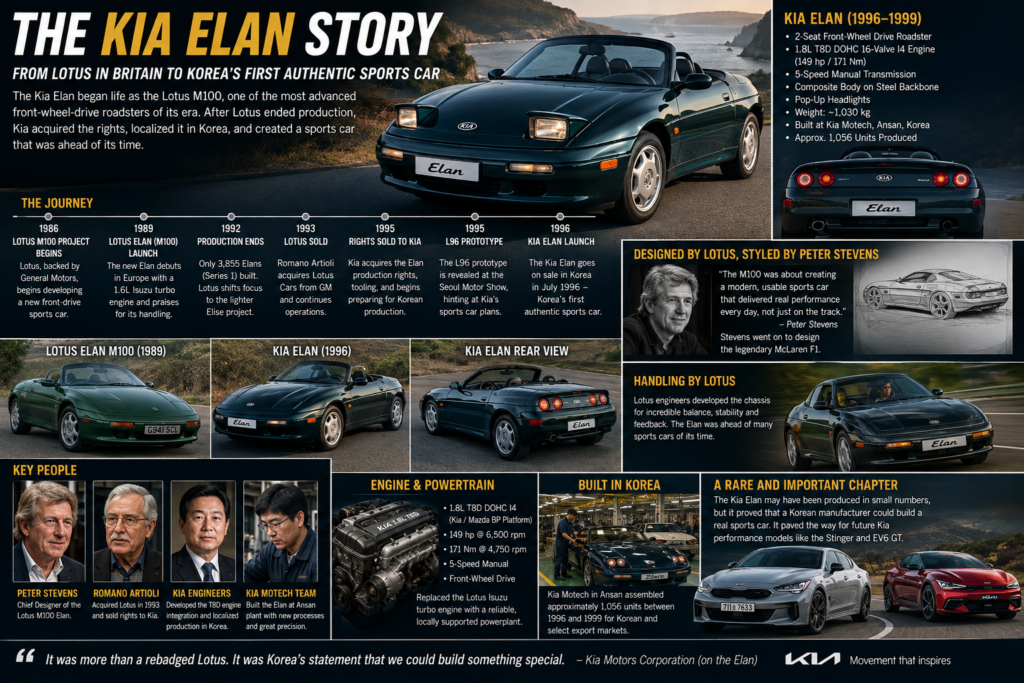
When Kia introduced the Elan in South Korea in July 1996, it was unlike anything else in the company’s range.
This was not a sporty version of a family sedan. It was a low, two-seat convertible with pop-up headlights, a composite body, a sophisticated independent suspension and engineering inherited from Lotus.
Kia officially remembers the Elan as Korea’s first authentic sports car. That description captures its historical importance, but the story is more complicated than simply calling it a Korean-designed roadster. The Elan began life in Britain, was developed by Lotus with General Motors financing, used Japanese powertrain technology and was later acquired, localized and manufactured by Kia in South Korea.
Its creation was therefore not the work of one famous designer or executive. It was a relay race between British designers, Lotus chassis engineers, an Italian entrepreneur and a largely anonymous group of Korean engineers who turned a discontinued European sports car into one of the most unusual vehicles in Kia history.
The Story Begins Long Before Kia
The basic car that became the Kia Elan originated inside Lotus during the 1980s.
Lotus had previously built the celebrated rear-wheel-drive Elan of the 1960s and 1970s. That original car represented founder Colin Chapman’s lightweight philosophy, but the company’s attempt to revive the name would be radically different.
After General Motors acquired Lotus in 1986, the British manufacturer received the financial backing needed to create a new compact roadster. The programme became known internally as M100.
Rather than producing another rear-wheel-drive traditional sports car, Lotus chose front-wheel drive. That decision was controversial, but Lotus engineers believed front-wheel drive could provide exceptional traction, stability and point-to-point speed in real-world conditions. The car used a rigid steel backbone structure covered by composite body panels, maintaining an important connection with Lotus engineering tradition even though its drivetrain layout was unconventional.
The project reportedly represented an investment of approximately £35 million—an enormous amount for Lotus at the time. Dozens of development and crash-test vehicles covered nearly one million test miles in environments ranging from the Arctic to Arizona. Lotus also subjected the car to endurance testing at Snetterton Circuit.
Much of the difficult engineering work that made the later Kia possible had therefore been completed years before Kia became involved.
Peter Stevens and the Shape of the M100
The designer most closely associated with the M100 Elan was Peter Stevens.
Stevens would later become internationally famous for designing the McLaren F1, but during the late 1980s he was responsible for shaping a new generation of Lotus vehicles. His design for the M100 was approved in late 1986, and Lotus engineers transformed it from a clay model into a production vehicle in less than three years.
The finished car avoided the deliberately nostalgic styling that would help make the Mazda MX-5 successful. Instead, the Elan looked futuristic for 1989.
Its low nose, smooth composite surfaces, hidden headlights, steeply raked windshield and short rear deck made it appear almost like a miniature exotic car. The styling also reflected practical aerodynamic and packaging requirements rather than merely trying to reproduce the appearance of the original 1960s Elan.
That design would survive almost intact when Kia began building the car years later.
Peter Stevens did not design a “Kia Elan” as a separate project. He designed the Lotus M100. Nevertheless, because Kia retained the basic body, chassis and proportions, his work became the visual foundation of Korea’s first serious production roadster.
Lotus Engineering Made the Car Special
The M100’s greatest achievement was not necessarily its appearance or acceleration. It was its chassis.
Lotus developed the car to remain stable, predictable and extremely fast over difficult roads. The company’s engineers worked to minimize the torque steer and steering kickback commonly associated with powerful front-wheel-drive cars.
The Elan used fully independent suspension and a remarkably rigid central structure. Contemporary testing often praised its wet-weather traction, steering accuracy and ability to carry speed through imperfect corners.
Some traditionalists complained that it was too secure. They wanted a Lotus sports car to rotate and slide like a rear-wheel-drive machine. Lotus had deliberately created something different: a roadster that allowed ordinary drivers to use a large percentage of its performance without constantly threatening to spin.
That accessible handling character was one of the most valuable things Kia inherited.
Kia did not have to create an advanced sports-car chassis from nothing. It acquired a platform that Lotus had already spent years and substantial amounts of money refining.
Why the Lotus Elan Failed Commercially
The M100 was technically impressive, but commercial timing worked against it.
The Lotus was expensive to develop and manufacture. Its composite construction and specialized components made it difficult to produce cheaply. At the same time, Mazda launched the MX-5, a simpler and less expensive rear-wheel-drive roadster that visually recalled classic British sports cars.
The Lotus was faster and more technologically ambitious, but the Mazda was easier for customers to understand.
Lotus reportedly built 3,855 examples during the original production period from 1989 to 1992. A second run of approximately 800 Series 2 cars followed between 1994 and 1995 after additional engines became available. By then, Lotus was preparing to move toward the lighter and more radical Elise.
The M100’s career appeared to be finished.
Then Kia entered the story.
Romano Artioli and the Sale to Kia
General Motors sold Lotus in 1993 to a company controlled by Italian businessman Romano Artioli, best known for reviving Bugatti during the 1990s. Artioli inherited a company with valuable engineering expertise but limited financial resources.
After the last Lotus Elans were produced in 1995, the M100’s tooling and production rights still had potential value. Kia saw an opportunity.
For Lotus, selling the rights and equipment created revenue from a programme that was no longer central to its future. For Kia, the transaction offered a shortcut into a segment it had never entered.
Rather than spending years and a large amount of money developing a roadster from a blank page, Kia could begin with one of the best-handling front-wheel-drive platforms ever produced.
Kia acquired the rights and tooling and prepared to transfer production to South Korea. The revised vehicle appeared as the L96 prototype at the 1995 Seoul Motor Show, providing Korean buyers with an early look at the company’s planned sports car.
What Kia Was Trying to Accomplish
The Kia of the mid-1990s was very different from the design-led global company known today.
It had achieved success with practical cars such as the Pride and was expanding into new international markets. It had also introduced the Sportage and was seeking to demonstrate that Korean manufacturers could produce more than inexpensive transportation.
The Elan was a halo car before that expression became common within Kia.
It was never likely to become a high-volume product. A two-seat convertible has limited practicality, particularly in a market where most families owned relatively few vehicles. Its purpose was partly symbolic.
The Elan showed that Kia could manufacture something exotic, specialized and emotionally desirable. It also allowed the company’s engineers to gain experience with composite bodies, low-volume assembly, sports-car suspension and a product that demanded a much higher level of dynamic refinement.
Kia’s official corporate timeline places the Elan’s July 1996 launch alongside other major moments in the company’s growth and calls it Korea’s first authentic sports car.
Kia Could Not Simply Change the Badge
The Kia Elan is frequently described as a rebadged Lotus, but that description is incomplete.
Visually, the two cars were extremely similar because Kia retained the Lotus body design and much of its underlying structure. Nevertheless, Kia had to make meaningful changes before it could sell the vehicle as a Korean product.
Historical accounts state that South Korean industrial regulations discouraged or prohibited Kia from merely importing another manufacturer’s design and attaching its own badge. Local production, employment and engineering content had to be incorporated into the project.
That requirement forced Kia to do more than assemble old Lotus parts.
The most important change was under the hood.
From Isuzu Turbo Power to Kia’s T8D Engine
The Lotus M100 had used a 1.6-litre Isuzu engine, with the best-known version employing turbocharging.
Kia replaced it with the company’s own 1.8-litre T8D four-cylinder engine, a Mazda-derived double-overhead-cam design also connected with Kia’s Sephia programme. In the Elan it produced approximately 149 horsepower, or roughly 151 metric horsepower.
The Kia engine was naturally aspirated rather than turbocharged.
That made the Kia slightly less powerful than the turbocharged Lotus Elan SE, but it also reduced Kia’s dependence on an ongoing supply arrangement for the Isuzu powertrain. The T8D could be supported through Kia’s existing engineering and parts network.
The engine change was more complicated than placing a different motor into the same opening.
Kia engineers had to develop suitable mounts, cooling connections, intake and exhaust systems, electronics, transmission integration and calibration. Changes in engine weight and torque delivery also required consideration of the vehicle’s suspension and overall balance.
This work represents the most important Korean contribution to the Elan project.
The Korean Engineers History Rarely Names
Unlike the Stinger, whose development produced extensive English-language material about Peter Schreyer, Gregory Guillaume and Albert Biermann, the individual Korean engineers behind the Elan are poorly documented in internationally accessible sources.
Production was handled by Kia Motech, Kia’s technology operation, at Ansan in South Korea. Its engineers were responsible for adapting the Lotus design to Korean manufacturing, installing the T8D powertrain and ensuring that the completed vehicle could be serviced and sold as a Kia.
Yet most surviving articles do not name the programme managers, powertrain calibrators, manufacturing engineers or test drivers individually.
That absence should not be mistaken for an absence of Korean engineering.
It instead reflects how automotive companies presented development stories during the 1990s. Corporate history often credited the manufacturer rather than turning individual engineers into public personalities. Language barriers and the Elan’s very small production run further limited the preservation of those names internationally.
The Kia Elan was therefore shaped by identifiable British figures, but it was completed by Korean specialists whose individual contributions largely disappeared into the company name.
Kia-Specific Exterior and Interior Changes
The easiest way to distinguish a Kia Elan from a Lotus M100 is from the rear.
The Lotus had used taillights sourced from the Renault Alpine GTA. Kia replaced them with a unique arrangement of circular lamps integrated into a revised rear panel.
Kia also added its own badging, steering-wheel identification and wheel designs. Certain trim pieces and interior details differed depending on market and production date.
The basic silhouette, pop-up headlights, windshield structure and composite body remained recognizably Lotus.
This made the Kia Elan a peculiar mixture. It looked almost exactly like a British exotic but contained a Korean-installed engine and Kia-specific finishing details.
Building the Elan in Ansan
Kia began production in 1996 at the Kia Motech facility in Ansan.
Moving a specialized low-volume sports car from Britain to South Korea would have required far more than shipping a collection of moulds and machinery. Kia had to reproduce a manufacturing process built around a steel structure and composite exterior panels—very different from the stamped-steel construction used for most mass-market cars.
Composite panels can offer corrosion resistance, light weight and styling freedom, but they also require specialized moulding, finishing, alignment and paint preparation.
Kia’s challenge was to preserve the body quality and structural characteristics of the Lotus while working with a vehicle that would never achieve the volume necessary to make its manufacturing process inexpensive.
That problem helps explain why the Elan remained rare and costly.
A Korean Sports Car With an International Identity
The Kia Elan cannot be neatly assigned to one national automotive tradition.
Its styling and chassis came from Lotus in Britain.
Its original platform had benefited from General Motors investment.
The Lotus version used an Isuzu engine from Japan.
The Kia version employed a Korean-built, Mazda-derived engine.
The rights were sold while Lotus was controlled by an Italian entrepreneur.
The finished Kia was assembled in South Korea and sold primarily to Korean customers, with small numbers reaching Japan and parts of Europe.
In Japan, versions are often associated with the Vigato name, while some European markets referred to it more simply as the Kia Roadster.
Rather than weakening the Elan’s Korean significance, this international background makes it an excellent example of how South Korea’s car industry developed.
Korean manufacturers learned rapidly by licensing, adapting and improving foreign technology. Over time, those experiences helped them acquire the capability to create increasingly independent vehicles.
Why the Elan Did Not Sell in Large Numbers
The Elan faced several obvious commercial difficulties.
It was a relatively expensive two-seat convertible carrying a Kia badge at a time when consumers did not yet associate Kia with premium or high-performance automobiles.
Its front-wheel-drive layout disappointed some traditional sports-car enthusiasts, even though Lotus engineers had made it exceptionally capable.
The naturally aspirated Kia engine also lacked the turbocharged excitement of the fastest Lotus version.
Most importantly, the vehicle arrived during a period of growing financial instability for Kia and the wider South Korean economy. The Asian financial crisis contributed to Kia entering bankruptcy proceedings, and Hyundai subsequently took control of the company in 1998.
A specialized roadster was understandably not the highest priority for a manufacturer fighting for survival.
Production estimates vary slightly among historical sources. The most frequently cited total is 1,056 vehicles, built from 1996 through approximately 1999, although some accounts give a shorter production period or simply state that around 1,000 were made.
That uncertainty is part of the car’s obscure history.
Was It Truly a Kia?
Some enthusiasts regard the Elan as nothing more than a Lotus wearing Kia badges.
Mechanically and historically, that judgment is too simple.
Kia did not originate the chassis or exterior design. Those were unquestionably Lotus achievements. Kia also benefited from a vehicle that had already completed an unusually extensive development programme.
But Kia assumed responsibility for the car after Lotus had abandoned it.
Korean engineers installed a different powertrain, revised its components, established a new production line, manufactured the vehicle and supported it in a new market. Without Kia, the M100 story would have ended in Britain in 1995.
The Kia Elan is best understood as a licensed continuation that became a genuine localization project.
It was not a clean-sheet Korean sports car, but neither was it merely a shipment of completed Lotus vehicles with new emblems.
The People Who Made the Elan Possible
The Elan’s development can be divided among several groups.
Peter Stevens and the Lotus Designers
Peter Stevens established the shape, proportions and visual personality that Kia retained. His design gave the car an identity strong enough to survive a change of manufacturer.
The Lotus Chassis and Test Engineers
Lotus engineers created the backbone structure, suspension geometry, steering behaviour and front-wheel-drive handling that made the M100 exceptional. Their extensive testing gave Kia an unusually mature platform to inherit.
Romano Artioli and Lotus Management
Romano Artioli controlled Lotus during the period in which the M100 programme ended and the production rights were transferred. The sale made it possible for Kia to continue the car rather than allowing its tooling to become industrial scrap.
Kia’s Product Planners and Executives
Kia’s leadership approved an irrational but strategically important vehicle. The Elan could not promise large sales, yet it offered technical learning and brand prestige at a time when Kia wanted to demonstrate growing ambition.
Kia Motech Engineers and Production Workers
The Ansan team transformed the British vehicle into a Korean-manufactured product. They integrated the engine, modified components, established production and solved the everyday technical problems that separate a motor-show prototype from a salable car.
The public may remember the famous Lotus name, but these Korean employees are the reason the vehicle can legitimately be called the Kia Elan.
The Elan’s Place in Korean-Car History
The Elan did not directly lead to a continuous line of Kia sports cars.
After production ended, Kia concentrated on rebuilding its mainstream range under Hyundai Motor Group. The company would not launch another similarly emotional halo model until the Stinger appeared more than two decades later.
Nevertheless, the Elan established an important precedent.
It proved that Kia was willing to sell a car primarily because it was exciting.
It gave Korean engineers experience with specialized performance hardware.
It showed domestic customers that a Korean manufacturer could build a low-volume roadster with legitimate European sports-car roots.
It also anticipated a pattern that would later become central to the Korean automotive industry: combine international knowledge with Korean engineering, production discipline and long-term ambition.
From the Elan to the Stinger and EV6 GT
The Elan, Stinger and EV6 GT were created in very different ways.
The Elan was an acquired and localized British platform.
The Stinger was developed within Hyundai Motor Group through cooperation among Korean and European teams.
The EV6 GT used a modern electric architecture largely developed inside the group.
Taken together, they illustrate Kia’s technical progression.
In 1996, Kia entered the sports-car world by purchasing an existing Lotus design.
By 2017, it possessed the resources to engineer its own rear-wheel-drive twin-turbo grand tourer.
By the 2020s, it could create an electric performance car capable of competing internationally on acceleration, chassis technology and design.
The Elan was not the final destination. It was an early, experimental step.
The Legacy of Kia’s Forgotten Lotus
The Kia Elan was commercially unsuccessful, produced in tiny numbers and launched shortly before its manufacturer entered one of the most difficult periods in its history.
Yet those facts make its existence more remarkable.
Kia took a discontinued Lotus, moved its production across continents, installed a Korean powertrain and sold it as the country’s first authentic sports car.
Peter Stevens gave it shape.
Lotus engineers gave it extraordinary handling.
Romano Artioli’s Lotus made the transfer possible.
Kia’s executives took the risk.
Kia Motech’s engineers and factory employees made the Korean version real.
The Elan was not created in the straightforward way that modern cars are presented through carefully organized corporate histories. It emerged from financial pressure, industrial ambition, international licensing and the desire of a growing Korean manufacturer to prove it could build something unnecessary—but memorable.
That is why the Kia Elan deserves to be remembered.
It was more than a rebadged Lotus and less than a fully independent Korean design. It was a bridge between the era when Kia learned through foreign partnerships and the era when the company became capable of producing globally respected performance cars of its own.