0
0
 0
0
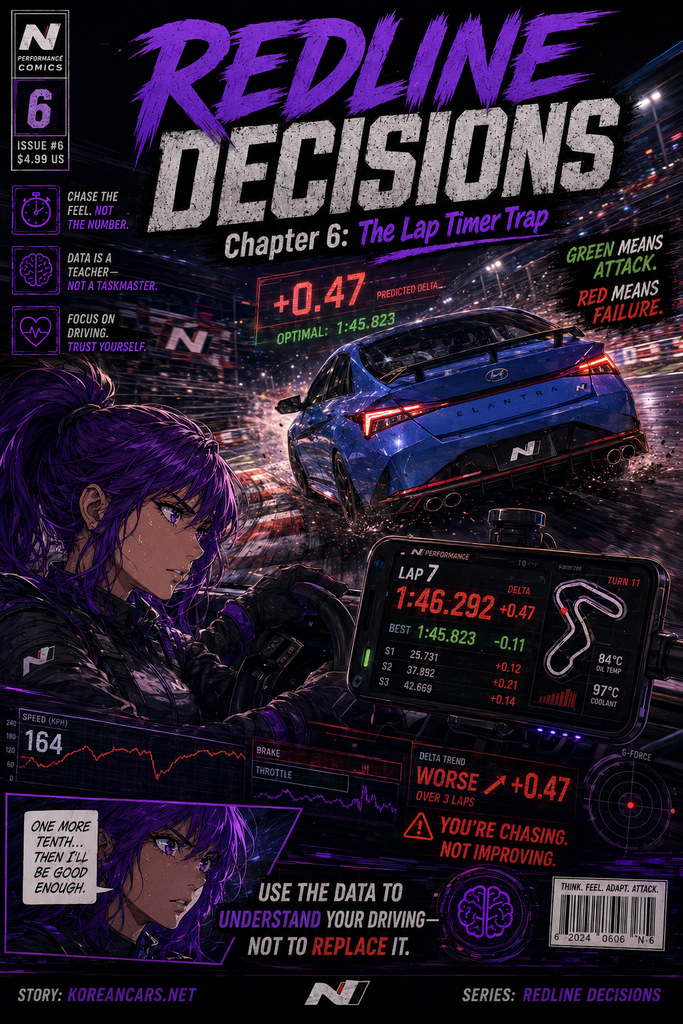
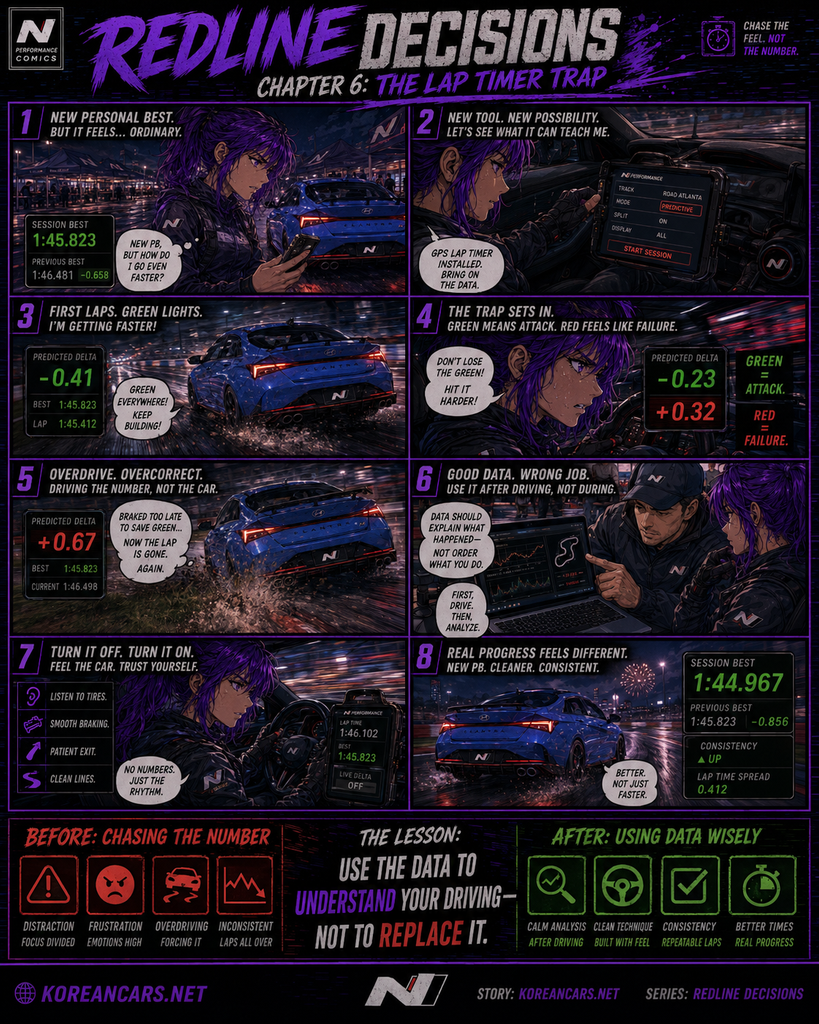
The fastest lap of Erin Vale’s day did not feel fast.
That bothered her.
She sat inside the parked Elantra N with her helmet resting against the passenger seat and the driver’s door open to the paddock air. Heat rose from the hood in thin waves. Brake dust covered the front wheels, and small pieces of rubber clung to the edges of the tires.
Her phone displayed the session results.
Best lap: 1:16.904
A personal record.
Erin studied the number as though it contained a mistake.
The lap had felt controlled.
No dramatic slide.
No desperate late-braking manoeuvre.
No heroic correction.
She had simply followed the line, used the brakes consistently, and accelerated cleanly out of the final corner.
It had felt almost ordinary.
Yet it was the fastest lap she had ever completed.
Mina leaned through the open passenger window.
“You broke into the sixteens.”
Erin nodded.
“By almost a second.”
“That’s a lot.”
“It didn’t feel like a lot.”
Mina smiled.
“That’s usually a good sign.”
Erin looked back at the screen.
The previous chapters of her track life had been full of obvious lessons.
The intake had taught her that sound and performance were not the same thing.
The tires had taught her that power was useless without grip.
The tune had taught her that more speed magnified weak technique.
The alignment had taught her not to copy another driver’s setup.
The brakes had taught her that consistency mattered more than drama.
Now the car finally seemed prepared.
So did she.
Erin should have been satisfied.
Instead, the lap time created a new question.
How much faster could she go?
That evening, she opened her laptop.
Her search began innocently.
How to improve track lap times
Then:
Elantra N data logger
Then:
GPS lap timer with live predictive timing
The products looked more sophisticated than the simple phone application she had been using.
Dedicated GPS receivers.
High-refresh positioning.
Throttle and brake overlays.
Sector analysis.
Video synchronization.
Real-time predictive displays that showed whether a driver was gaining or losing time against their best lap.
Every product promised clarity.
One advertisement showed a driver approaching a corner while a bright green number appeared on the screen:
–0.42
Four-tenths faster.
Another showed a red number:
+0.31
Time lost.
Erin leaned closer.
This was not a vague modification.
It would not rely on sound, appearance or forum opinion.
It would show the truth.
Corner by corner.
Second by second.
She watched a demonstration video in which a driver explained how the predictive timer encouraged him to brake later, carry more speed and find time he could not feel from the cockpit.
Erin added the unit to her cart.
The price was significant, but not outrageous.
She justified it immediately.
This was not a cosmetic upgrade.
It was driver development.
She clicked Buy Now.
No hesitation.
The package arrived three days later.
The device was smaller than she expected.
A compact black screen.
A magnetic GPS receiver.
A windshield mount.
Cables for power and optional connection to the car’s diagnostic port.
Erin spent the evening configuring it.
Her purple hair was tied into a loose ponytail as she sat in the driver’s seat, navigating menus beneath the garage lights.
Track database.
Vehicle profile.
Predictive timing.
Sector display.
Automatic video synchronization.
She selected the most detailed screen layout available.
Current lap.
Best lap.
Delta.
Sector time.
Speed.
She mounted the display high on the windshield where it would remain visible without requiring her to look far from the track.
When she turned the ignition on, the screen came alive.
WAITING FOR GPS
A few seconds later:
READY
Erin smiled.
The Elantra had gained no horsepower.
But she felt as though she had installed something more powerful.
Knowledge.
The next track day began beneath a clear sky.
Erin arrived early and went through the routine she had learned after the brake incident.
Tire pressures recorded.
Wheel torque checked.
Pad thickness inspected.
Fluid level confirmed.
Nothing rushed.
Nothing ignored.
Then she turned on the lap timer.
The display found the circuit automatically.
Mina walked past carrying a pressure gauge.
“What’s that?”
“Dedicated GPS timer.”
“Your phone wasn’t enough?”
“This gives live deltas.”
Mina looked through the windshield.
“So it tells you when you’re faster?”
“And where I’m losing time.”
Mina nodded slowly.
“That sounds useful.”
“It is.”
“That wasn’t enthusiasm.”
“It sounds useful,” Mina repeated. “It also sounds distracting.”
Erin closed the door.
“I’m not going to stare at it.”
Mina raised an eyebrow.
“Of course not.”
The first session was meant to be a warm-up.
Erin allowed the engine, brakes and tires to reach temperature gradually. She used familiar braking points and avoided attacking the curbs.
The timer remained neutral during the out lap.
When she crossed the start line, the display activated.
REFERENCE LAP REQUIRED
She completed a moderate lap.
The screen recorded:
1:19.842
The next lap began.
Through the first sector, the display turned green.
–0.18
Erin’s pulse rose.
She was already faster.
At the first heavy braking zone, she pressed the pedal slightly later.
The car slowed cleanly.
The number improved.
–0.31
She smiled inside the helmet.
This was working.
Through the long right-hander, however, the number began to shrink.
–0.24
Then:
–0.11
She had lost two-tenths.
Erin increased the throttle before the car had fully settled.
The front pushed slightly wider.
She corrected.
The delta turned red.
+0.07
The green advantage was gone.
Frustration arrived immediately.
She accelerated harder onto the straight.
By the finish line, the display showed:
1:19.901
Slower by six hundredths.
The difference was meaningless.
It did not feel meaningless.
Erin started another lap.
By the fifth lap, she was no longer driving the track.
She was driving the number.
Green meant attack.
Red meant failure.
Every corner became an argument with the display.
If she gained time under braking, she tried to brake even later the next lap.
If she lost time through a corner, she entered faster.
If the number turned red on exit, she pressed the accelerator earlier.
Her eyes still looked toward the track, but part of her attention remained fixed on the changing digits.
At the final hairpin, the timer showed:
–0.46
Nearly half a second faster.
Erin’s heart beat harder.
All she had to do was complete the lap.
She approached the braking zone.
The number remained green.
She waited.
A little longer.
Still green.
She braked.
Too late.
The front tires protested.
The car crossed the first apex and ran toward the outside edge of the track. Erin reduced steering angle and used the paved runoff before rejoining safely.
The timer turned red.
+1.84
“Damn it!”
Her voice echoed inside the helmet.
She had not simply lost the lap.
She felt as though the screen had taken something from her.
She completed another circuit, chasing the lost time.
The tires were hotter now.
The brakes were hotter.
Her inputs became less patient.
The next lap was slower.
Then the next.
When the session ended, Erin returned to the paddock angry despite having completed every lap safely.
Mina was waiting beside the parking space.
“How was it?”
“I was half a second up.”
“That’s good.”
“Then I lost it.”
“That happens.”
“I had it until the last corner.”
Mina looked at the timer still glowing on the windshield.
“Did you have the lap, or did the display say you had it?”
Erin removed her helmet.
“What’s the difference?”
Mina did not answer immediately.
“That last lap looked messy from the pit wall.”
“I was pushing.”
“You were chasing.”
Erin reached for her water bottle.
“That’s the point.”
“No,” Mina said. “The point is to drive well. The time comes from that.”
Erin dismissed the warning.
The device was new.
She simply needed to learn how to use it.
During the second session, she changed the display to show larger predictive numbers. She wanted to see the delta without shifting her focus.
The result was worse.
Every gain encouraged her to take more risk.
Every loss created urgency.
She stopped judging corners by balance and exit speed. She judged them by whether the number changed colour.
A green sector felt successful even when the car felt unsettled.
A red sector felt wrong even when her line was clean.
Halfway through the session, Erin caught a slower hatchback.
The driver moved toward the side of the track but did not immediately signal a pass.
Erin waited.
The timer turned red.
+0.63
Time lost.
She moved closer to the car ahead.
The driver still had not given a point-by.
The number worsened.
+0.91
Erin’s frustration rose.
She began looking for an opportunity that did not exist.
At the next corner, the hatchback finally signalled.
Erin accelerated past.
She was now too focused on recovering the lost time.
She entered the following braking zone faster than usual.
The Elantra slowed, but her line was poor. She crossed the apex awkwardly and had to delay the throttle.
The delta became even more negative.
The entire lap unravelled.
When the checkered flag ended the session, Erin felt exhausted.
Not physically.
Mentally.
She had spent twenty minutes reacting to numbers that never stopped moving.
Back in the paddock, she reviewed the data.
The timer had recorded far more information than her old application.
Speed traces.
Sector comparisons.
A map showing time gained and lost.
Erin selected her fastest lap and overlaid it with her previous personal best.
The graphs revealed something unexpected.
Her new fastest lap was not the lap where she had attacked every corner.
It was one of the calmer laps from the first session.
Her braking points were not dramatically later.
Her maximum speed was not dramatically higher.
The improvement came from carrying slightly more speed through several corners and getting on the throttle smoothly.
Small gains.
Repeated.
No single heroic moment.
A man standing nearby glanced at the screen.
He was one of the instructors Erin had seen before, though they had never spoken. His name, printed on his shirt, was Aaron.
“New toy?”
Erin looked up.
“Data logger.”
“Having fun?”
She looked back at the graphs.
“Not really.”
Aaron smiled.
“Then you’re probably using it wrong.”
Erin turned the laptop toward him.
“I thought it would show me how to go faster.”
“It can.”
“It keeps telling me I’m losing time.”
“That’s because you’re asking it a question every second.”
Aaron pulled over a folding chair.
“Show me your best lap.”
Erin selected it.
He studied the speed trace.
“This one looks clean.”
“It didn’t feel fast.”
“Good.”
He pointed at a section of the graph.
“You’re carrying three kilometres per hour more through this corner than your old best.”
“I didn’t notice.”
“You also get back to full throttle earlier here.”
“I didn’t notice that either.”
“Exactly.”
Aaron leaned back.
“The timer is good at showing patterns after the driving is done. It’s less good at telling you how to drive while you’re still trying to learn.”
“But professional drivers use live deltas.”
“Professional drivers also have years of experience managing attention. They know when to ignore the display.”
Erin crossed her arms.
“So I should turn it off?”
“Turn off the predictive timing.”
“Then why did I buy it?”
“To collect information.”
Aaron pointed toward the track.
“Data should explain what happened. It shouldn’t order you around while it’s happening.”
Erin looked through the windshield at the timer.
The display had felt objective.
Honest.
But she had given it authority it had not earned.
A red number did not mean she was driving badly.
It might mean traffic.
Different tire temperature.
A slightly slower exit that created a better position for the next corner.
A deliberate cooldown.
A safer decision.
The timer measured time.
It did not measure judgment.
Erin opened the settings menu and disabled live predictive timing.
The screen now displayed only the current lap count and session time.
No green.
No red.
No emotional verdict.
Mina walked over as Erin finished.
“You broke it already?”
“I simplified it.”
“That sounds suspiciously mature.”
“Don’t get used to it.”
The third session began quietly.
Without the delta display, Erin felt strangely blind.
She crossed the start line and waited for a number that no longer appeared.
Nothing told her whether she was gaining or losing time.
She had to return to older information.
The sound of the tires.
The pressure through the brake pedal.
The movement of the chassis.
The position of the car relative to the apex.
Her own vision.
The first lap felt slow.
She resisted the urge to turn the predictive display back on.
At the long right-hander, she focused on releasing the brakes smoothly and allowing the front tires to settle before adding throttle.
The car held the line.
At the next corner, she looked farther ahead.
Her hands moved less.
The Elantra flowed through the transition.
No number rewarded her.
She continued anyway.
Behind a slower car, she waited for a clear signal.
No red delta punished her patience.
When the pass came, she took it cleanly.
On the next lap, she used the same braking points.
Then the same again.
The session developed a rhythm.
Not spectacular.
Not desperate.
A conversation between the track and the car.
When the checkered flag appeared, Erin completed a cooldown lap and returned to the paddock.
Only after switching off the engine did she look at the timer.
Best lap: 1:16.481
A new personal record.
More importantly, four laps were within three-tenths of one another.
Erin stared at the results.
Mina leaned against the open door.
“Well?”
“I went faster.”
“With the numbers hidden?”
Erin nodded.
“That must be difficult for the numbers.”
That evening, Erin reviewed the data differently.
She did not begin by looking for the single fastest lap.
She selected three consistent laps and compared them.
The patterns became clearer.
On one lap, she braked slightly earlier for the hairpin but exited faster.
On another, she carried more speed through the long right-hander but positioned the car poorly for the following corner.
A third lap had no standout sector, yet it was the fastest because every section was competent.
The data was no longer shouting instructions.
It was answering questions.
Why was one exit better?
Where did the car become unsettled?
Which technique was repeatable?
Erin wrote notes in her track notebook.
Corner 3: Earlier brake release, calmer front end.
Corner 6: Stop chasing entry speed. Prioritize exit.
Final hairpin: Fast lap came from patience, not late braking.
The numbers finally felt useful.
They were evidence.
Not judgment.
At the next event, Erin kept predictive timing disabled for most of the day.
She turned it on only during the final session, after her lines and braking points had become consistent.
Even then, she treated the colours differently.
Green was information.
Red was information.
Neither was praise or failure.
On one lap, the display showed that she had lost two-tenths in the opening sector. The old Erin would have tried to recover the time immediately.
Instead, she continued driving normally.
By the end of the lap, she had regained the difference through cleaner exits.
The timer showed a new personal best.
Erin smiled, but she did not chase another desperate lap.
She completed a cooldown and returned to the paddock.
The car remained healthy.
The brakes remained firm.
The tires remained within their working range.
The data had helped.
But it had not driven.
As the sun lowered behind the circuit, Erin sat on the hood of the Elantra with the timer in her hand.
The device was not the mistake.
Her relationship with it had been.
She had wanted certainty.
A machine that could tell her whether every decision was correct.
But driving was too complex for a single changing number.
Sometimes a slower corner created a faster lap.
Sometimes a lost second protected the car.
Sometimes patience was the quickest option available.
Erin switched off the display.
The screen went black, reflecting a faint outline of her purple hair and the track behind her.
For the first time, the silence felt informative.
Final Line
“Use the data to understand your driving—not to replace it.”
End of Chapter 6