0
 0
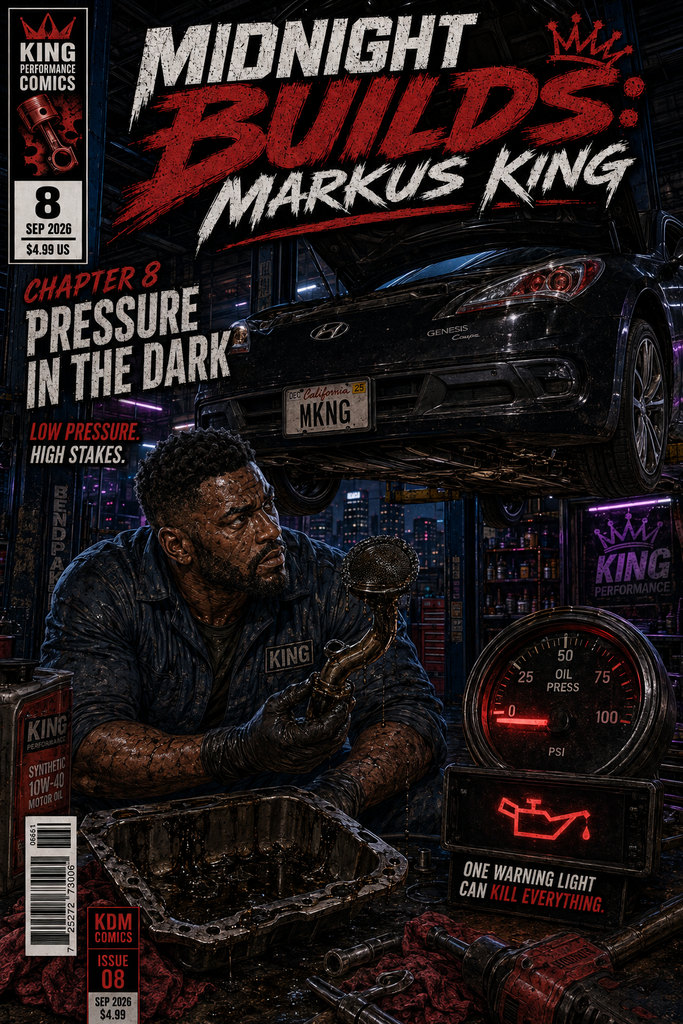
The Genesis sat beneath a dead streetlight with its hood open.
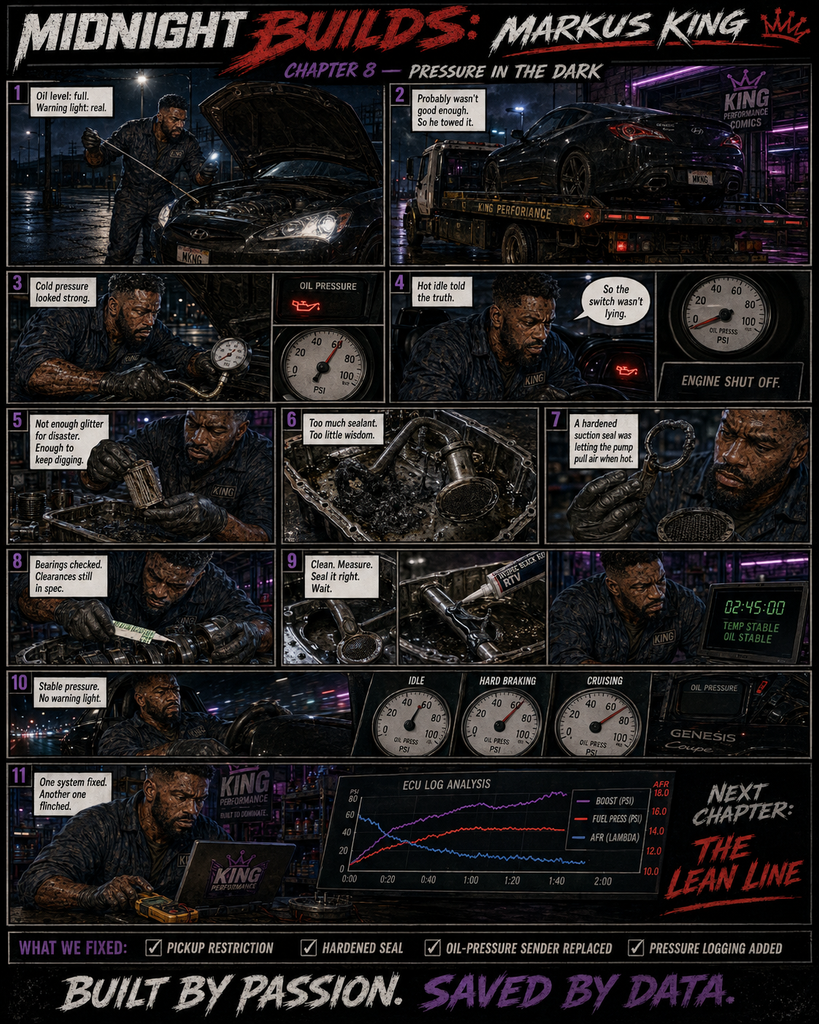
Markus King stood beside it, one hand resting on the roof while the other held the dipstick beneath his phone light.
Oil level: full.
Colour: dark amber.
No foam.
No obvious fuel smell.
No glitter.
Nothing that explained why the oil-pressure warning had flickered twice on the drive.
Markus wiped the dipstick and checked it again.
Full.
Behind him, the city was beginning to wake. Delivery trucks moved along the main road. A subway rumbled somewhere beneath the pavement.
Markus looked through the windshield at the instrument cluster.
The warning light was off now.
That meant nothing.
A pressure warning did not measure how much oil was inside the engine.
It measured whether the engine was receiving enough pressure to keep a microscopic film of oil between parts that could destroy each other in seconds.
Crankshaft journals.
Rod bearings.
Camshafts.
Timing components.
Turbocharger bearings.
The engine could contain the correct amount of oil and still have almost no usable pressure.
Markus closed the hood.
He was less than ten kilometres from the garage.
The Genesis probably could have driven there.
Probably.
Markus pulled out his phone and called the tow truck.
The Genesis returned to King Performance on a flatbed.
Markus rolled it into the same bay where he had just finished the clutch and driveshaft work.
For several seconds he simply stared at it.
Three nights earlier, the car had been fighting itself through a slipping clutch.
Then came the driveshaft vibration.
Now the engine had entered the conversation.
Markus connected his laptop and reviewed the previous drive.
Coolant temperature normal.
Engine speed normal.
No obvious misfire.
No dramatic knock correction.
Nothing in the ECU log explained an oil-pressure warning because the factory switch was essentially binary.
Pressure.
No pressure.
It could not tell Markus whether the engine had forty psi, twenty psi or four.
The first possibility was simple.
A failing oil-pressure switch.
A cheap sensor could create a terrifying warning even when the engine itself was perfectly healthy.
Markus unplugged the electrical connector.
There was oil inside it.
He smiled slightly.
“That would be convenient.”
A leaking pressure switch was suspicious.
But suspicious was not the same as guilty.
Markus removed it.
Instead of immediately installing a replacement, he threaded a mechanical oil-pressure gauge into the port.
A real gauge.
No ECU.
No warning-light logic.
No guessing.
He checked the oil level one more time.
Then started the engine.
The gauge needle jumped instantly.
Pressure was strong during cold idle.
Markus watched silently.
Five minutes.
Ten.
As the oil warmed, the pressure gradually fell.
Nothing unusual about that.
Cold oil resisted movement. Hot oil flowed more easily. Every healthy engine showed lower pressure at operating temperature than immediately after startup.
Markus continued waiting.
The radiator fans cycled.
Coolant temperature stabilized.
The oil became fully hot.
The mechanical gauge dropped farther.
Markus leaned closer.
The needle hovered just above the bottom of the scale.
He raised the engine speed gently.
Pressure climbed.
He released the throttle.
The needle fell again.
Then the warning light on the dashboard flickered.
At exactly the same moment, the mechanical gauge showed dangerously low pressure.
Markus shut the engine off.
The garage became silent.
The pressure switch was not lying.
He drained the oil into a perfectly clean pan.
If the engine had started eating bearings, the evidence might already be suspended in the lubricant.
Markus aimed a bright inspection light across the surface.
Nothing obvious.
He dragged a magnet slowly through the oil.
Clean.
That was encouraging.
Not conclusive.
Bearing material was not always magnetic.
He removed the oil filter.
Instead of throwing it away, Markus clamped it into a filter-cutting tool and opened the metal casing without filling it with saw debris.
The pleated filter element came out onto the bench.
He unfolded it section by section.
Paper.
Oil.
A few harmless dark particles.
Then he saw something silver.
Markus stopped.
He touched it with the end of a pick.
A tiny metallic flake.
Then another.
His expression hardened.
Every engine shed microscopic material over its lifetime. Finding one glitter-sized particle did not automatically mean a bearing was failing.
Finding many would.
Markus spent twenty minutes examining the filter.
There were particles.
But not enough to explain catastrophic bearing failure.
Not yet.
He looked beneath the Genesis.
The next step was obvious.
Oil pan.
The lower crossmember complicated access.
So did the steering components.
So did several bolts positioned as though the engineers responsible had personally disliked mechanics.
By midnight, Markus had the Genesis supported securely and the lower obstacles moved aside.
The oil pan bolts came out one at a time.
Then the pan refused to move.
Someone had previously sealed it with RTV.
Far too much RTV.
Markus worked a thin separator along the flange without gouging the aluminium mating surface.
The sealant finally released.
The pan dropped.
Markus stared upward.
And immediately saw the first problem.
A strand of black silicone hung from the oil pickup screen.
He pulled it free.
Then another.
Then a larger piece.
The pickup screen was not completely blocked.
But perhaps a third of its surface was partially covered with hardened sealant fragments.
Markus looked down at the oil pan.
Thick beads of old RTV surrounded the perimeter.
Whoever had installed the pan previously had treated sealant like insurance.
More must be better.
Except excess RTV squeezed inward when the pan was tightened.
Eventually pieces broke loose.
Those pieces went exactly where the oil pump tried to draw oil.
Markus shook his head.
“Shortcuts always send an invoice.”
He removed the oil pickup assembly.
Then he found the second problem.
The seal where the pickup entered the pump housing was flattened and hard.
Markus twisted it between his fingers.
Healthy rubber should have flexed.
This one behaved almost like plastic.
A pickup tube existed on the suction side of the lubrication system.
That mattered.
A pressure-side leak sprayed oil outward.
A suction-side leak could pull air inward.
When the oil was cold and thick, the pump might still maintain acceptable pressure.
When the oil became hot and thin, the weakened seal could allow aeration and reduce the pump’s ability to maintain pressure—especially at idle.
That matched the symptoms.
Strong cold pressure.
Weak hot idle pressure.
Warning during braking and low engine speed.
Markus placed the hardened seal beside the RTV fragments.
Two small defects.
One frightening dashboard light.
But he was not satisfied yet.
Low oil pressure could also result from worn bearings.
And if the bearings were already damaged, repairing the pickup would only hide the real problem temporarily.
Markus removed the windage tray.
The crankshaft became visible.
He rotated the engine by hand and inspected what he could see.
No obvious scoring.
No blue heat discoloration.
He selected one accessible connecting-rod bearing for inspection.
The cap came off carefully.
Markus looked at the bearing shell.
There was wear.
There was always wear.
But the surface remained uniform. No copper showing through. No deep scratches. No smeared material indicating the bearing had overheated and begun welding itself to the journal.
He cleaned the journal and used Plastigage to check clearance.
Torque.
Remove.
Measure.
Within specification.
Markus repeated the procedure on another bearing.
Also within specification.
His shoulders relaxed slightly.
The engine had probably been caught before sustained low pressure caused serious internal damage.
Probably.
There was that word again.
He inspected the oil pump accessible surfaces and checked the pressure-relief system for obvious sticking or contamination.
Nothing alarming appeared.
The pickup restriction and hardened suction seal remained the strongest explanation.
Markus ordered the correct replacement seal, a fresh pickup gasket where required, a quality oil filter and new oil.
Then he cleaned.
And cleaned.
And cleaned again.
Every trace of loose RTV disappeared from the pan.
The pickup screen was flushed until light passed cleanly through every section.
The mating surfaces were scraped without damaging the aluminium.
Markus applied the new sealant exactly where required.
A controlled bead.
Not a sculpture.
He allowed the sealant proper curing time before filling the engine.
The sun rose.
The sun set.
Markus waited.
Midnight Builds had taught him that impatience could undo twelve hours of careful work in twelve seconds.
The next night, fresh oil entered the Genesis.
Markus left the mechanical pressure gauge installed.
He disabled fuel and ignition and cranked the engine briefly to prime the lubrication system without allowing it to start.
The gauge moved.
Good.
He restored the ECU controls.
The engine started.
Pressure rose immediately.
Markus watched.
Five minutes.
Ten.
Fifteen.
The oil warmed.
Pressure dropped.
But this time it stopped falling.
The engine reached full operating temperature.
The gauge remained comfortably above the previous reading.
Markus switched on the headlights.
Air conditioning.
Electrical loads.
The cooling fans cycled.
Idle speed changed slightly.
Pressure stayed stable.
He blipped the throttle.
The needle responded immediately.
He let the engine idle another fifteen minutes.
No warning light.
Markus shut it down.
Then started it again while hot.
Pressure appeared immediately.
He smiled.
“Better.”
But a repair was not proven on a lift.
The Genesis rolled into the city shortly after 2:00 a.m.
Markus kept the mechanical gauge temporarily routed where he could observe it safely.
First intersection.
Brake.
Idle.
Pressure stable.
Second intersection.
Harder braking.
Still stable.
He drove through twenty minutes of stop-and-go streets deliberately recreating the conditions that had triggered the warning.
Nothing.
Then he entered the industrial district.
The same district had exposed almost every hidden weakness in the car.
Markus accelerated through second gear without boost.
Third.
Fourth.
Oil pressure increased with engine speed exactly as it should.
He coasted.
Pressure fell smoothly.
No sudden drop.
At the next stop, the engine idled quietly.
Markus looked at the gauge.
Stable.
He leaned back in the seat.
Sometimes the difference between an engine surviving and an engine destroying itself was noticing one light flicker for half a second.
He drove on.
Several days later, Markus removed the mechanical gauge and installed a new quality pressure sender.
But he made another change.
A proper oil-pressure sensor.
Not merely an on/off warning switch.
He connected it to the logging system so pressure could be recorded alongside RPM, coolant temperature, throttle position and boost.
The Genesis had taught him something.
Warnings were useful.
Data was better.
He programmed an engine-protection strategy.
If pressure became abnormally low relative to engine speed, Markus wanted the ECU to know before his ears heard bearings knocking.
A warning.
Then intervention.
Because the fastest car in the city meant nothing if it could not protect itself.
Markus leaned against the fender and looked at the laptop.
Oil pressure.
Normal.
Coolant.
Normal.
Fuel pressure.
Normal.
Air-fuel ratio.
Normal.
He paused.
Fuel pressure.
Markus opened an older log from one of the full-boost runs after the clutch replacement.
He zoomed into the upper RPM range.
Fuel pressure climbed with boost.
Then, near the end of third gear, it flattened.
Markus leaned closer.
Boost continued rising.
Injector duty increased.
But fuel pressure stopped following.
At almost exactly the same moment, the air-fuel ratio began moving leaner.
Only briefly.
He had lifted the throttle before it became dangerous.
Markus opened another log.
Same pattern.
Another.
Again.
It had been hidden among the other problems because the car had never remained under full load long enough for the pattern to become obvious.
The clutch used to slip.
The driveshaft used to vibrate.
The engine had triggered the oil-pressure warning.
Now all three problems were gone.
Which meant Markus could finally keep his foot down long enough to discover the next limitation.
He stared at the fuel-pressure trace.
The pump was either running out of capacity…
…or voltage.
Markus closed the log.
The garage lights reflected across the Genesis’s black bodywork.
Another system had told the truth.
He reached for the multimeter.
To be continued…
Next Chapter: The Lean Line
The engine survived low oil pressure. Now Markus has to find out why the fuel system stops keeping up when the boost comes in.