0
0
 0
0
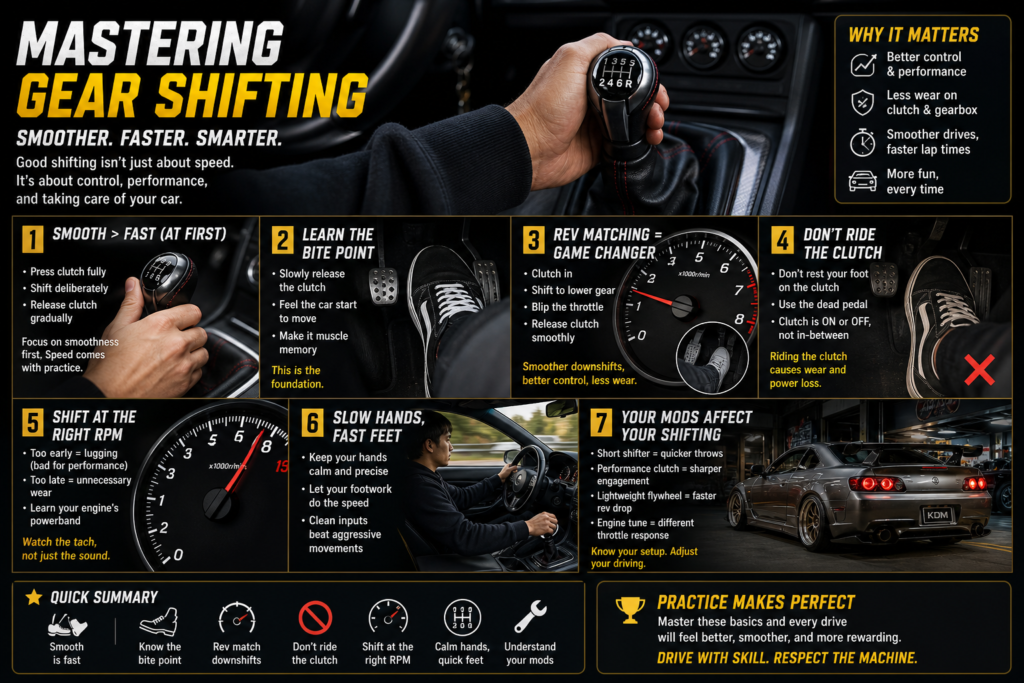
If you’re driving a manual—whether it’s a daily or something tuned like a KDM build—your shifting technique matters more than most people realize.
It’s not just about getting into the next gear.
It’s about control, longevity, and performance.
Bad shifting = worn synchros, clutch damage, sluggish acceleration.
Good shifting = smoother power delivery, better feel, faster driving.
Let’s break it down properly.
🎯 1. Smooth > Fast (At First)


A lot of beginners try to shift fast right away.
That’s a mistake.
Focus on smoothness first:
- Press clutch fully
- Shift deliberately (not rushed)
- Release clutch gradually
Once smoothness becomes natural, speed comes automatically.
👉 Fast but rough shifting actually slows you down and stresses the drivetrain.
⚙️ 2. Learn the “Bite Point” Like It’s Muscle Memory


The bite point is where the clutch starts to engage and transfer power.
If you don’t know this point, your driving will always feel:
- Jerky
- Inconsistent
- Unrefined
Practice this:
- Slowly release clutch in 1st gear without gas
- Feel exactly when the car starts moving
- Repeat until it’s instinct
👉 This is foundational. Even advanced drivers rely on this feel constantly.
🔄 3. Rev Matching = The Game Changer


If you want to level up instantly—learn rev matching.
When downshifting:
- Engine speed needs to match wheel speed
- Otherwise → jerk, drivetrain shock
How to do it:
- Clutch in
- Shift to lower gear
- Quickly tap the gas (“blip”)
- Release clutch smoothly
Result:
- Smoother downshifts
- Less clutch wear
- Better control (especially in corners)
👉 On a tuned car, this becomes essential, not optional.
🚫 4. Don’t Ride the Clutch


One of the most common bad habits.
Riding the clutch = partially pressing it when you shouldn’t.
This causes:
- Premature clutch wear
- Heat buildup
- Power loss
Fix it:
- Foot fully off clutch when not shifting
- Use the dead pedal (left foot rest)
👉 Think of the clutch like an on/off tool—not something you hover on.
⬆️ 5. Shift at the Right RPM (Not Just by Sound)


Every engine has an optimal shift range.
General idea:
- Daily driving: ~2,000–3,000 RPM
- Spirited driving: ~3,500–5,500 RPM
- Performance pulls: near redline (depends on setup)
If you shift:
- Too early → lugging engine (bad for performance)
- Too late → unnecessary wear
👉 With tuned setups, your powerband changes—so learn your car specifically.
🧠 6. Slow Hands, Fast Feet


This is a subtle but powerful concept.
- Your hand should be calm and precise
- Your footwork (clutch + throttle) does the real speed work
If your hand is frantic:
- You’ll miss gears
- You’ll feel sloppy
👉 Clean inputs always beat aggressive chaos.
🔧 7. Your Mods Affect Your Shifting
If you’re building a KDM car, your setup directly changes how shifting feels:
- Short shifter → quicker throws, more precise
- Performance clutch → sharper engagement (harder for beginners)
- Lightweight flywheel → revs drop faster (requires better timing)
- Engine tune (like Haltech ECU) → changes throttle response
👉 The more modified your car becomes, the more your driving skill needs to level up with it.
🔥 Final Thought
Great shifting isn’t about looking cool—it’s about mechanical sympathy and control.
Anyone can slam gears.
Very few can make it feel effortless.
If you can:
- Shift smoothly
- Rev match cleanly
- Control the clutch instinctively
Then your car—no matter the power—will feel 10x better to drive.