If you rewind 20 years, the idea of Korean cars being part of a global tuning culture would’ve sounded… unrealistic.
Back then, KDM wasn’t a “scene.”
It was barely even a conversation.
Fast forward to today?
Korean cars are:
- Winning performance comparisons
- Showing up at meets
- Getting built with intention
👉 The rise of KDM isn’t random—it’s been a slow, layered evolution.
Let’s break it down era by era.
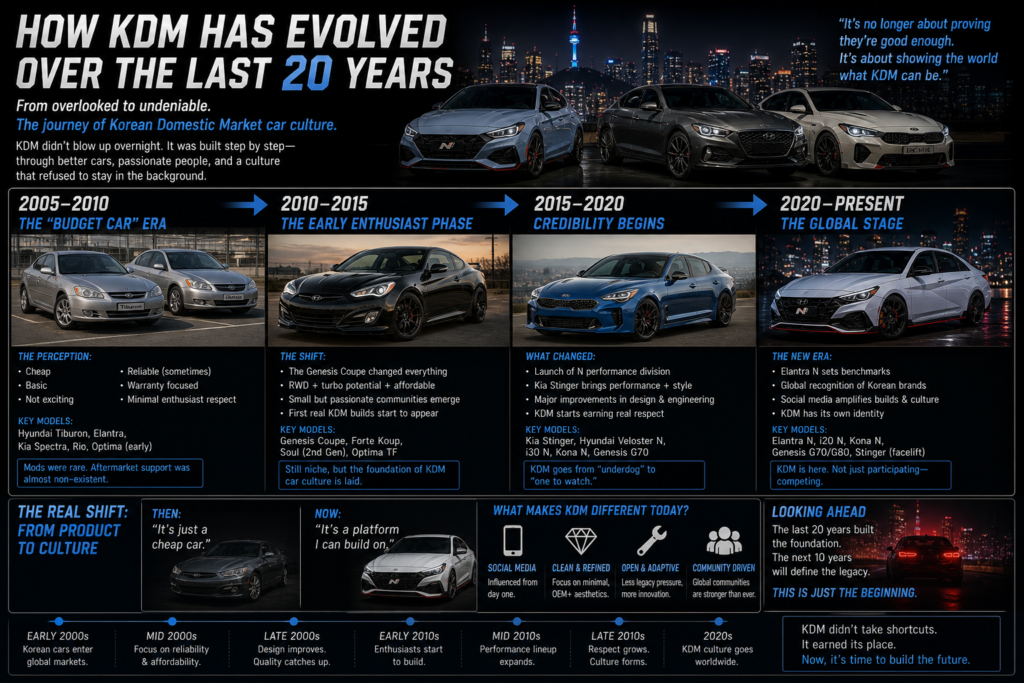
🕰️ 2005–2010: The “Budget Car” Era


This was the perception:
- Cheap
- Reliable (sometimes)
- Not exciting
Brands like Hyundai Motor Company and Kia Corporation were focused on:
- Affordability
- Warranty
- Market entry
Car culture reality:
- Little aftermarket support
- Minimal enthusiast respect
- Mods were rare—and often not taken seriously
👉 If you were modding a Korean car back then, you were way ahead of the curve.
🔧 2010–2015: The Early Enthusiast Phase


This is where things started shifting.
The big moment:
👉 Introduction of cars like the Genesis Coupe
Now suddenly:
- Rear-wheel drive platform
- Turbo potential
- Affordable performance
What changed:
- Small enthusiast communities formed
- First real KDM builds appeared
- Forums and early social groups started growing
👉 Still niche—but now visible.
🚀 2015–2020: Credibility Begins


This era gave KDM something it didn’t have before:
👉 Respect
Key developments:
- Launch of performance-focused models (N division)
- Release of cars like the Stinger
- Major improvements in design and engineering
Now people started saying:
- “Wait… these are actually good.”
Car culture impact:
- More builds
- Better quality mods
- Cleaner aesthetics
👉 KDM wasn’t a joke anymore—it was emerging.
🌐 2020–Present: The Global Stage


This is where things accelerate.
Now we have:
- Fully developed performance lines
- Global recognition of Korean brands
- Social media amplifying builds worldwide
Cars like:
- Elantra N
- G70 / G80
- Updated Genesis Coupe builds
👉 These aren’t just “good for Korean cars.”
They’re competitive. Period.
🧠 The Real Shift: From Product → Culture
The biggest change isn’t just the cars.
It’s the mindset.
Then:
- “It’s just a cheap car”
Now:
- “It’s a platform I can build on”
That shift is everything.
KDM today is:
- Intentional
- Design-focused
- Community-driven
🔥 What Makes KDM Different Today
Unlike JDM or Euro, KDM is evolving in a modern era.
That means:
- Influenced by social media from day one
- Less tied to legacy—more open to experimentation
- Built around clean, refined aesthetics
👉 It’s not trying to copy other scenes—it’s quietly forming its own identity.
🔮 Final Thought
KDM didn’t explode overnight.
It:
- Started as overlooked
- Grew through enthusiasts
- Earned credibility
- Is now building culture
And the most interesting part?
👉 It’s still early.
The last 20 years built the foundation.
The next 10 might define the legacy.