0
0
 0
0
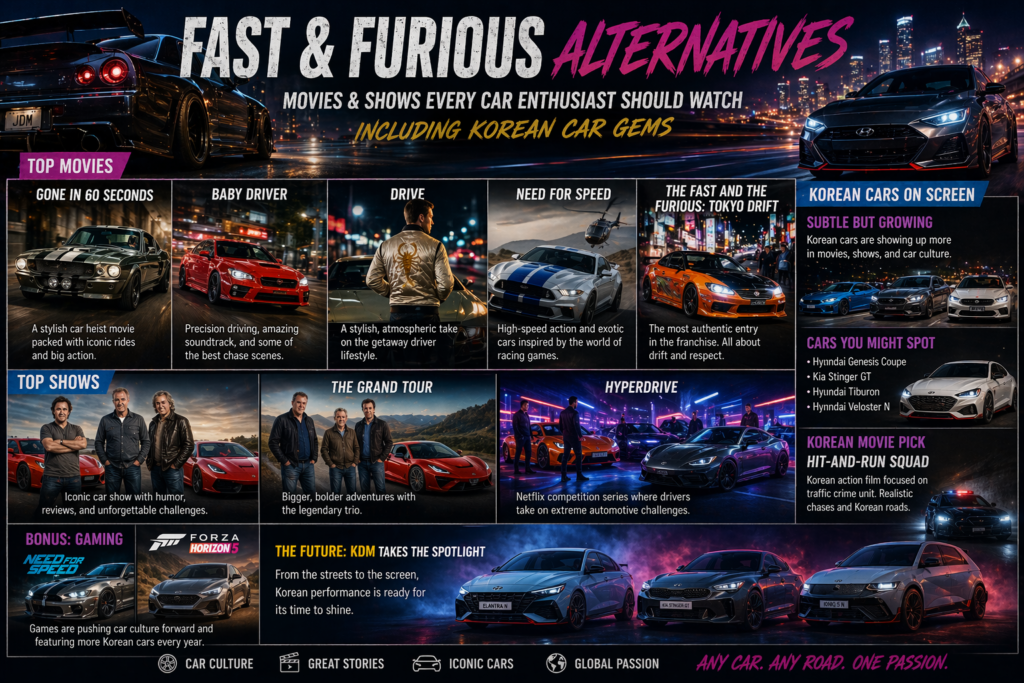
The Fast & Furious franchise defined a generation of car enthusiasts—street racing, over-the-top action, and a culture built around modified machines. But if you’ve already watched them all (multiple times), there’s a whole world of automotive films and shows worth diving into.
And for those building or following the KDM movement, there are even a few hidden gems where Korean cars make appearances—subtle, but meaningful.
🎬 Classic Alternatives That Capture the Spirit
Gone in 60 Seconds


A mix of car culture and heist film, this movie focuses more on the art of stealing cars than racing—but the automotive love is real.
Why watch:
- Iconic cars (especially Eleanor)
- Strong car-focused narrative
- Less fantasy, more grounded action
Baby Driver


A modern classic that blends music and driving in a way no other film has.
Why it stands out:
- Precision driving scenes
- Realistic chase choreography
- Focus on driving skill over explosions
Drive


A slower, more artistic take on the getaway driver concept.
Vibe:
- Minimal dialogue
- Heavy atmosphere
- Stylish, neon-lit driving sequences
🏁 Street Racing & Tuner Culture
Need for Speed


Closer to Fast & Furious in tone, but with more emphasis on real driving stunts.
The Fast and the Furious: Tokyo Drift (Revisit Worthy)


Even within the franchise, this one stands apart.
Why it matters:
- Deep dive into drift culture
- Stronger connection to car identity
- More grounded than later entries
📺 Car Shows Worth Watching
Top Gear / The Grand Tour


Not street racing—but essential viewing.
Why:
- Entertaining + informative
- Global car culture exposure
- Occasional Korean car features
Hyperdrive


A Netflix series focused on drivers competing in extreme automotive challenges.
Key appeal:
- Real drivers, real builds
- International competitors
- Raw car culture energy
🇰🇷 Where Korean Cars Appear (Subtle but Growing)
Korean cars haven’t traditionally been the stars of car films—but that’s changing.
1. Background and Supporting Roles


Cars like:
- Hyundai Genesis Coupe
- Kia Stinger GT
- Hyundai Tiburon
…have started appearing in:
- Background scenes
- Car meets
- Secondary character vehicles
They’re not always the hero cars—but they’re increasingly present.
2. Korean Films and Dramas
Korean media is starting to reflect its own car culture.
Hit-and-Run Squad


A Korean action film centered around traffic crime units.
Why it’s interesting:
- Realistic Korean road settings
- Focus on enforcement and driving
- Glimpse into Korea’s automotive environment
🎮 Bonus: Gaming as the New “Fast & Furious”


Games are now doing what movies used to:
- Need for Speed
- Forza Horizon
These platforms:
- Feature Korean cars more frequently
- Allow full customization
- Let KDM culture grow digitally
🚀 Why Korean Cars Haven’t Dominated (Yet)
Let’s be honest:
Reasons:
- Historically weaker performance image
- Less global tuner culture visibility
- Film industry bias toward JDM and American muscle
But that’s changing fast.
With cars like the Hyundai Elantra N and Kia EV6 GT, the foundation is being built.
🔮 The Future: KDM on Screen
As KDM culture grows, it’s only a matter of time before:
- Korean cars take lead roles in films
- KDM-focused stories emerge
- Global audiences recognize Korean performance
👉 The opportunity is wide open.
Conclusion
If Fast & Furious introduced you to car culture, these films and shows can expand your perspective—from grounded driving films to global car communities.
And while Korean cars may not yet dominate the screen, they’re quietly entering the scene—just like they did in the real world.
For KDM enthusiasts, this is the early stage.
👉 The stage where the culture hasn’t peaked yet.
Which means…
You’re watching it grow in real time.