0
0
 0
0
With electric cars, over-the-air updates, and AI-assisted driving, it’s easy to assume:
👉 “Mechanical skills won’t matter anymore.”
That’s the wrong conclusion.
What’s actually happening is a shift—not a disappearance.
Some skills will fade.
Others will become more valuable than ever.
And a few will turn into high-income, hard-to-replace specialties.
Let’s break it down.
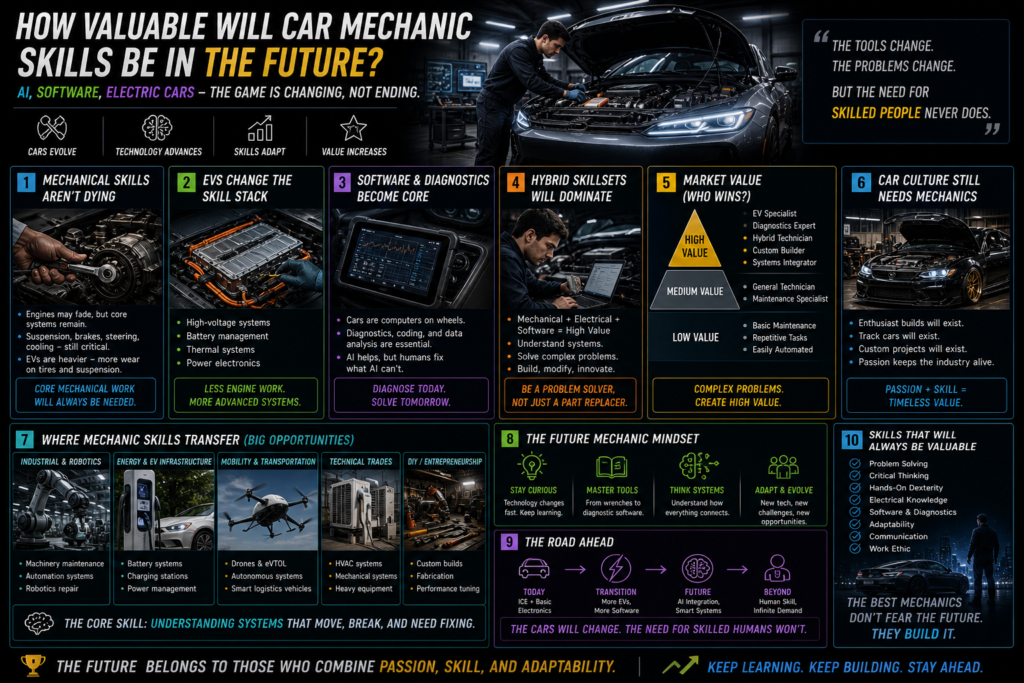
🔧 1. Mechanical Skills Aren’t Dying—They’re Narrowing


Internal combustion engines (ICE) will decline over time.
That means:
- Fewer oil changes
- Fewer engine rebuilds
- Less routine maintenance
But:
👉 Cars still have suspension, brakes, steering, cooling systems, chassis components
These don’t go away.
In fact, EVs are:
- Heavier
- Harder on tires and suspension
👉 So core mechanical work doesn’t disappear—it concentrates.
⚡ 2. EVs Change the Skill Stack (Not Eliminate It)


Electric vehicles remove:
- Engines
- Transmissions (in many cases)
But introduce:
- High-voltage systems
- Battery management
- Thermal control systems
👉 New rule:
Low-level wrenching ↓
High-level system understanding ↑
The barrier to entry rises.
Which means:
👉 Skilled technicians become more valuable, not less.
🤖 3. Software + Diagnostics Become Core Skills


Modern cars are basically:
👉 Computers on wheels
So the future mechanic needs to understand:
- Diagnostics tools
- Firmware / software behavior
- Sensor systems
This is where AI actually increases demand:
- More systems = more complexity
- More complexity = more need for troubleshooting
👉 The best future “mechanics” are part technician, part engineer.
🧠 4. Hybrid Skillsets Will Dominate


The highest value skillset will be:
👉 Mechanical + Electrical + Software
Examples:
- Installing EV upgrades safely
- Diagnosing sensor failures
- Integrating aftermarket tech systems
Pure “bolt-on mechanics” will struggle.
But hybrid builders?
👉 They become rare and highly paid.
🔄 5. Where These Skills Transfer (This Is the Big Opportunity)
Here’s where it gets interesting.
Car mechanic skills aren’t just about cars.
They transfer into:
⚙️ Industrial & Robotics
- Machinery maintenance
- Automation systems
- Robotics repair
🔋 Energy & EV Infrastructure
- Battery systems
- Charging stations
- Grid-connected hardware
🚁 Mobility & Transportation Tech
- Drones
- Autonomous systems
- Smart logistics vehicles
🛠️ Hands-On Technical Trades
- HVAC systems
- Mechanical systems in buildings
- Heavy equipment
👉 The core skill is:
Understanding systems that move, break, and need fixing.
That never goes out of demand.
💰 6. Marketability: Who Wins in the Future?
Let’s be real.
The market won’t reward everyone equally.
Low-value path:
- Basic oil change level skills
- Repetitive, easily automated tasks
High-value path:
- Diagnostics expert
- EV specialist
- Hybrid mechanical/software technician
- Custom builder / fabricator
👉 The more complex problems you can solve, the more valuable you become.
🔥 7. Car Culture Still Needs Mechanics
Even in an AI + EV world:
- Enthusiast builds still exist
- Track cars still exist
- Custom projects still exist
👉 And those require hands-on skill
In fact:
As cars become more “sealed” and software-controlled…
👉 People who can still physically work on cars become more rare—and more respected.
🔮 Final Thought
AI, EVs, and software won’t kill mechanic skills.
They will:
👉 Filter them
- Basic skills → less valuable
- Advanced, hybrid skills → more valuable
The future mechanic isn’t just:
- A wrench-turner
They’re:
- A systems thinker
- A problem solver
- A bridge between hardware and software
And that kind of skill?
👉 Doesn’t just survive.
It becomes essential.