0
 0
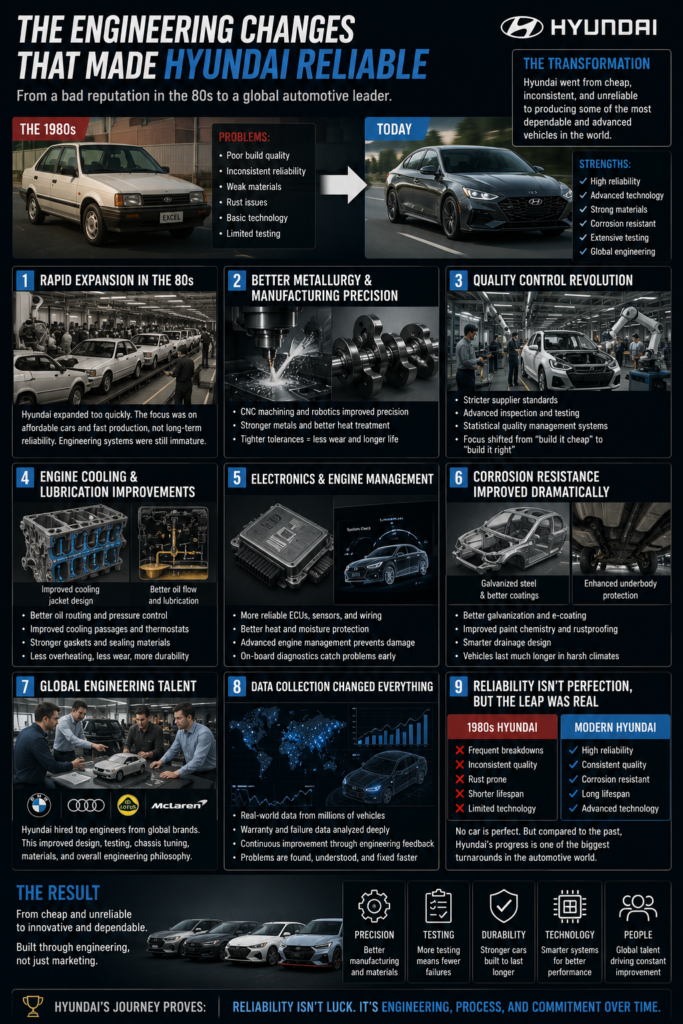
Today, many people see modern Hyundai Motor Company vehicles as:
- Reliable
- Technologically advanced
- Competitive with Japanese brands
But older enthusiasts remember a very different era.
Back in the 1980s and early 1990s, Hyundai had a rough reputation in many markets:
- Cheap materials
- Poor long-term durability
- Inconsistent build quality
- Weak corrosion resistance
So what changed?
The answer wasn’t one magical breakthrough.
👉 Hyundai underwent a massive engineering transformation over decades.
And technically speaking, the changes were extremely significant.
🚗 1. Early Hyundai’s Biggest Problem: Rapid Expansion


In the 1980s, Hyundai expanded aggressively into global markets.
Especially with:
- The Hyundai Excel
The issue was:
👉 Hyundai scaled faster than its engineering maturity.
They focused heavily on:
- Affordability
- Mass production
- Fast market entry
But reliability engineering systems were still developing.
This created:
- Weak quality control
- Inconsistent tolerances
- Supplier inconsistency
⚙️ 2. Better Metallurgy and Manufacturing Precision


One of the biggest technical improvements was:
👉 Manufacturing precision
Early Hyundai engines and transmissions often suffered from:
- Loose tolerances
- Inconsistent machining quality
- Faster wear patterns
Over time Hyundai invested heavily into:
- CNC machining
- Robotic manufacturing
- Improved metallurgy
- Better heat treatment processes
Result:
👉 Components lasted dramatically longer.
🧪 3. Massive Improvements in Quality Control Systems


This was one of the biggest hidden shifts.
Hyundai implemented:
- Stricter supplier standards
- Better assembly verification
- Expanded durability testing
- Statistical quality management systems
Instead of:
👉 “Build it cheaply”
The philosophy shifted toward:
👉 “Reduce long-term failure rates.”
This sounds simple—
But it changed everything.
🌡️ 4. Engine Cooling & Lubrication Improvements


Older engines often struggled with:
- Heat management
- Oil flow consistency
- Long-term wear under stress
Modern Hyundai engines improved through:
- Better oil routing
- Improved cooling jackets
- More advanced ECU thermal management
- Better gasket materials
These changes:
👉 Reduced overheating and internal wear dramatically.
🔌 5. Electronics Became Far More Sophisticated


Early Hyundai electronics could be:
- Basic
- Inconsistent
- Vulnerable to long-term failure
Modern systems improved through:
- Better ECU logic
- More reliable sensors
- Improved connectors and wiring
- Better shielding from heat and moisture
Modern engine management systems now:
👉 Prevent many problems before damage occurs.
🧱 6. Corrosion Resistance Improved Dramatically


One of Hyundai’s biggest historical weaknesses:
👉 Rust
Especially in harsh climates.
Modern improvements included:
- Better galvanization
- Improved undercoating
- Better paint chemistry
- Improved drainage engineering
Result:
👉 Modern Hyundai bodies survive much longer.
🧠 7. Hyundai Began Hiring Global Engineering Talent


This is where Hyundai evolved from:
- Regional manufacturer
To: - Global engineering competitor
They hired engineers from:
- BMW
- Audi
- Other global automakers
This improved:
- Chassis tuning
- Reliability testing
- Material selection
- Manufacturing philosophy
📊 8. Data Collection Changed Everything


Modern automakers collect huge amounts of:
- Warranty data
- Failure reports
- Thermal data
- Real-world stress testing information
Hyundai became far more aggressive at:
👉 Learning from failure patterns.
This accelerated reliability improvements significantly.
⚖️ 9. Reliability Isn’t Perfection — But the Reputation Shift Was Real
Let’s be balanced:
❌ Hyundai still has had problem engines and recalls over the years.
No manufacturer is perfect.
But compared to the 1980s:
👉 The engineering leap was enormous.
Modern Hyundai reliability is the result of:
- Manufacturing evolution
- Better testing
- Better materials
- Better systems engineering
Not luck.
🔮 Final Thought
The old Hyundai reputation came from a company trying to scale faster than its engineering systems had matured.
But instead of staying there:
👉 Hyundai invested aggressively into engineering refinement.
And over decades, that transformed the brand from:
- “Cheap transportation”
Into:
- A globally respected engineering company capable of:
- Luxury vehicles
- Performance cars
- Advanced EV platforms
The biggest lesson?
👉 Reliability isn’t built through marketing.
It’s built through:
- Precision
- Process
- Testing
- Iteration over time
And Hyundai’s evolution is one of the clearest examples of that in the automotive industry.