0
0
 0
0
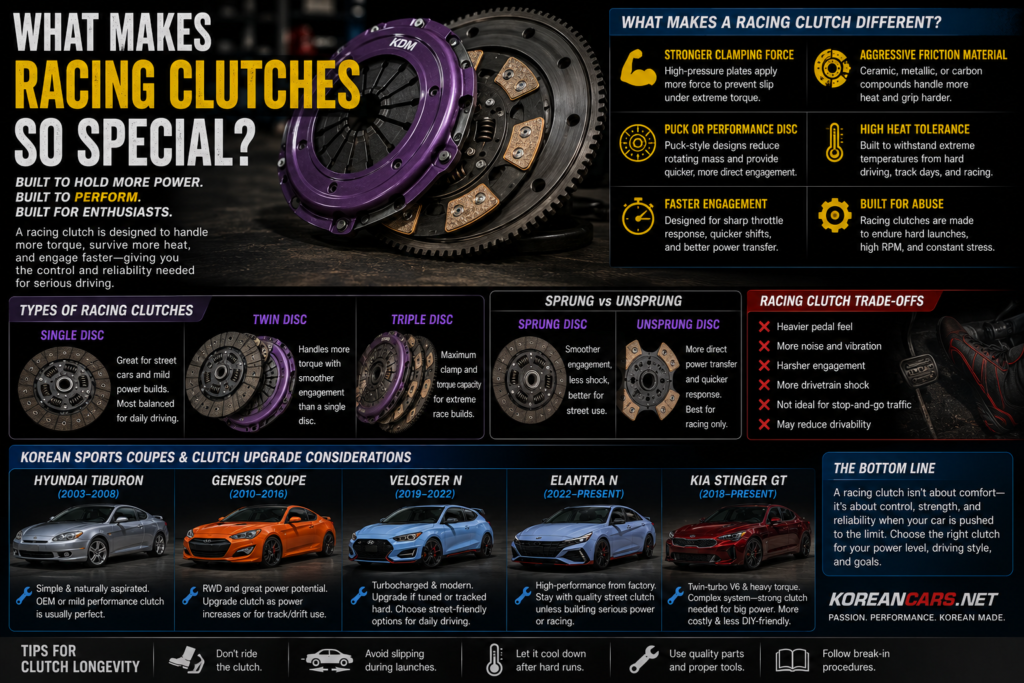
When people talk about building a faster manual car, they usually focus on horsepower first.
Turbo.
Tune.
Exhaust.
Injectors.
Intercooler.
Bigger brakes.
Better tires.
But one of the most important parts of a performance build sits between the engine and transmission: the clutch.
A stock clutch is designed for smoothness, comfort, easy driving, and long life under factory power levels. A racing clutch is built for something very different. It is designed to hold more torque, survive harder launches, handle more heat, and transfer power more aggressively.
That is what makes racing clutches special.
But “special” does not always mean “better for everyone.” A racing clutch can make a car stronger and more responsive, but it can also make it harder to drive in traffic, noisier, harsher, and less forgiving.
For Korean car enthusiasts driving cars like the Hyundai Tiburon, Genesis Coupe, Veloster N, Elantra N, and other manual KDM platforms, understanding the difference matters before choosing an upgrade.
What Does a Clutch Actually Do?
In a manual car, the clutch connects and disconnects the engine from the transmission.
When your foot is off the clutch pedal, the clutch is engaged and engine power flows into the gearbox. When you press the clutch pedal, the clutch disengages so you can shift gears or stop without stalling.
A clutch has several major parts:
- Clutch disc
- Pressure plate
- Flywheel
- Release bearing
- Pilot bearing or bushing, depending on design
- Clutch fork or hydraulic release system
The clutch disc is squeezed between the flywheel and pressure plate. The stronger that clamping force and friction material, the more torque the clutch can hold before slipping.
That is the basic idea behind performance and racing clutches.
Why Stock Clutches Are Not Enough for Some Builds
A factory clutch is designed around the car’s original power output.
That is fine for a stock daily driver, but once you start adding more torque, the clutch may become the weak point.
This is especially true for:
- Turbo builds
- Supercharged builds
- Aggressive ECU tunes
- Bigger turbo upgrades
- Track cars
- Drag cars
- Drift cars
- Cars launched frequently
- Cars running sticky tires
When the clutch can no longer hold the engine’s torque, it starts to slip. The engine revs climb, but the car does not accelerate properly. That slip creates heat, wears the disc, and can eventually destroy the clutch.
A racing clutch solves this by increasing torque-holding capacity.
What Makes a Racing Clutch Different?
1. Stronger Pressure Plate
The pressure plate is one of the biggest differences.
A racing clutch usually uses a stronger pressure plate with greater clamping force. More clamp force means the clutch disc is held more tightly against the flywheel.
This helps prevent slipping under high torque.
The trade-off is that pedal effort may increase. ACT notes that clutch design involves balancing pedal effort, longevity, torque capacity, and engagement quality. In other words, making a clutch stronger often affects how it feels to drive. (Advanced Clutch Technology)
For a race car, a heavier pedal may not matter. For a daily driver in traffic, it can become annoying.
2. More Aggressive Friction Material
Stock clutches usually use organic friction material because it is smooth, quiet, and easy to drive.
Racing clutches may use more aggressive materials such as:
- Ceramic
- Cerametallic
- Metallic compounds
- Carbon-based materials
- Sintered materials
These materials can handle more heat and torque than ordinary organic clutch material.
EXEDY describes its racing clutch range as designed for high-powered racing vehicles, with low-gravity cerametallic materials used to reduce inertia and improve shift response. (Exedy)
The advantage is stronger grip.
The disadvantage is harsher engagement.
That is why some racing clutches feel grabby. Instead of smoothly easing the car forward, they bite quickly. This can be great on track, but less pleasant in parking lots.
3. Puck-Style Disc Design
Many performance clutches use a full-face disc, similar in shape to a stock clutch. Racing clutches often use puck-style discs.
A puck clutch may have:
- 3 pucks
- 4 pucks
- 6 pucks
- 8 pucks
Instead of friction material covering the whole disc, the clutch has separate friction pads.
This reduces rotating mass and can create very strong engagement. But it can also make the clutch more abrupt.
Clutch Masters describes its FX400 ceramic paddle design as having quick, rapid engagement and notes that clutch chatter may not be ideal for street-driven vehicles. (Clutch Masters)
That is the key point: a racing clutch may work extremely well, but it may not behave like a normal street clutch.
4. Higher Heat Resistance
Racing creates heat.
Hard launches, repeated shifts, slipping during aggressive driving, and high torque loads can all heat up the clutch quickly.
A racing clutch is designed to survive more heat than a standard clutch.
This matters in:
- Drag racing
- Track days
- Drifting
- Hill climbs
- Time attack
- Road racing
- High-horsepower street builds
Heat resistance is one of the main reasons racing clutches use more aggressive friction materials. A normal clutch may glaze, slip, or fail when abused repeatedly.
5. Faster Engagement
A racing clutch is often designed to engage quickly and directly.
This gives the driver a sharper connection between engine and drivetrain.
Benefits include:
- Faster shifts
- Less slip
- More direct power transfer
- Better launch consistency
- Stronger response during aggressive driving
This is part of what makes a performance clutch feel exciting. The car can feel more mechanical, more serious, and more immediate.
But again, the street trade-off is real. Quick engagement can make stop-and-go driving less smooth.
Single-Disc vs. Twin-Disc vs. Triple-Disc Clutches
Not all racing clutches are the same.
Single-Disc Performance Clutch
A single-disc clutch is the most common upgrade for street and mild performance builds.
It is usually simpler, less expensive, and easier to live with than a multi-disc setup.
Best for:
- Mild turbo builds
- Street cars
- Daily-driven performance cars
- Basic bolt-on builds
- Owners who want better holding power without extreme harshness
For many Korean car owners, a good single-disc performance clutch is the most realistic choice.
Twin-Disc Clutch
A twin-disc clutch uses two clutch discs instead of one.
This increases surface area and torque capacity without always requiring an extremely heavy pedal. EXEDY’s Hyper Twin design, for example, is described as using features aimed at improving street comfort, including a cushion cover and strap drive design. (Exedy Racing)
Twin-disc setups are popular when a car makes serious power but still needs to be somewhat drivable.
Best for:
- High-horsepower street cars
- Track builds
- Drift builds
- Turbocharged engines
- Cars making too much torque for a single-disc clutch
A twin-disc clutch can be an excellent solution, but it costs more and may create more noise than a simple single-disc clutch.
Triple-Disc Clutch
A triple-disc clutch is more extreme.
It uses three clutch discs to handle very high torque levels. EXEDY offers twin and triple multi-plate clutches for high-powered applications, with lightweight flywheels and forged clutch covers in its Hyper Multi-Plate lineup. (EXEDY Globalparts Corporation)
Triple-disc clutches are usually overkill for normal street cars.
Best for:
- Dedicated race cars
- Very high-horsepower builds
- Drag cars
- Serious competition use
For most daily-driven Korean cars, a triple-disc clutch is unnecessary.
Sprung vs. Unsprung Clutch Discs
Another important difference is whether the clutch disc is sprung or unsprung.
Sprung Disc
A sprung disc has springs in the hub to absorb shock between the engine and transmission.
Benefits include:
- Smoother engagement
- Less drivetrain shock
- Better street manners
- Reduced harshness
EXEDY says its Stage 2 cerametallic discs use sprung center dampers to reduce shock loads transmitted through the drivetrain. (EXEDY Globalparts Corporation)
For street cars, a sprung disc is usually the better choice.
Unsprung Disc
An unsprung disc has no damper springs.
Benefits include:
- Faster response
- More direct engagement
- Less complexity
- Race-focused feel
Drawbacks include:
- More harshness
- More drivetrain shock
- More noise
- Poorer street manners
ACT warns that certain disc types should only be used in professional race settings and not on the street. (Advanced Clutch Technology)
For most street-driven Korean cars, an unsprung race disc is usually too aggressive.
Lightweight Flywheels: The Other Half of the Story
Many racing clutch kits include or pair with a lightweight flywheel.
A lighter flywheel reduces rotating mass. That can make the engine rev faster and feel more responsive.
Benefits include:
- Quicker revving
- Faster throttle response
- Sharper shifts
- Better engine response during performance driving
Drawbacks include:
- More chatter
- Easier stalling
- Less smooth takeoff
- More vibration
- Less relaxed daily driving
A lightweight flywheel can make a car feel more alive, but it can also make it less forgiving.
This is important for cars like the Tiburon or Genesis Coupe, where an owner may want sharper response but still needs the car to behave in normal traffic.
Why Racing Clutches Feel So Different
A racing clutch often changes the entire personality of the car.
You may notice:
- Heavier pedal feel
- More abrupt bite point
- More noise
- More vibration
- More clutch chatter
- Less smooth takeoff
- Faster rev matching
- More direct power transfer
- Less tolerance for lazy shifting
To some enthusiasts, this feels amazing. It makes the car feel raw and mechanical.
To others, it becomes tiring.
That is why clutch choice should match the car’s purpose.
A clutch that feels perfect on a track car may be miserable in rush-hour traffic.
Racing Clutch vs. Street Performance Clutch
This distinction matters.
A true racing clutch is designed for competition use.
A street performance clutch is designed to handle more power while still being tolerable for normal driving.
For many owners, a street performance clutch is the smarter choice.
Street Performance Clutch
Best for:
- Daily drivers
- Mild power upgrades
- Occasional spirited driving
- Light track use
- Owners who want reliability and comfort
Racing Clutch
Best for:
- Competition use
- High-power builds
- Track cars
- Drift cars
- Drag cars
- Cars that are not daily driven
The mistake many people make is installing a race clutch because it sounds cool, even though their car does not need it.
A clutch should be chosen by torque needs, not ego.
When Does a Racing Clutch Make Sense?
A racing clutch makes sense when:
- Your stock clutch is slipping
- Your car makes significantly more torque than stock
- You launch the car often
- You use sticky tires
- You track or drift the car
- You need faster engagement
- You are building for competition
- You are willing to accept harsher drivability
It does not make sense when:
- The car is mostly stock
- You daily drive in heavy traffic
- You want smooth OEM comfort
- You are not exceeding the stock clutch’s limits
- You do not want noise or chatter
- You are trying to impress people with a part you do not need
The best clutch is not the strongest clutch available. The best clutch is the one that matches the car.
Korean Car Platform Examples
Hyundai Tiburon
The Tiburon is usually not powerful enough in stock form to need a racing clutch.
For a naturally aspirated Tiburon, an OEM replacement or mild performance clutch is usually enough. A heavy race clutch can make the car less enjoyable without adding real benefit.
However, for turbocharged Tiburon builds, the clutch becomes much more important. Once torque rises beyond stock levels, a stronger clutch may be necessary.
Best choice for most Tiburons:
- OEM-style clutch for stock cars
- Mild performance clutch for bolt-ons
- Stronger street clutch for turbo builds
- Race clutch only for serious power or track use
Genesis Coupe
The Genesis Coupe is one of the Korean platforms where clutch upgrades make the most sense.
The 2.0T responds well to tuning, and the 3.8 V6 has enough torque that hard driving can expose clutch weaknesses. Drift use, track use, and power upgrades can all justify a stronger clutch.
Best choice:
- Street performance clutch for mild builds
- Strong single-disc or twin-disc for higher power
- Race clutch for drift or track-focused cars
Because the Genesis Coupe is rear-wheel drive, drivetrain shock matters. A clutch that is too aggressive can stress other components.
Veloster N
The Veloster N already comes from the factory as a serious performance car.
For stock or lightly modified cars, the factory clutch is usually part of the car’s balanced design. A more aggressive clutch may only be needed if the car is tuned, tracked hard, or showing signs of slip.
Best choice:
- Stock clutch for stock power
- Street performance clutch for tuned cars
- Race clutch only for heavy track use or serious power
For a daily-driven Veloster N, street manners still matter.
Elantra N
The Elantra N is similar to the Veloster N but more modern and more refined.
Manual Elantra N owners may eventually consider clutch upgrades if they tune the car or use it heavily on track.
Best choice:
- Keep it stock if the clutch is holding
- Upgrade only when power or usage demands it
- Prioritize drivability for daily use
- Avoid over-clutching the car
Because the Elantra N is already well-developed from the factory, the goal should be improving the car without ruining its balance.
Older Hyundai and Kia Manual Cars
For older Korean manuals, a racing clutch is usually unnecessary unless the car has major power modifications.
A basic clutch refresh can completely change the driving experience without making the car harsh.
Sometimes the smartest upgrade is not a race clutch. It is a new OEM-quality clutch, fresh fluid, good mounts, and properly adjusted linkage.
The Problem With “Stage” Ratings
Many clutch companies use stage ratings: Stage 1, Stage 2, Stage 3, Stage 4, and so on.
The problem is that these stages are not universal.
One company’s Stage 2 may be another company’s Stage 3. Some are street-friendly. Others are harsh. Some are organic. Others are ceramic. Some include lightweight flywheels. Others do not.
Do not choose a clutch based only on the stage number.
Look at:
- Torque rating
- Disc material
- Full-face vs. puck design
- Sprung vs. unsprung hub
- Pedal effort
- Intended use
- Flywheel included or not
- Break-in requirements
- Manufacturer reputation
- Real owner feedback
- Your actual power goal
The word “racing” does not automatically mean better.
Break-In Matters
A new clutch usually needs a break-in period.
During break-in, the friction surfaces mate properly. If you abuse the clutch too soon, you can glaze the disc, create hot spots, or shorten clutch life.
General break-in advice often includes:
- Avoid hard launches
- Avoid clutch slipping
- Avoid full-throttle pulls
- Avoid track use
- Drive normally and smoothly
- Follow the manufacturer’s instructions
This is especially important for performance clutches.
Installing an expensive clutch and then abusing it immediately is one of the fastest ways to ruin it.
The Downsides of Racing Clutches
Racing clutches have real drawbacks.
Harsh Engagement
They may grab suddenly, making smooth starts harder.
Chatter
Some performance clutches make noise during engagement or idle.
Heavier Pedal
Higher clamp force can increase pedal effort.
More Drivetrain Shock
Aggressive clutches can stress axles, mounts, gears, and differentials.
Shorter Street Life
Some race clutches are not designed for constant stop-and-go traffic.
Less Comfort
Daily driving can become tiring.
Higher Cost
Multi-disc clutch systems are often much more expensive than OEM-style replacements.
This does not mean racing clutches are bad. It means they are specialized.
Are Racing Clutches Worth It?
A racing clutch is worth it if your car actually needs one.
If your engine makes enough torque to overwhelm the stock clutch, or if you are using the car for motorsport, then a proper racing clutch can be one of the most important upgrades in the entire build.
It allows the car to put power down reliably. It improves response. It survives heat. It gives the driver a stronger connection to the drivetrain.
But if your car is mostly stock, daily driven, and used mainly for commuting, a racing clutch may make the car worse.
The right clutch should match:
- Power level
- Torque output
- Driving style
- Tire grip
- Vehicle weight
- Track use
- Daily driving needs
- Budget
- Long-term goals
A clutch is not about bragging rights. It is about compatibility.
Final Thoughts
Racing clutches are special because they are built to survive conditions that normal clutches cannot.
They can hold more torque, handle more heat, engage faster, and transfer power more directly. They are essential for many high-performance builds, especially turbocharged, track-driven, drift, or drag cars.
But they come with trade-offs.
More grip often means less smoothness.
More clamp force can mean more pedal effort.
More aggressive material can mean more chatter.
More racing ability can mean less daily comfort.
For Korean car enthusiasts, the smartest approach is to choose the clutch that fits the build.
A stock Tiburon does not need the same clutch as a turbo Genesis Coupe.
A daily-driven Veloster N does not need the same clutch as a track-only car.
A mild Elantra N does not need the same clutch as a high-boost race build.
The best clutch is not always the most aggressive one.
The best clutch is the one that lets your car hold power, shift cleanly, stay reliable, and still feel right for the way you actually drive.