0
0
 0
0
The burgundy Scoupe had been running for four days.
Frank Han still refused to call it restored.
It started without outside assistance, moved under its own power, and no longer left a trail of fuel across the garage floor. To Leon, these developments represented a miracle. To Frank, they merely meant the Scoupe had earned the right to remain indoors.
He stood beside the open hood early Saturday morning, listening to the engine idle.
The turbocharger still needed rebuilding. The cooling fan operated whenever it felt sufficiently motivated. One injector ticked more loudly than the others, and the exhaust produced a faint metallic rattle at precisely 2,300 rpm.
Frank wrote each problem into a black notebook.
Leon leaned through the open garage door holding two paper cups of coffee.
“People online think it’s finished.”
Frank did not look up.
“People online cannot hear that bearing.”
Maya followed Leon into the workshop with her laptop tucked beneath one arm.
“They also want to know when you’re accepting customer cars.”
“I’m not.”
“You have a business sign.”
“It keeps delivery drivers from confusing the garage with the house.”
“You have a website.”
“You made the website.”
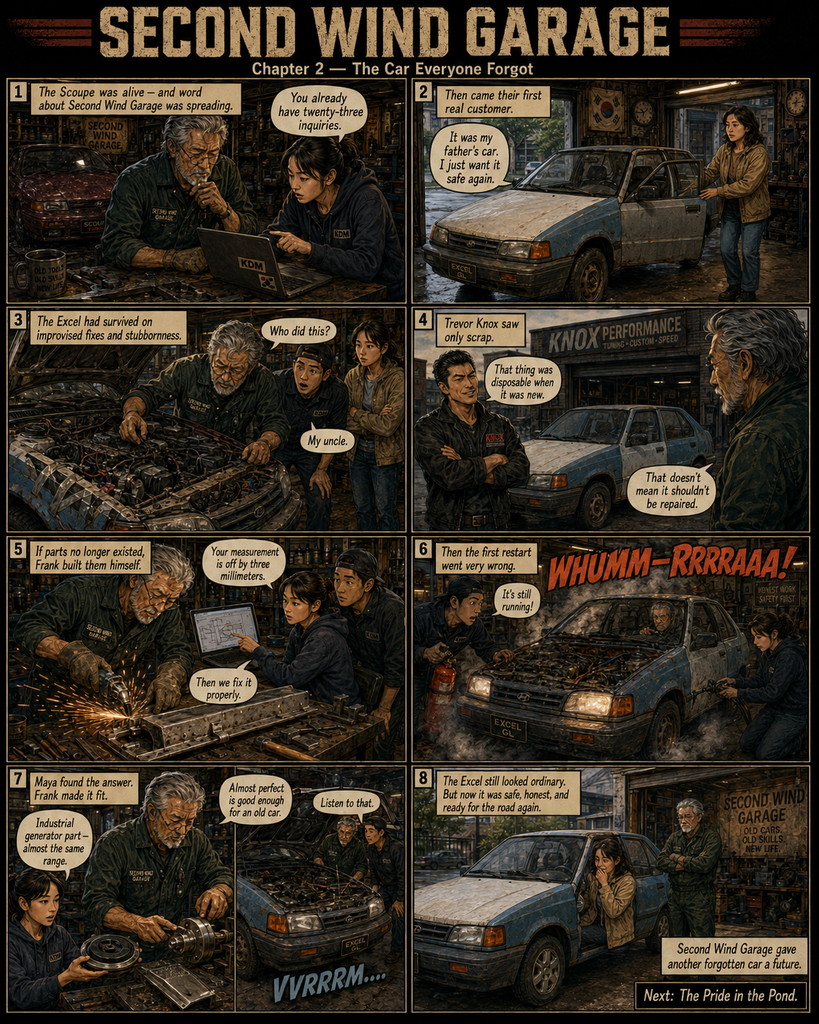
“You have twenty-three inquiries.”
Frank finally looked away from the engine.
“Twenty-three?”
Maya opened the laptop on the workbench. Photographs filled the screen: old Accents, damaged Tiburons, a Daewoo Lanos with mismatched doors, and a Kia Sephia that appeared to have spent several years parked beneath a tree.
Leon pointed excitedly at each one.
“This guy wants a turbo conversion. This woman has a Stellar. Someone wants us to turn an Excel into a rally car.”
“There is no ‘us,’” Frank said.
A small silver hatchback stopped at the end of the driveway.
Its passenger door was grey, its hood was white, and the rest of the body had once been light blue.
The engine continued running after the driver switched it off.
It coughed, shook, and finally stopped with a hollow metallic clatter.
Frank closed his notebook.
“That one sounds expensive.”
The First Customer
The driver introduced herself as Hannah Cho, a thirty-one-year-old elementary school teacher.
She stood beside the battered car with both hands wrapped around its keys.
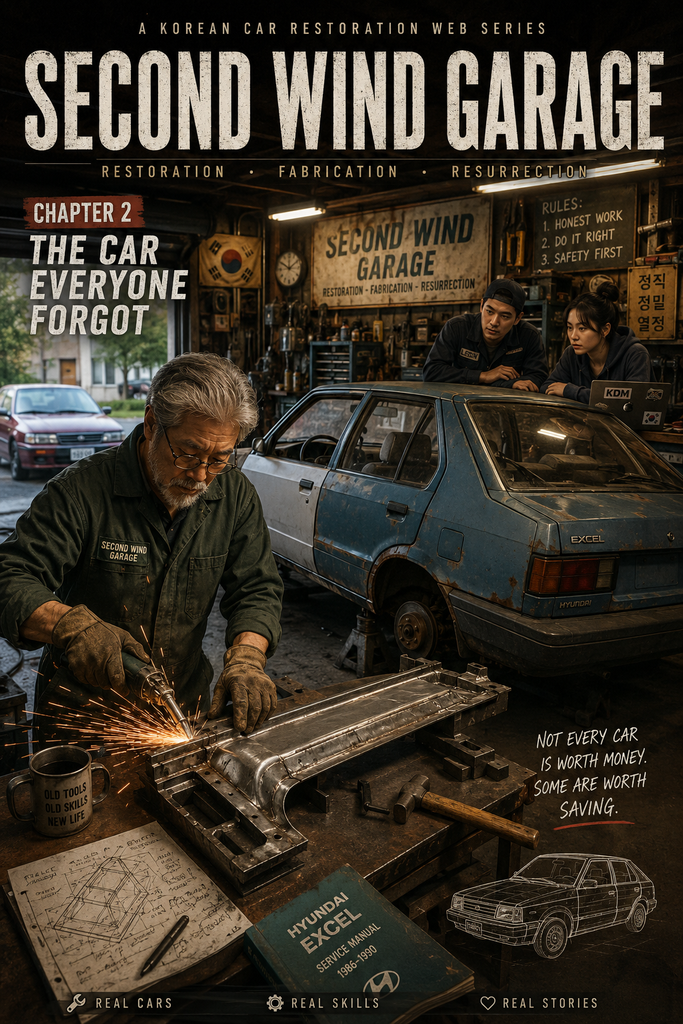
It was a 1988 Hyundai Excel GL, a five-door hatchback from an era when Hyundai was still fighting to establish itself in North America.
The paint had faded almost completely from the roof. Rust had opened along both rocker panels. The rear hatch required a broom handle to remain open, and the interior carried the unmistakable scent of old fabric, rainwater, and decades of winter.
Leon circled it with the reverence normally reserved for rare sports cars.
“This might be one of the oldest Excels still driving around here.”
“It barely drove here,” Hannah said.
Frank opened the hood.
The engine compartment was filled with improvised repairs. Electrical tape covered sections of the wiring harness. A garden-hose clamp secured part of the intake. Several vacuum lines had been plugged with screws.
Someone had replaced a missing throttle spring with what appeared to be a piece of hardware-store wire.
Frank stared at it.
“Who has been working on this?”
“My uncle.”
Frank slowly removed his glasses from his pocket.
“Is your uncle angry with the car?”
Hannah almost smiled.
She explained that the Excel had belonged to her father, who purchased it shortly after arriving in Canada. It had carried him to factory shifts, evening classes, grocery stores, and eventually to the hospital where Hannah was born.
When he could finally afford a newer vehicle, he kept the Excel anyway.
After his death, the car remained behind his house under a portable shelter. Hannah’s relatives repeatedly encouraged her to scrap it. She had refused, although she could not explain exactly what she intended to do with it.
Then she saw Maya’s video of Frank uncovering the Scoupe.
“I don’t need it turned into a show car,” Hannah said. “I just want to drive it once without wondering whether something will fall off.”
Frank looked beneath the car.
A flake of rust dropped onto the concrete.
“That may be an ambitious first goal.”
A Car With No Value
The Excel occupied the second bay while Frank performed his inspection.
The list grew quickly.
The carburetor leaked.
The front wheel bearings were worn.
The fuel tank contained rust.
One rear brake cylinder had seized.
The radiator showed signs of an old repair using metallic sealant.
The left rocker panel had nearly separated from the floor.
Maya photographed everything for the work record.
Leon removed a plastic bag from beneath the driver’s seat. Inside were registration papers, old fuel receipts, and a small notebook filled with Hannah’s father’s handwriting.
Every oil change had been recorded.
So had tire rotations, spark-plug replacements, and fuel purchases from road trips taken decades earlier.
Several pages contained simple notes.
Hannah’s first day of school.
Family trip to Niagara.
Car started at minus twenty-seven. Good little machine.
Frank read the final entry.
September 18. Engine rough. Fix next week.
There were no later notes.
Frank closed the book carefully.
Maya watched him.
“You’re taking the job, aren’t you?”
“No.”
Leon looked surprised.
Frank pointed toward the rusted rocker panel.
“If we repair everything properly, the work will cost more than the car is worth.”
Hannah stood silently near the garage door.
Frank continued.
“If we repair it improperly, it will be dangerous. I will not do that.”
Hannah nodded, disappointed but not angry.
“I understand.”
She took the keys from the workbench.
Before she could leave, the sound of a performance exhaust echoed from the street.
A black pickup truck carrying the logo of Knox Performance stopped outside the garage.
Trevor Knox stepped from the driver’s seat.
He had come to collect a diagnostic scanner Frank had borrowed several months earlier, although he appeared far more interested in inspecting the new business.
He glanced at the Excel.
“What is that doing here?”
Leon answered proudly.
“Possible restoration.”
Trevor laughed.
“That thing was disposable when it was new.”
Hannah looked down at the keys in her hand.
Frank’s expression changed.
Not dramatically. His shoulders simply became straighter.
Trevor walked around the Excel.
“You could put ten thousand dollars into this and still have a five-hundred-dollar car.”
Frank placed the maintenance notebook on the roof.
“Then its owner will have a five-hundred-dollar car with ten thousand dollars of work.”
Trevor grinned.
“Exactly.”
“You think the value of work is determined by what a stranger will pay afterward?”
“That is generally how business operates.”
Frank opened the driver’s door and removed the broom handle holding up the rear hatch.
“No. That is how reselling operates.”
He turned to Hannah.
“The labour will be limited to what makes it safe and mechanically honest. We preserve what can be preserved. We improve only what needs improving.”
Hannah looked uncertain.
“You said it wasn’t worth repairing.”
“It isn’t.”
Frank handed the keys back to her.
“That is not the same as saying it should not be repaired.”
The Rules of Second Wind Garage
Gloria created the first official customer contract that evening.
It contained three rules.
First: Frank would not hide structural damage.
Second: No modification would be installed merely because it looked impressive.
Third: The owner would receive every removed part, every receipt, and a written record of the work.
Hannah signed.
Frank estimated the project would take six weeks.
Gloria quietly changed the estimate to eight.
The Excel restoration began with complete disassembly of the damaged lower body.
When the rusted rocker covers were removed, Leon discovered that part of the inner structure had been patched years earlier using flattened sections of a household appliance.
He held up a corroded piece of metal bearing half of an old manufacturer’s logo.
“Is this from a washing machine?”
Frank examined it.
“Dryer.”
“How can you tell?”
“Washing machines use thicker steel.”
Maya stared at him.
“Why do you know that?”
Frank placed the piece on the scrap pile.
“Because people used to repair everything with appliances.”
Building What No Longer Existed
Replacement rocker panels could not be found.
Frank contacted suppliers, wrecking yards, and restoration shops. Most had not seen an early Excel in years. Those who remembered the car laughed when he explained what he needed.
He finally stopped calling.
Using measurements from the surviving passenger side, Frank created a cardboard pattern for the missing inner structure. He transferred the shape to sheet steel, formed it by hand, and refined it using the old brake and roller in his garage.
Maya created a digital model to check the dimensions.
Frank ignored it until her model identified a mounting point he had measured incorrectly.
He looked from the laptop to his paper drawing.
“Your machine is useful occasionally.”
Maya smiled.
“I’ll put that on the website.”
They welded the new structure into place section by section.
Leon rebuilt the rear brakes.
Maya traced the damaged wiring harness and designed a small replacement fuse panel that could be installed without altering the original dashboard.
Frank disassembled the carburetor across a clean white cloth.
Inside, he found varnished fuel deposits, a damaged float, and a needle valve worn almost smooth.
No rebuild kit matched the exact carburetor.
Frank measured the valve under a magnifying lamp.
He spent the next afternoon machining a replacement from brass.
Leon watched the tiny piece rotate in the lathe.
“You could have installed a modern fuel-injection system.”
“I could also replace the entire car.”
“It would start more easily.”
“It started easily when it was new. That means the original design is capable of doing the job.”
Frank polished the new valve and installed it.
“Modern technology is useful when it solves a problem. Not when it prevents us from understanding one.”
The First Failure
Three weeks into the project, the repaired engine started for the first time.
It idled smoothly.
For twelve seconds.
Then the engine raced uncontrollably.
Frank reached through the window and switched off the ignition.
The engine continued running.
Smoke entered the garage.
Leon grabbed a fire extinguisher.
Maya disconnected the fuel supply while Frank blocked the carburetor intake with a thick rubber mat. The engine shuddered and finally stopped.
Silence filled the workshop.
Gloria entered from the house carrying a laundry basket.
She looked at the smoke, the extinguisher, and the three mechanics frozen around the car.
“Should I ask?”
“No,” Frank said.
“Good.”
She continued toward the house.
Frank found the cause an hour later.
A vacuum diaphragm inside the carburetor had split. The resulting leak forced the throttle mechanism open.
The component had not appeared damaged during the rebuild.
Leon leaned against the workbench.
“So what happens now?”
“We repair it.”
“There’s no replacement.”
“Then we make one.”
“You can make a rubber diaphragm?”
Frank stared at the disassembled mechanism.
“No.”
For the first time since the project began, he appeared defeated.
Maya’s Solution
Maya remained in the garage after everyone else went inside.
She searched through industrial catalogues, classic-car forums, and archived parts diagrams. The Excel’s original component was unavailable, but similar vacuum diaphragms were still used in older industrial generators.
The mounting pattern was different.
The operating range was nearly identical.
The next morning, Maya placed a new component beside the damaged original.
Frank compared them.
“It does not fit.”
“Not yet.”
Using her digital model, Maya designed a small aluminium adapter. Frank machined it. Leon modified the linkage.
The new diaphragm disappeared beneath the original housing once installed.
The engine started again.
This time, it settled into a steady idle.
Frank adjusted the mixture by ear while Maya watched the exhaust reading on a portable analyser.
“You’re rich,” she said.
Frank turned the screw a fraction.
“Now?”
“Better.”
He adjusted it again.
“Now?”
“Almost perfect.”
Frank stopped.
“Almost perfect is where old cars are happiest.”
The Test Drive
The Excel returned to the road eight weeks after arriving.
Gloria’s estimate had been correct.
The body still carried mismatched paint. Frank refused to use Hannah’s limited budget on cosmetics while the suspension and brakes required attention.
The white hood remained.
The grey passenger door remained.
But the rust was structurally repaired, the brakes worked evenly, the engine started without complaint, and the rear hatch now held itself open without assistance from household cleaning equipment.
Frank drove first.
Leon sat beside him while Maya followed in the Scoupe.
The Excel accelerated slowly, transmitted every vibration through its thin steering wheel, and produced more wind noise than engine noise above eighty kilometres per hour.
Leon smiled.
“It feels ancient.”
Frank shifted into fourth.
“It feels light.”
The car climbed a long hill without overheating.
At the top, Frank pulled onto the shoulder and listened to the idle.
No bearing noise.
No fuel leak.
No steam.
He wrote one final note in the repair ledger.
Safe. Honest. Ready.
The Return
Hannah arrived at the garage on a quiet Sunday afternoon.
She stopped when she saw the Excel.
The car had not been transformed.
It still looked like her father’s car.
Frank had cleaned and polished the original paint rather than covering it with a modern finish. The dents remained. The old dealership sticker remained in the rear window. Even the worn fabric on the driver’s seat had been repaired using material carefully matched to the original pattern.
Hannah opened the door.
Her father’s maintenance notebook rested on the passenger seat.
Beside it was a new black book embossed with the words:
SECOND WIND GARAGE — CONTINUED SERVICE RECORD
Frank handed her the keys.
“It will need another inspection before winter.”
Hannah sat behind the wheel.
She turned the key.
The engine started immediately.
For several seconds, she did not move.
Then she placed both hands on the steering wheel and lowered her head.
Frank stepped away from the door.
He gave her privacy without making it obvious that he was doing so.
When Hannah finally drove from the garage, the Excel’s exhaust produced a soft, uneven hum. It was not fast, valuable, or fashionable.
But it moved down the road exactly as her father had once intended.
Leon watched until the car disappeared.
“Think she’ll keep it forever?”
Frank returned to the workbench.
“Nothing lasts forever.”
He opened the large paper ledger titled CARS GIVEN A SECOND WIND.
Beneath the entry for the Scoupe, he wrote:
1988 Hyundai Excel GL
Owner: Hannah Cho
Reason for restoration: Not everything ordinary is replaceable.
Maya’s phone vibrated.
She looked at the new message.
“We have another inquiry.”
Frank continued writing.
“What car?”
“A Kia Pride.”
“What condition?”
Maya opened the attached photograph.
The small red hatchback was sitting nose-down in a shallow pond.
She turned the screen toward him.
Frank stared at it for several seconds.
“That is not a condition.”
Leon leaned closer.
“What is it?”
Frank closed the ledger.
“That is a rescue operation.”
To be continued.