0
 0
First, Make Sure You Have an Elantra N—not an N Line
This guide applies specifically to the 2022–2026 Hyundai Elantra N with the turbocharged 2.0-litre engine. It does not apply to the Elantra N Line, which uses a smaller 1.6-litre turbocharged engine and requires a different tuning strategy.
The 2026 Elantra N is rated at 276 horsepower and 289 lb-ft of torque and is offered with either a six-speed manual transmission or an eight-speed wet dual-clutch transmission. Hyundai also states that premium fuel is required to produce the advertised maximum horsepower.
The Elantra N is already highly optimized from the factory. Therefore, successful tuning is not about replacing every visible component. It is about improving fuel delivery, controlling temperature, calibrating torque and carefully using the additional airflow available from the factory turbocharger.
Decide What Kind of Elantra N You Want
Before purchasing anything, choose the purpose of the build.
A daily-driven Elantra N should prioritize consistent pump fuel, moderate boost, smooth torque delivery and factory-like drivability. A track build should emphasize intercooler efficiency, oil temperature control, repeatable power and conservative protection strategies. A drag or maximum-power build may use ethanol mixtures, water-methanol injection, an upgraded turbocharger and aggressive transmission calibration, but it will require more frequent inspection and maintenance.
For most owners, the best target is approximately 300 to 330 wheel horsepower with strong midrange response rather than the highest possible dyno number.
Step One: Establish a Healthy Baseline
Never tune around an existing mechanical problem. Before flashing the ECU, inspect the car for stored or pending diagnostic codes, ignition misfires, boost leaks, oil consumption, abnormal fuel trims and inconsistent fuel pressure.
The engine should receive fresh oil, a clean air filter and a careful inspection of its intake, charge pipes, intercooler connections and vacuum lines. Any questionable ignition coils or injectors should be diagnosed before additional boost is requested.
A stock baseline datalog should be completed using the same fuel that will be used after tuning. Ideally, the car should also receive a baseline dyno test so that future gains can be measured against the individual vehicle instead of an internet estimate.
Step Two: Choose the Fuel Before Choosing the Tune
The ECU calibration must be designed around the fuel that will actually be available.
A Canadian owner who regularly fills with 91-octane gasoline should request a dedicated 91-octane calibration. Do not purchase an aggressive 93-octane map and assume that occasional 91-octane fuel will be acceptable. The ECU may be able to reduce ignition timing when knock is detected, but relying on constant correction defeats the purpose of a properly developed tune.
Owners using 93-octane gasoline can generally support more ignition timing and boost. Ethanol blends such as E20 or E30 can provide additional knock resistance, but only when the blend is measured accurately and the fuel system has enough capacity. Never estimate ethanol content by simply adding an arbitrary amount of E85.
A sensible street car should also retain a lower-output map for questionable fuel, very hot weather or long-distance travel.
Step Three: Install the Supporting Parts That Actually Matter
Colder Spark Plugs
Colder spark plugs are commonly required by Elantra N tuners. LAP3 specifies HKS M45XL plugs for its Elantra N ECU calibrations, while N75 lists heat-range-nine plug options for the 2.0T N platform.
The correct plug gap should come directly from the tuner. An excessively large gap can contribute to spark blowout under boost, while unnecessarily closing the gap can reduce idle and low-load quality.
High-Pressure Fuel Pump
The high-pressure fuel pump is one of the most important supporting upgrades when power is raised. Several N-platform tuners recommend an upgraded HPFP before aggressive tuning, and upgraded Hyundai-compatible pumps are available specifically for the Elantra N, Kona N, Veloster N and i30 N.
Fuel pressure must remain close to the tuner’s commanded target during a full-load pull. A pump that cannot maintain pressure can cause the ECU to reduce power, create lean operation or produce inconsistent combustion.
An upgraded HPFP may not create horsepower by itself. Its purpose is to make the requested horsepower repeatable and properly fueled.
Intercooler
The factory intercooler may be adequate for a mild street calibration, but an upgraded intercooler becomes increasingly valuable during repeated acceleration, hot summer operation and track sessions.
Intercooler upgrades are available specifically for the Elantra N from companies such as SXTH Element, Forge and N75.
The important result is not the appearance of the intercooler. It is lower and more stable intake-air temperature. A car that produces an impressive first pull but repeatedly loses ignition timing as heat builds is not properly optimized.
Intake and Turbo Inlet
An intake and larger turbo inlet can reduce restriction ahead of the compressor and increase induction sound. However, they should not be treated as substitutes for fuel-system capacity, intercooler efficiency or proper calibration.
Current Elantra N-specific intake and turbo-inlet systems are available from established N-platform manufacturers, including SXTH Element.
A mild tune can be performed with the original intake. The inlet becomes more useful as airflow and turbocharger demand rise.
Exhaust and Downpipe
The factory active exhaust already flows well enough for many street builds. A mid-pipe primarily changes sound and may slightly reduce restriction, while the downpipe has a greater effect on turbine backpressure.
A high-flow downpipe becomes more relevant near the upper end of the factory turbo’s output. However, removing or modifying catalytic converters can violate emissions laws, trigger fault codes and make the car unsuitable for public-road registration in some regions.
Avoid aggressive flame maps or constant artificial crackles. These strategies add fuel and heat to the exhaust system and can shorten the life of the catalytic converter, turbocharger and exhaust components.
Step Four: Choose the Correct Flashing Method
Elantra N tuning can be performed through a replacement ECU, a mailed-in ECU, a bench flash or a compatible handheld flashing and logging device.
The EK1 Mini2+, for example, can store multiple maps, read diagnostic codes, log engine data and support ECU or TCU calibrations. N75 notes that 2024-and-newer Elantra N models require an additional bench harness for its EK1 flashing process.
A spare ECU can reduce downtime and make returning the vehicle to its original calibration easier. However, the owner should confirm whether immobilizer programming, VIN coding, dealer updates or connected services will be affected.
The safest approach is a custom calibration created from the car’s actual logs rather than blindly loading the most aggressive off-the-shelf file available.
Step Five: Tune More Than Boost Pressure
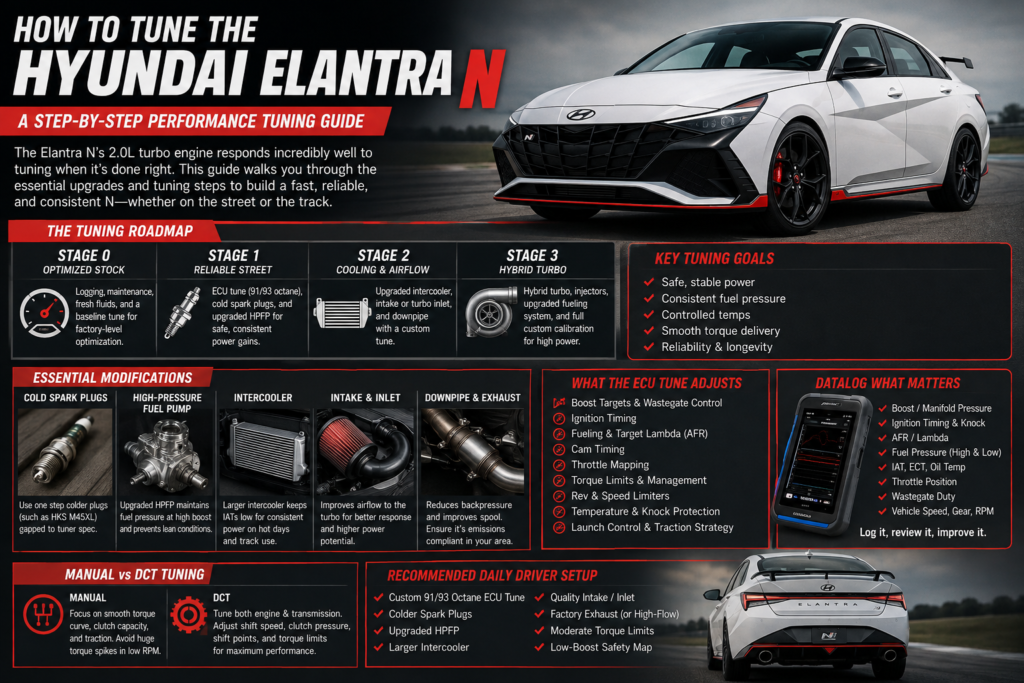
A complete ECU tune changes several related systems together:
- Boost targets and wastegate control
- Ignition timing
- Commanded lambda or air-fuel ratio
- Camshaft timing
- Throttle mapping
- Load calculations
- Torque limits
- Rev and speed limiters
- Temperature-based protection
- Launch-control behavior
LAP3 identifies boost, ignition timing, cam timing, target lambda, throttle mapping, wastegate control and torque-management limits among the areas modified in its Elantra N calibrations.
Simply commanding more boost without recalibrating fuel, torque, ignition and airflow models is not a complete tune.
A Practical Elantra N Tuning Roadmap
Stage Zero: Optimized Factory Hardware
Use premium fuel, complete a health check and install a logging solution. The ECU can then be calibrated for more consistent factory-level performance, improved throttle behavior and less dependence on the factory octane-learning process.
This is appropriate for an owner who wants the car to feel more responsive without substantially increasing mechanical stress.
Stage One: Reliable Street Tune
Install colder spark plugs and strongly consider upgrading the HPFP. Use a custom 91- or 93-octane ECU calibration while retaining the factory downpipe and turbocharger.
A responsible Stage One map should increase power progressively rather than delivering a huge torque spike at low rpm. This protects traction, connecting rods, engine mounts, tires and the transmission while making the car faster through the full powerband.
LAP3 advertises approximately 300–330 wheel horsepower for its 91-octane Stage One Elantra N calibration, although real results vary with the dyno, fuel, transmission, temperature and vehicle condition.
Stage Two: Cooling and Airflow
Add an upgraded intercooler, intake or turbo inlet, upgraded HPFP and, where legal, a high-flow downpipe. Then create a custom calibration around those exact components.
This stage should concentrate on maintaining power at higher rpm and during repeated use. A good Stage Two tune is not merely Stage One with another few pounds of boost.
Depending on fuel and supporting hardware, tuners advertise factory-turbo outputs ranging from the low 300s into the mid-to-upper 300-wheel-horsepower range. These figures should be understood as vendor claims rather than guaranteed results.
Stage Three: Hybrid Turbo
Once the factory turbocharger is being operated near its efficient limit, adding more boost may create more heat and exhaust backpressure without delivering proportional airflow.
A hybrid turbocharger can provide a larger compressor and turbine while retaining relatively straightforward fitment. At this level, the build may require upgraded injectors, additional low-pressure fuel capacity, an upgraded HPFP, intercooling, oil cooling, a downpipe and a fully customized ECU calibration.
Hybrid-turbo systems advertised for the Elantra N platform target approximately 400 wheel horsepower or more, but this is no longer a simple bolt-on daily-driver tune.
Manual Versus DCT Tuning
The six-speed manual and eight-speed DCT should not receive identical torque strategies.
On the manual car, clutch capacity becomes increasingly important as midrange torque rises. A tune that produces a large torque hit at relatively low rpm may cause clutch slip even when peak horsepower remains moderate.
On the DCT, the ECU and transmission controller exchange torque information. A DCT calibration may adjust clutch pressure, shift speed, torque limits, launch behavior and shift points. The transmission should not simply be told that the engine is producing less torque than it actually is.
For a street car, retain smooth low-load shifts and factory-like behavior in Normal and Eco modes. Reserve the highest torque, fastest shifts and most aggressive throttle response for N mode.
How to Datalog the Elantra N
Datalogging should be performed on a chassis dyno or closed course—not through high-speed testing on public roads.
Useful channels include:
- Engine speed
- Manifold pressure or boost
- Boost target
- Throttle position
- Ignition timing and knock correction
- Commanded and measured lambda
- Short- and long-term fuel trims
- High-pressure fuel-rail pressure
- Intake-air temperature
- Coolant and oil temperature
- Wastegate position and target
- Vehicle speed and selected gear
N75’s EK1 tuning instructions specifically request channels including rpm, boost or manifold pressure, throttle position, ignition timing, AFR, short-term fuel trim, long-term fuel trim, vehicle speed and wastegate data where supported.
A tuner should examine how the complete pull behaves—not just the maximum boost number. Fuel pressure should remain stable, lambda should follow the commanded target, throttle should not unexpectedly close, temperature should remain controlled and repeated knock correction should be investigated.
Tune the Torque Curve, Not Just the Peak Number
The Elantra N is front-wheel drive. Giving it maximum available torque immediately at low rpm can produce wheelspin, wheel hop, steering interference and unnecessary load on the engine and drivetrain.
A better calibration limits torque in the lower gears, builds boost progressively and holds airflow toward redline. This often makes the vehicle faster in actual use even when the dyno sheet shows a slightly lower peak torque figure.
For a track-focused calibration, sustained response and temperature stability matter more than a brief dyno spike.
Recommended Daily-Driver Combination
A strong and relatively conservative street package would include:
- A custom 91- or 93-octane ECU tune
- One-step-colder plugs specified by the tuner
- An upgraded high-pressure fuel pump
- A larger intercooler
- A quality intake or improved turbo inlet
- Factory active exhaust and catalytic converter
- Moderate, gear-based torque limits
- A low-boost safety map
- Regular datalogging and maintenance
This combination improves power, consistency and throttle response without immediately moving into hybrid-turbo, water-methanol or auxiliary-fueling territory.
Final Thoughts
The Elantra N should be tuned as a complete system. Raising boost is easy. Maintaining stable fuel pressure, controlling combustion, managing heat and delivering usable torque are the difficult parts.
For most owners, the ideal Elantra N is not the one with the highest screenshot from a dyno session. It is the car that starts cleanly, drives smoothly, survives traffic and hot weather, completes repeated track laps and continues producing the same power months later.
Start with fuel quality and vehicle health. Add plugs and fuel capacity. Improve cooling. Log everything. Then increase airflow and boost only as far as the complete system can support.