0
0
 0
0

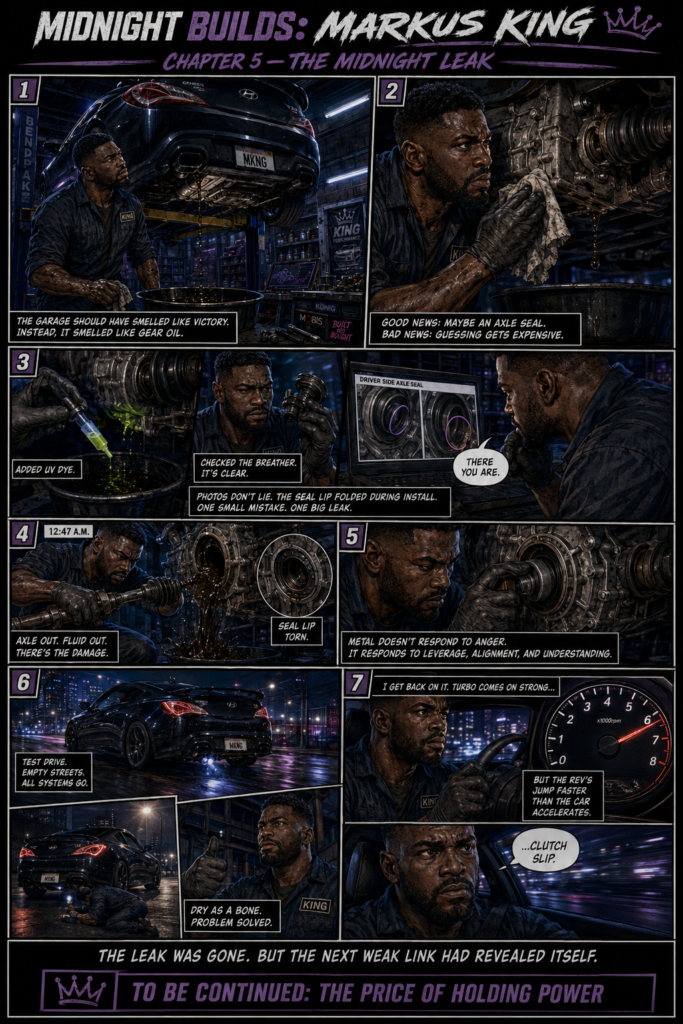
The garage should have smelled like hot brakes, rubber and victory.
Instead, it smelled like gear oil.
Markus King stood beneath the raised Genesis Coupe, staring at a dark drop forming along the bottom of the transmission. It grew slowly, reflecting the fluorescent lights before falling into the drain pan below.
Tap.
He wiped the casing clean with a shop towel.
Thirty seconds later, another wet line appeared.
“Of course,” Markus muttered. “The car finally handles right, so something else has to bleed.”
Only an hour earlier, he had returned from his first proper drive since correcting the suspension setup. The Genesis no longer wandered over uneven pavement. The rear tires sat squarely instead of disappearing beneath excessive negative camber. The dampers finally worked with the springs rather than fighting them.
For the first time in weeks, the car felt balanced.
Then Markus had noticed the smell.
He rolled beneath the car on a creeper and aimed a work light toward the newly installed limited-slip differential. The differential itself was hidden inside the transmission housing, but every component around it carried evidence of the recent work: fresh tool marks, cleaned bolts and a thin film of oil that had not been there before.
The leak seemed to begin near the driver-side axle.
That was both good news and bad news.
Good, because an axle seal could be replaced without opening the entire transmission again.
Bad, because guessing was how people replaced three good parts before finding the broken one.
Markus sprayed the housing with cleaner, wiped every surface dry and lowered the car.
He added a small amount of ultraviolet dye to the transmission fluid, started the engine and let the Genesis idle in neutral. After several minutes, he selected first gear with the car still raised and allowed the wheels to turn slowly.
The drivetrain rotated without load.
No leak appeared.
Markus narrowed his eyes.
“Only when it’s hot,” he said. “Or only when the axle moves.”
He shut the engine off and inspected the transmission breather. A blocked breather could allow pressure to build inside the case as the fluid heated, forcing oil past seals that might otherwise hold.
The breather was dirty but open.
Next, he grabbed the driver-side axle and pushed it upward.
A faint metallic movement answered him.
Not much.
But enough.
Markus lowered the car and opened his laptop. Photographs from the differential installation filled the screen: the transmission separated from the engine, the original open differential resting on the bench, the new helical limited-slip unit beside it.
He zoomed in on one image taken immediately before the axle had been reinstalled.
The seal looked slightly uneven.
Markus leaned closer.
One edge of the rubber lip appeared darker than the rest.
He remembered the resistance he had felt while sliding the axle through it. The splines had caught briefly before the shaft finally seated.
At the time, he had assumed the retaining clip was fighting him.
Now he knew better.
The axle had probably folded the inner sealing lip.
It remained tight enough not to leak while cold and stationary. But once the fluid warmed and the axle began moving under load, oil found its way past the damaged edge.
Markus checked the time.
12:47 a.m.
The responsible decision would have been to stop.
The seal could be purchased in the morning. The car was already safely parked. Nothing required immediate attention.
But the Genesis hung above him like an unfinished sentence.
Markus reached for the impact gun.
The axle nut resisted with the confidence of something installed by a machine that hated mechanics.
Markus leaned against the breaker bar until it finally cracked loose.
He disconnected the lower suspension hardware, moved the knuckle outward and carefully released the axle from the hub. The opposite end remained locked inside the transmission.
He positioned a pry bar behind the inner joint.
“Come on.”
The axle refused.
He changed the angle and tried again.
Nothing.
A harder pull would have removed it—but could also have damaged the joint, the transmission casing or Markus himself.
He stepped back.
Years earlier, Markus would have taken the resistance personally. He would have attacked the part until either it surrendered or something broke.
Midnight builds had taught him patience.
Metal did not respond to anger. It responded to leverage, alignment and understanding.
He rotated the axle slightly, repositioned the pry bar against a stronger section of the housing and applied one sharp movement.
The retaining clip released.
The axle popped free.
A stream of transmission fluid followed it.
Markus guided the shaft away, then stared directly at the seal.
The damage was immediately visible.
A section of the inner lip had folded backward. A tiny cut ran along the rubber where an axle spline had passed across it.
“There you are.”
He removed the seal carefully, making sure not to scratch the aluminum bore surrounding it. Beneath the work light, the old seal looked almost perfect.
Almost.
The kind of failure that could escape a hurried inspection and slowly empty a transmission over several weeks.
Markus placed it on the bench beside the new replacement.
Before installing anything, he examined the axle itself. He checked the sealing surface for grooves, rust and burrs. A new seal would not survive long if the shaft running through it was damaged.
The surface remained smooth.
He lightly polished it, cleaned the bore and coated the outside of the replacement seal with a thin film of suitable sealant. A large socket with the correct outer diameter became his installation tool.
He tapped around it evenly.
One side began entering faster than the other.
Markus stopped immediately.
He pulled it back out before it could distort.
“Not twice.”
He cleaned everything again and started over.
This time, every strike was light and deliberate. He moved in a circular pattern, watching the seal settle evenly into the bore until it reached the correct depth.
Installing the axle required even more care.
Markus covered the splines with a thin protective sleeve so their sharp edges could not drag directly across the fresh rubber. He lubricated the seal lip, aligned the shaft and guided it inward without forcing it.
The retaining clip clicked into place.
He pulled back gently on the inner joint.
Locked.
No torn rubber. No folded lip. No shortcuts.
He reassembled the suspension, tightened the axle nut and torqued every fastener he had disturbed. Then he lowered the car until it sat level and removed the transmission fill plug.
Only a small amount of fluid escaped when he opened it.
The transmission had already lost more than he expected.
Markus stared at the drain pan.
Had he ignored the smell and continued driving, the new limited-slip differential might have become the most expensive damaged part in the entire build.
He refilled the transmission with the correct fluid, stopping when it reached the proper level at the fill opening.
By then, the garage clock read 3:26 a.m.
The city outside was silent.
Markus started the Genesis.
The engine settled into a deep mechanical idle. He selected first gear and pulled slowly out of the garage.
He avoided boost during the first few kilometres.
The streets were empty and silver beneath the overhead lights. Markus listened for every vibration, every scrape and every change in drivetrain noise.
Nothing sounded wrong.
As the fluid warmed, he entered an industrial area where broad turns and abandoned loading roads gave him space to test the car without pushing reckless speeds.
He accelerated gently through second gear.
The limited-slip differential transferred power smoothly. Both rear tires worked together rather than allowing one to surrender traction.
He turned through a long bend.
The corrected suspension kept the Genesis flat and predictable. The steering communicated clearly. The rear remained planted without feeling trapped.
For the first time, the differential and suspension felt like parts of the same car.
Markus pulled beneath a streetlight and stopped.
He climbed out and looked beneath the transmission.
Dry.
He waited.
Still dry.
Markus allowed himself a small smile.
It was not the dramatic victory people imagined when they pictured a modified car. There was no crowd, no trophy and no camera recording the moment.
Only an empty road, a clean transmission casing and a machine that had survived another mistake.
That was enough.
He returned to the driver’s seat and accelerated onto the main road. This time, he pressed the throttle farther.
The turbocharger began to whistle.
Boost built.
Torque reached the rear wheels, and the limited-slip differential divided it across the axle. The Genesis drove forward with a hard, unified shove.
No wheelspin.
No wandering.
No leak.
“Finally,” Markus said.
Then the engine speed jumped.
For half a second, the tachometer climbed faster than the car accelerated.
Markus released the throttle immediately.
The engine settled.
He tried again in a higher gear, applying torque gradually.
The revs flared.
The car hesitated before catching up.
Markus looked down at the shifter.
The differential was holding.
The tires were holding.
But somewhere between the engine and the transmission, something else had become the weak link.
He turned the Genesis toward home.
The streets remained quiet as the car disappeared beneath the neon glow.
Behind the wheel, Markus already knew what the next midnight would require.
The clutch had begun to slip.
And unlike the leak, it would not be repaired from outside the transmission.
To be continued…
Next Chapter: The Price of Holding Power