A Limited-Slip Differential (LSD) is one of the most transformative performance upgrades you can install on a vehicle. Whether you’re driving a Hyundai Elantra N, Genesis Coupe, Kia Stinger GT, or your modified Hyundai Tiburon, an LSD improves traction, stability, and power delivery—especially during spirited driving and acceleration.
But how exactly does it work, and why is it so essential for performance enthusiasts? This guide explains everything you need to know, complete with diagrams to simplify the mechanics behind this critical component.
What Is a Differential?
Before understanding a Limited-Slip Differential, it’s important to know the purpose of a standard differential.
A differential allows the wheels on the same axle to rotate at different speeds. This is necessary when a vehicle turns, as the outer wheel travels a longer distance than the inner wheel.
However, traditional open differentials have a major drawback: they send power to the wheel with the least traction. This can result in wheel spin and reduced performance.
Open Differential Diagram


Drawback of an Open Differential
- Power is directed to the slipping wheel.
- Reduced traction during acceleration.
- Poor performance in slippery conditions.
This is where a Limited-Slip Differential comes into play.
What Is a Limited-Slip Differential (LSD)?
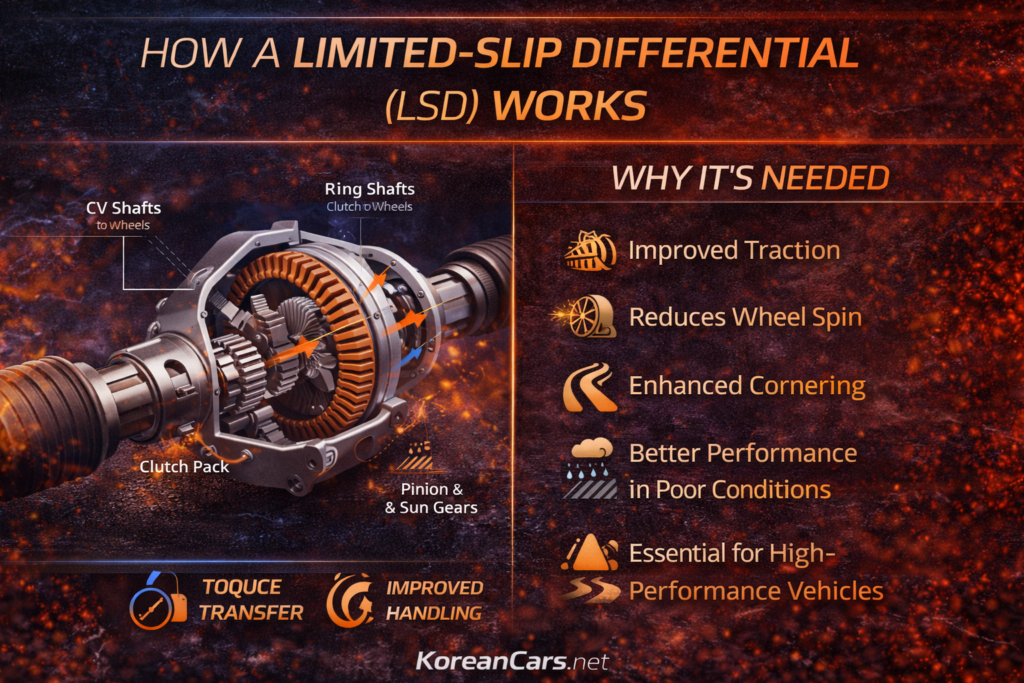
A Limited-Slip Differential is designed to distribute power more evenly between the driven wheels. When one wheel begins to slip, the LSD transfers torque to the wheel with better traction.
Key Benefits
- Improved acceleration
- Reduced wheel spin
- Enhanced cornering performance
- Greater stability and control
- Better handling in wet or slippery conditions
How a Limited-Slip Differential Works
Unlike an open differential, an LSD uses mechanical or electronic mechanisms to limit the difference in rotational speed between the wheels.
When traction is lost at one wheel, the LSD redirects power to the wheel with grip, ensuring efficient power delivery to the road.
Limited-Slip Differential Diagram


Step-by-Step Operation
- Normal Driving: Power is evenly distributed between both wheels.
- Wheel Slip Occurs: One wheel loses traction.
- Torque Transfer: The LSD limits slip and redirects torque.
- Enhanced Grip: The wheel with better traction receives more power.
- Improved Acceleration: The vehicle maintains stability and forward momentum.
Types of Limited-Slip Differentials
1. Clutch-Type LSD
Uses friction plates to transfer torque between wheels.
Pros:
- Strong traction and performance
- Popular in motorsports
Cons:
- Requires periodic maintenance
2. Helical (Torsen) LSD
Uses gears instead of clutch plates to distribute torque.
Pros:
- Smooth operation
- Low maintenance
- Ideal for daily driving
Cons:
- Requires some traction on both wheels
3. Viscous LSD
Utilizes fluid-filled chambers to manage torque transfer.
Pros:
- Smooth engagement
- Comfortable for street use
Cons:
- Slower response time
4. Electronic LSD (e-LSD)
Controlled by sensors and onboard computers.
Pros:
- Highly precise
- Adaptive performance
Cons:
- More complex and expensive
Types of LSD Diagram


Why Is a Limited-Slip Differential Needed?
1. Improved Straight-Line Performance
An LSD reduces wheel spin during hard acceleration, allowing more efficient power transfer to the road.
2. Enhanced Cornering Ability
By distributing torque effectively, an LSD improves stability and reduces understeer.
3. Better Traction in Poor Conditions
An LSD provides superior control on wet roads, gravel, and uneven surfaces.
4. Essential for High-Performance Vehicles
High-horsepower cars require an LSD to harness power effectively.
5. Ideal for Track and Motorsport Applications
An LSD ensures consistent performance during aggressive driving and racing conditions.
Real-World Performance Comparison
| Feature | Open Differential | Limited-Slip Differential |
|---|---|---|
| Traction | Low | High |
| Acceleration | Moderate | Improved |
| Cornering Stability | Average | Excellent |
| Wheel Spin | Common | Reduced |
| Performance Driving | Limited | Superior |
| Track Capability | Poor | Outstanding |
Vehicles Equipped with LSDs
Many modern performance cars come equipped with factory-installed LSDs.
Popular Korean Models
- Hyundai Elantra N (Electronic LSD)
- Hyundai Veloster N (Electronic LSD)
- Hyundai Kona N (Electronic LSD)
- Hyundai Genesis Coupe
- Kia Stinger GT
- Genesis G70
- Hyundai IONIQ 5 N
These vehicles demonstrate the importance of LSD technology in maximizing performance.
Advantages and Disadvantages
Advantages
✔ Improved traction and acceleration
✔ Enhanced handling and cornering
✔ Reduced wheel spin
✔ Better stability in adverse conditions
✔ Increased performance on track
Disadvantages
✖ Higher cost
✖ Increased mechanical complexity
✖ Potential maintenance requirements
✖ Slightly increased tire wear
Is an LSD Worth It?
For enthusiasts and performance drivers, the answer is a resounding yes. Few upgrades offer such noticeable improvements in real-world driving dynamics.
Ideal For:
- Track-day enthusiasts
- Spirited drivers
- High-horsepower builds
- Turbocharged vehicles
- Front-wheel-drive performance cars
Conclusion
A Limited-Slip Differential is one of the most effective upgrades for enhancing traction, control, and overall performance. By ensuring power is delivered to the wheels with the most grip, an LSD transforms how a car accelerates, corners, and handles challenging driving conditions.
Whether you’re launching your Hyundai Tiburon from a standstill or carving through corners in a Hyundai Elantra N, an LSD provides the confidence and performance that enthusiasts demand.
If horsepower determines how fast you go, an LSD determines how effectively you use it.