0
0
 0
0
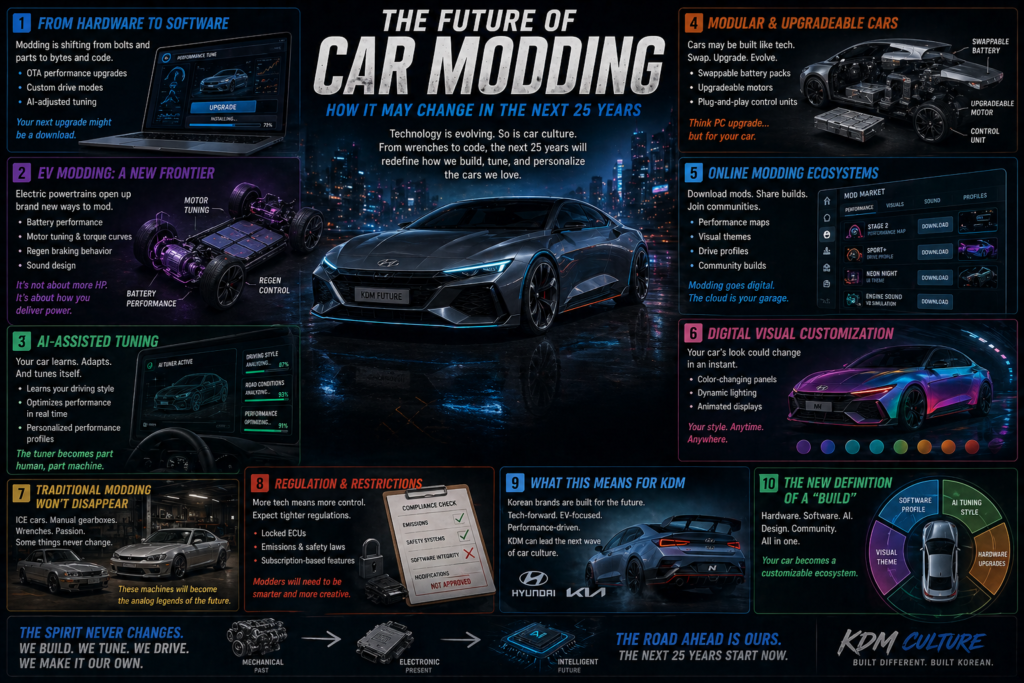
Car modding has always evolved with technology.
From:
- Carburetors → ECUs
- Naturally aspirated → turbocharged
- Mechanical tuning → software tuning
Now, we’re entering the biggest shift yet:
👉 Electric, digital, and AI-driven cars
So what happens to car culture—and especially KDM—over the next 25 years?
Let’s break it down.
⚡ 1. The Shift from Hardware to Software


In the future, modding won’t always mean:
- Changing parts
- Installing hardware
Instead, it will increasingly mean:
👉 Unlocking performance through software
What This Looks Like:
- OTA (over-the-air) performance upgrades
- Custom drive modes
- AI-adjusted throttle, suspension, and torque delivery
Cars like the Hyundai Ioniq 5 N are already hinting at this.
👉 Your “build” might become something you download.
🔋 2. EV Modding Will Become Its Own Culture


Electric vehicles will change everything.
New Modding Areas:
- Battery performance (range vs power trade-offs)
- Motor tuning (torque delivery curves)
- Regenerative braking behavior
- Sound design (yes—fake engine sounds)
👉 The question shifts from:
“More horsepower?”
to
👉 “How do you control power delivery?”
🧠 3. AI-Assisted Tuning


Imagine this:
Your car learns:
- How you drive
- Where you drive
- When you push the car
And then…
👉 It tunes itself.
Future Possibilities:
- AI optimizing lap times
- Auto-adjusting suspension in real time
- Personalized performance profiles
👉 The tuner becomes part human, part machine.
🧩 4. Modular Cars and Plug-and-Play Upgrades


Manufacturers may begin designing cars with modding in mind.
What That Means:
- Swappable battery packs
- Modular motors
- Upgradeable control units
👉 Think:
- Like upgrading a PC
- But for your car
This could redefine aftermarket culture entirely.
🌐 5. Online Modding Ecosystems


Instead of buying parts from shops, you might:
👉 Download mods from an online marketplace
Examples:
- Performance maps
- Visual UI themes
- Driving profiles
Even communities could share:
- Custom tunes
- “Build files”
👉 Like sharing presets in gaming.
🎨 6. Visual Mods Go Digital


Paint jobs and wraps might evolve into:
Digital Surfaces:
- Color-changing panels
- Animated lighting
- Dynamic styling
👉 Your car’s look could change instantly.
🔧 7. Traditional Modding Won’t Disappear
Let’s be clear:
👉 Mechanical modding isn’t going away
There will always be:
- Enthusiasts who prefer ICE engines
- Hands-on builds
- Analog driving experiences
Cars like:
- Hyundai Genesis Coupe
- Hyundai Tiburon
…may become:
👉 future classics for pure mechanical modding
⚖️ 8. Regulation Will Shape Everything


As cars become more digital:
Expect:
- Locked ECUs
- Manufacturer restrictions
- Subscription-based features
👉 Modding may become:
- Harder in some ways
- More creative in others
🇰🇷 9. What This Means for KDM
Korean brands are uniquely positioned.
Companies like:
- Hyundai
- Kia
Are already:
- Tech-forward
- EV-focused
- Software-driven
👉 KDM could become a leader in:
- Digital modding
- EV performance culture
- AI-driven tuning
🔥 10. The New Definition of a “Build”
In the future, your build might include:
- Software profile
- Visual theme
- AI tuning style
- Hardware upgrades (optional)
👉 Your car becomes:
A customizable digital + physical system
🏁 Conclusion
Car modding isn’t dying—it’s evolving.
From:
- Wrenches and bolts
To:
- Code and customization
The next 25 years will bring:
- New tools
- New communities
- New definitions of performance
But the core stays the same:
👉 The desire to make a car your own
And whether it’s:
- A classic Hyundai Tiburon
- Or a future EV platform
That spirit of customization?
👉 It’s not going anywhere.