Rear-wheel drive (RWD) has always been associated with performance, balance, and driving purity.
For years, Korean automakers weren’t known for it—until cars like the Hyundai Genesis Coupe changed that perception.
But today, the industry is shifting toward electric vehicles.
So the question becomes:
👉 Is Korea still developing rear-wheel drive platforms?
👉 And does RWD even matter anymore in the EV era?
The answer is surprisingly interesting.
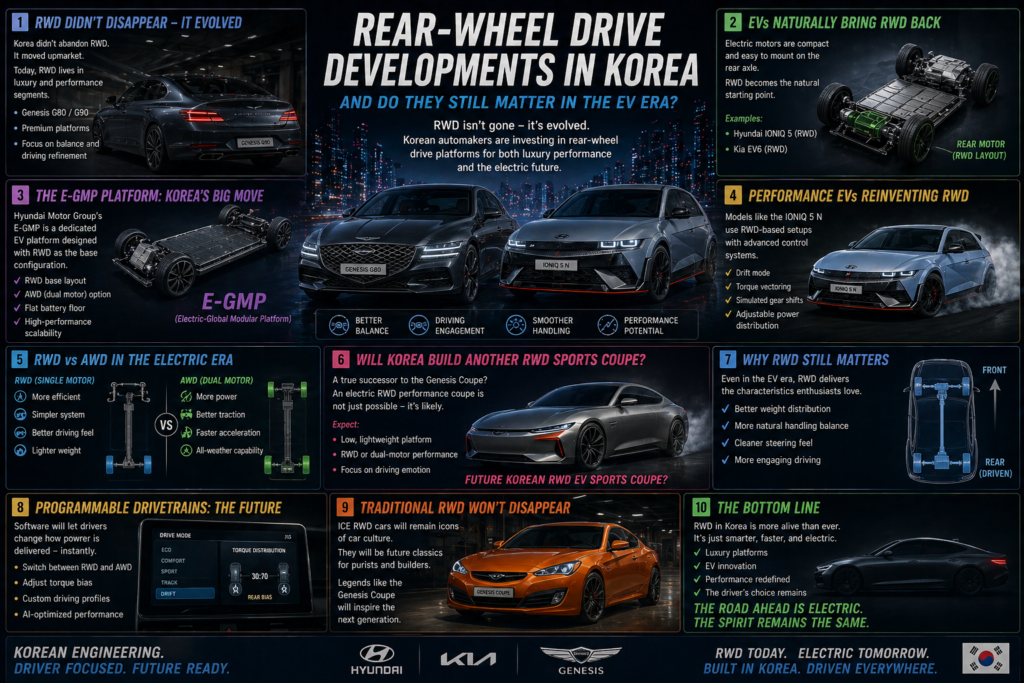
🔧 1. RWD Didn’t Disappear — It Evolved


Korean automakers never abandoned RWD.
Instead, they refocused it.
Where RWD Lives Today:
- Luxury segment
- Performance-oriented platforms
Key Example:
- Genesis G80
- Genesis G90
These cars:
- Use RWD or AWD-biased platforms
- Prioritize balance and refinement
👉 RWD became a premium feature, not a mass-market one
⚡ 2. EVs Quietly Bring RWD Back


Here’s the twist:
👉 Electric vehicles are naturally suited to rear-wheel drive
Why?
- Electric motors are compact
- Easier to mount on rear axle
- No need for long driveshafts
Korean Example:
- Hyundai Ioniq 5 (base RWD configuration)
- Kia EV6
👉 Many EVs start as RWD by default
🧠 3. The E-GMP Platform (Korea’s Big Move)


Hyundai and Kia developed a dedicated EV platform:
👉 E-GMP (Electric-Global Modular Platform)
Key Features:
- Rear-wheel drive base layout
- Optional dual-motor AWD
- Flat battery floor
- High-performance scalability
👉 This is arguably Korea’s most important modern drivetrain development
🔥 4. Performance EVs Are Reinventing RWD


Cars like the Hyundai Ioniq 5 N are redefining what RWD means.
New Capabilities:
- Drift modes
- Torque vectoring
- Simulated gear shifts
- Adjustable power distribution
👉 You can literally program how RWD behaves
This is something ICE cars could never fully do.
⚖️ 5. RWD vs AWD in the Electric Era
RWD (EV):
- Simpler
- More efficient
- Better driving feel
AWD (Dual Motor):
- More power
- Better traction
- Faster acceleration
👉 Most EVs offer both:
- RWD for efficiency
- AWD for performance
🇰🇷 6. Will Korea Build Another RWD Sports Coupe?


This is the big question for enthusiasts.
Will we see a true successor to:
👉 Hyundai Genesis Coupe ?
Possibility:
- Electric coupe platform
- RWD or dual-motor performance
- Lightweight, software-tuned driving dynamics
👉 If it happens, it likely won’t be ICE—it will be EV
🧩 7. Why RWD Still Matters
Even in the EV era, RWD is still important.
It Provides:
- Better balance
- More engaging driving dynamics
- Cleaner steering feel (front wheels not driven)
👉 It’s still the driver’s choice layout
🔮 8. The Future: Programmable Drivetrains


In the future, drivetrain layout might not be fixed.
Imagine:
- Switching between RWD and AWD modes
- Adjusting torque bias instantly
- Custom driving profiles
👉 RWD becomes:
A setting—not just a physical layout
🏁 Conclusion
Rear-wheel drive isn’t dying.
👉 It’s evolving.
In Korea:
- RWD continues in luxury platforms
- EVs are bringing it back in new ways
- Performance models are redefining how it feels
And in many ways…
👉 The electric era might be the best thing that ever happened to RWD
Because now, it’s not just mechanical.
👉 It’s fully controllable, customizable, and more powerful than ever