0
 0
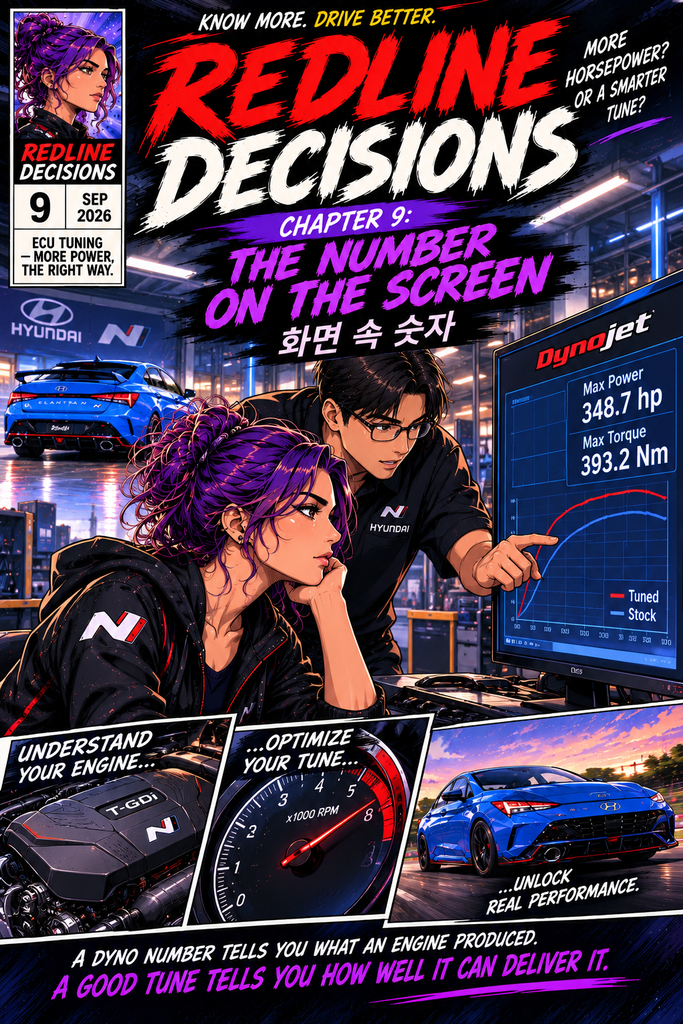
ENGLISH VERSION
The Temptation of More Power
Erin Vale had become familiar with the language of performance.
Horsepower.
Torque.
Boost pressure.
Dyno graphs.
Every car meet seemed to have someone talking about how much power their engine produced.
One Saturday, she stood beside her blue Hyundai Elantra N while a group of enthusiasts compared tuning results.
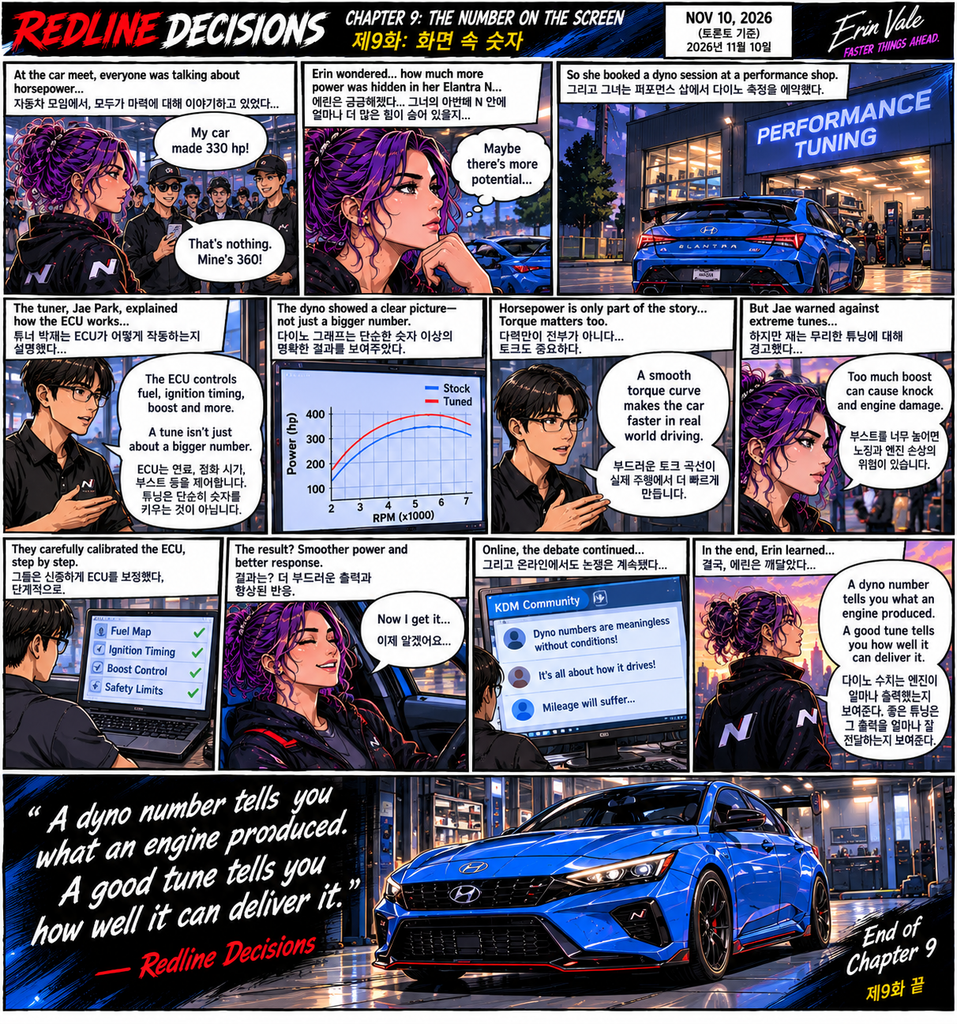
“My car made 330 horsepower,” one driver announced.
Another immediately responded.
“That’s nothing. Mine made 360.”
A third person showed a photograph of a dyno screen.
The numbers were impressive.
Erin looked at her own car.
It was quick, responsive, and enjoyable to drive.
But she wondered how much more potential was hidden inside the engine.
That evening, she began researching ECU tuning.
A few clicks later, she was looking at advertisements promising dramatic horsepower increases.
Some claimed enormous gains from a simple software upgrade.
Others offered aggressive boost targets and performance maps.
The idea was tempting.
What if her Elantra could become substantially faster without changing major mechanical components?
The Dyno Appointment
The following week, Erin visited a performance workshop recommended by Sora Han.
The tuner, Jae Park, welcomed her into the shop.
“So, you’re interested in an ECU tune?”
“I want more power. But I don’t want to damage the engine.”
Jae smiled.
“That’s a better starting point than most people have.”
He explained that the engine control unit, or ECU, managed many aspects of engine operation.
It used information from sensors to control functions such as:
- Fuel delivery.
- Ignition timing.
- Boost pressure.
- Throttle response.
- Variable engine operating strategies.
- Protection systems designed to prevent damage.
Changing the calibration could alter how the engine behaved.
But it wasn’t simply a matter of turning every setting up.
“Before we change anything,” Jae said, “we need to understand what the car is doing right now.”
Establishing a Baseline
Erin’s Elantra was secured on the dynamometer.
The technicians checked the vehicle and prepared the equipment.
Jae explained that a dyno measured power under controlled conditions, allowing them to compare the car before and after calibration.
The first run began.
The engine climbed through the rev range.
The rollers spun beneath the tires.
A graph appeared on the screen.
Erin leaned forward.
“That’s my horsepower?”
“That’s the result from this run, under these conditions,” Jae replied.
He explained that dyno figures could vary depending on the machine, correction method, atmospheric conditions, gear selection, and other factors.
A number from one dyno was not automatically comparable to a number from another.
“That’s why we care about repeatable measurements and the shape of the curve, not just the biggest number.”
He pointed to the graph.
The curve showed how power and torque developed across the engine’s operating range.
Erin noticed that the peak figure was only one part of the story.
A strong, useful torque curve could matter more to the driving experience than a brief peak near the top of the rev range.
The Question of Torque
Jae brought up another graph.
“Horsepower gets all the attention, but torque is important too.”
He explained that torque represented rotational force, while horsepower described the rate at which work was being done.
The relationship between them depended on engine speed.
“So a car with a bigger peak horsepower number isn’t necessarily faster everywhere?”
“Exactly. The power curve, gearing, traction, vehicle weight, and how the engine delivers its power all matter.”
Erin looked at the graph again.
She had been comparing cars using one number.
Now she was beginning to see the larger picture.
The Dangerous Shortcut
Erin showed Jae an online advertisement.
It promised a substantial power increase through an aggressive ECU calibration.
“What about something like this?”
Jae studied the page.
“Marketing makes it sound simple. But a safe calibration depends on the engine, its condition, fuel quality, supporting hardware, and the conditions where the car will operate.”
He explained that excessive ignition advance or unsuitable boost targets could increase the risk of knock.
Knock was abnormal combustion that could damage engine components if not properly controlled.
The ECU used sensors and protective strategies to help manage that risk, but those systems were not an excuse for careless tuning.
“Can you just raise the boost?”
“You can change the target. That doesn’t mean the engine can safely support it.”
Erin closed the advertisement.
She was beginning to understand why the cheapest tune was not necessarily the best deal.
Reading the Data
Jae connected the tuning equipment and reviewed the engine’s operating data.
They examined air-fuel behaviour, ignition timing, boost control, temperatures, and signs of knock activity.
He explained that modern engine management was a balancing act.
The engine needed the correct amount of fuel for its operating conditions.
Ignition timing needed to be appropriate for the fuel and load.
Boost targets had to remain within a safe range for the engine and its supporting components.
And the calibration needed to account for real-world driving, not just one impressive dyno pull.
“An engine doesn’t live on a dyno,” Jae said.
“It has to deal with different temperatures, different loads, different fuel batches, and everyday driving.”
Erin nodded.
A tune that looked impressive for a few seconds might not be suitable for an entire ownership experience.
The Calibration
Jae proposed a conservative calibration designed around Erin’s existing hardware and intended use.
They would prioritize smooth power delivery, predictable throttle response, and appropriate safety margins.
The process involved repeated adjustments and controlled dyno runs.
After each change, Jae reviewed the data.
He didn’t simply chase the highest number.
He watched how the engine responded.
If a change produced an undesirable result, he adjusted it or returned to the previous setting.
Erin watched the process.
It was less dramatic than she expected.
There was no magical button.
No instant transformation.
Just careful measurement, adjustment, and verification.
Eventually, Jae was satisfied with the result.
The final graph showed a useful improvement across much of the operating range.
But the most important difference was how the engine delivered its power.
The response was smoother and more consistent.
The Test Drive
Erin took the Elantra onto a familiar road for a controlled test.
She accelerated gently.
The engine responded cleanly.
She increased the throttle.
The power delivery felt more immediate, but not unpredictable.
There was no sudden surge that made the car difficult to manage.
Back at the workshop, she looked at Jae.
“So, how much horsepower did I gain?”
He showed her the before-and-after graphs.
“There’s an improvement. But remember, those numbers belong to this dyno and these test conditions.”
Erin smiled.
“I think I finally understand.”
“Understand what?”
“I’m not buying a number. I’m improving the way the car works.”
Jae nodded.
“Now you’re thinking like a tuner.”
The Online Debate
That evening, Erin returned to the same car community.
The conversation had moved on to another horsepower competition.
Someone posted a dyno sheet.
Another person questioned the correction factor.
A third argued that the result was meaningless without knowing the fuel and testing conditions.
Erin watched the discussion.
A few weeks earlier, she would have wanted to join the competition.
Now she had a different question.
“How does it drive?”
The group went quiet for a moment.
One driver replied.
“Pretty good, actually.”
Erin smiled.
That was the answer she wanted to hear.
The Final Decision
Back in her garage, Erin opened the tuning report.
She saved the original calibration information and the final results.
She also recorded the fuel requirements and maintenance recommendations provided by the tuner.
She knew that future modifications could change what the engine needed.
Any significant hardware change would require the calibration to be reviewed again.
She closed the laptop and looked at the Elantra.
The car had more power now.
But the biggest improvement wasn’t the number on the screen.
It was knowing why the engine behaved the way it did.
Erin started the car.
The engine settled into a smooth idle.
She smiled.
“More power is easy to advertise,” she said.
“Good calibration is harder to prove.”
She turned off the garage lights.
The next modification could wait.
For now, the engine was doing exactly what she had asked it to do.
Final Line:
“A dyno number tells you what an engine produced. A good tune tells you how well it can deliver it.”
End of Chapter 9
한국어 버전
레드라인 디시전스
제9화: 화면 속 숫자
더 많은 출력에 대한 유혹
에린 베일은 이제 자동차 성능에 관한 용어에 익숙해져 있었다.
마력.
토크.
부스트 압력.
다이노 그래프.
자동차 모임에 갈 때마다 누군가는 자신의 엔진이 얼마나 강력한 출력을 내는지 이야기하고 있었다.
어느 토요일, 에린은 파란색 현대 아반떼 N 옆에 서서 튜닝 결과를 비교하는 사람들을 지켜보고 있었다.
“내 차는 330마력이야.”
한 운전자가 자신 있게 말했다.
다른 사람이 곧바로 대답했다.
“그 정도는 별거 아니지. 내 차는 360마력이야.”
세 번째 사람은 다이노 측정 화면을 찍은 사진을 보여 줬다.
숫자는 인상적이었다.
에린은 자신의 차를 바라봤다.
이미 충분히 빠르고, 반응도 좋았으며, 운전하는 재미도 있었다.
하지만 엔진 안에 아직 얼마나 많은 잠재력이 숨어 있는지 궁금해졌다.
그날 저녁, 그녀는 ECU 튜닝을 검색하기 시작했다.
몇 번의 클릭만으로 엄청난 출력 향상을 약속하는 광고들이 나타났다.
간단한 소프트웨어 업그레이드만으로 큰 폭의 출력 상승이 가능하다는 업체도 있었다.
공격적인 부스트 설정과 고성능 맵을 제공한다는 곳도 있었다.
유혹적이었다.
주요 기계 부품을 교체하지 않고도 아반떼를 훨씬 빠르게 만들 수 있다면 어떨까?
다이노 예약
다음 주, 에린은 한소라가 추천한 퍼포먼스 튜닝 전문점을 방문했다.
튜너인 박재가 그녀를 맞이했다.
“ECU 튜닝에 관심이 있으신가요?”
“출력을 높이고 싶어요. 하지만 엔진을 망가뜨리고 싶지는 않아요.”
재는 미소를 지었다.
“대부분의 사람보다 훨씬 좋은 출발점이네요.”
그는 ECU, 즉 엔진 제어 장치가 엔진 작동의 여러 부분을 관리한다고 설명했다.
각종 센서에서 정보를 받아 다음과 같은 기능을 제어한다.
- 연료 분사량.
- 점화 시기.
- 부스트 압력.
- 스로틀 반응.
- 엔진의 다양한 작동 전략.
- 엔진 손상을 방지하기 위한 보호 기능.
ECU의 보정값을 변경하면 엔진의 작동 특성도 달라질 수 있었다.
하지만 모든 설정을 무조건 높이는 단순한 작업은 아니었다.
“무엇을 바꾸기 전에,” 재가 말했다. “현재 자동차가 어떻게 작동하는지부터 알아야 합니다.”
기준점 만들기
에린의 아반떼는 다이노 장비 위에 고정됐다.
정비사들은 차량 상태와 장비를 점검하고 측정을 준비했다.
재는 다이노가 통제된 조건에서 출력을 측정하기 때문에 튜닝 전후의 변화를 비교하는 데 도움이 된다고 설명했다.
첫 번째 측정이 시작됐다.
엔진 회전수가 올라갔다.
타이어 아래의 롤러가 회전했다.
화면에 그래프가 나타났다.
에린은 몸을 앞으로 기울였다.
“저게 제 차의 마력이에요?”
“이번 측정에서, 지금 조건으로 나온 결과입니다.” 재가 대답했다.
그는 다이노 장비의 종류와 보정 방식, 대기 조건, 기어 선택 등 여러 요인에 따라 측정값이 달라질 수 있다고 설명했다.
한 장비에서 나온 숫자를 다른 장비의 숫자와 무조건 직접 비교할 수는 없었다.
“그래서 우리는 가장 높은 숫자만 보는 게 아니라 반복해서 측정할 수 있는 결과와 그래프의 형태를 중요하게 생각합니다.”
그는 그래프를 가리켰다.
그래프는 엔진 회전수에 따라 출력과 토크가 어떻게 변화하는지 보여 줬다.
에린은 최고 출력 수치가 전체 이야기의 일부에 불과하다는 것을 깨달았다.
회전수의 특정 지점에서 잠깐 나타나는 최고 출력보다 넓은 영역에서 유용한 토크를 제공하는 것이 실제 운전에서는 더 중요할 수도 있었다.
토크에 관한 질문
재는 또 다른 그래프를 띄웠다.
“마력이 모든 관심을 받지만 토크도 중요합니다.”
그는 토크가 회전력을 의미하고, 마력은 일정 시간 동안 얼마나 많은 일을 하는지를 나타내는 출력의 개념이라고 설명했다.
두 수치의 관계는 엔진 회전수에 따라 달라졌다.
“그러면 최고 마력이 더 높은 차가 모든 상황에서 더 빠른 건 아니네요?”
“정확합니다. 출력 곡선과 기어비, 접지력, 차량 무게, 그리고 엔진이 출력을 전달하는 방식까지 모두 중요하죠.”
에린은 다시 그래프를 바라봤다.
그동안 그녀는 단 하나의 숫자로 자동차를 비교하고 있었다.
이제 더 넓은 그림이 보이기 시작했다.
위험한 지름길
에린은 재에게 인터넷 광고 하나를 보여 줬다.
공격적인 ECU 보정으로 상당한 출력 상승을 약속하는 제품이었다.
“이런 건 어떨까요?”
재는 광고 페이지를 살펴봤다.
“마케팅은 간단한 작업처럼 설명하죠. 하지만 안전한 보정은 엔진 상태와 연료 품질, 보조 부품, 실제 운행 조건에 따라 달라집니다.”
그는 지나치게 앞당겨진 점화 시기나 적절하지 않은 부스트 목표가 노킹 위험을 높일 수 있다고 설명했다.
노킹은 정상적이지 않은 연소 현상으로, 제대로 제어되지 않으면 엔진 부품을 손상시킬 수 있었다.
ECU에는 이런 위험을 관리하기 위한 센서와 보호 전략이 있지만, 그렇다고 부주의한 튜닝을 해도 된다는 뜻은 아니었다.
“그냥 부스트를 높이면 안 되나요?”
“목표값을 변경할 수는 있죠. 그렇다고 엔진이 그 압력을 안전하게 견딜 수 있다는 뜻은 아닙니다.”
에린은 광고를 닫았다.
가장 저렴한 튜닝이 반드시 가장 좋은 선택은 아니라는 사실을 이해하기 시작했다.
데이터를 읽다
재는 튜닝 장비를 연결하고 엔진의 작동 데이터를 검토했다.
공연비 변화와 점화 시기, 부스트 제어, 온도, 노킹 발생 징후 등을 확인했다.
그는 현대 엔진 관리가 균형을 맞추는 작업이라고 설명했다.
엔진은 작동 조건에 맞는 정확한 연료량이 필요했다.
점화 시기는 연료와 부하에 적합해야 했다.
부스트 목표는 엔진과 관련 부품이 안전하게 감당할 수 있는 범위에 있어야 했다.
그리고 튜닝은 인상적인 다이노 측정 한 번만을 위한 것이 아니라 실제 주행 환경까지 고려해야 했다.
“엔진은 다이노 위에서만 작동하는 게 아닙니다.” 재가 말했다.
“서로 다른 온도와 부하, 연료 상태, 일상적인 운전 환경까지 모두 견뎌야 하죠.”
에린은 고개를 끄덕였다.
몇 초 동안 인상적인 결과를 보여 주는 튜닝이 자동차를 소유하는 전체 기간에 적합한 것은 아닐 수 있었다.
ECU 보정
재는 에린의 기존 하드웨어와 실제 운전 목적에 맞춘 보수적인 ECU 보정을 제안했다.
부드러운 출력 전달과 예측 가능한 스로틀 반응, 적절한 안전 여유를 우선하기로 했다.
작업은 반복적인 설정 변경과 통제된 다이노 측정으로 진행됐다.
변경할 때마다 재는 데이터를 검토했다.
그는 단순히 가장 높은 숫자를 쫓지 않았다.
엔진이 어떻게 반응하는지 살폈다.
어떤 변경이 바람직하지 않은 결과를 만들면 설정을 조정하거나 이전 값으로 되돌렸다.
에린은 그 과정을 지켜봤다.
생각보다 극적인 작업은 아니었다.
마법 같은 버튼도 없었다.
순식간에 자동차가 변하는 일도 없었다.
그저 신중한 측정과 조정, 검증이 반복될 뿐이었다.
마침내 재는 결과에 만족했다.
최종 그래프는 엔진 작동 영역의 상당 부분에서 유용한 개선을 보여 줬다.
하지만 가장 중요한 차이는 엔진이 출력을 전달하는 방식이었다.
반응은 더 부드럽고 일관적이었다.
시운전
에린은 익숙한 도로에서 아반떼를 조심스럽게 테스트했다.
부드럽게 가속했다.
엔진은 깨끗하게 반응했다.
스로틀을 더 열었다.
출력은 더 즉각적으로 느껴졌지만 예측하기 어려울 정도는 아니었다.
차량을 통제하기 힘들게 만드는 갑작스러운 출력 폭발도 없었다.
작업장으로 돌아온 에린은 재를 바라봤다.
“그래서 마력은 얼마나 늘었어요?”
재는 튜닝 전후 그래프를 보여 줬다.
“개선됐습니다. 하지만 이 수치는 이 다이노 장비와 이번 측정 조건에서 나온 결과라는 점을 기억하세요.”
에린은 미소를 지었다.
“이제 조금 이해한 것 같아요.”
“무엇을요?”
“저는 숫자를 구매하는 게 아니네요. 자동차가 작동하는 방식을 개선하는 거예요.”
재는 고개를 끄덕였다.
“이제 튜너처럼 생각하기 시작했군요.”
온라인 논쟁
그날 저녁, 에린은 다시 자동차 커뮤니티에 접속했다.
대화 주제는 또 다른 마력 경쟁으로 바뀌어 있었다.
누군가는 다이노 측정표를 올렸다.
다른 사람은 보정 계수에 의문을 제기했다.
또 다른 사람은 연료와 측정 조건을 모르면 결과에 의미가 없다고 주장했다.
에린은 논쟁을 지켜봤다.
몇 주 전이었다면 그녀도 그 경쟁에 참여하고 싶었을 것이다.
하지만 이제는 다른 질문이 떠올랐다.
“그래서 실제로 운전하면 어떤가요?”
잠시 대화가 조용해졌다.
한 운전자가 대답했다.
“사실 꽤 괜찮아요.”
에린은 미소를 지었다.
그녀가 듣고 싶었던 대답이었다.
최종 결정
차고로 돌아온 에린은 튜닝 보고서를 열었다.
기존 ECU 보정 정보와 최종 결과를 저장했다.
튜너가 제공한 연료 요구 사항과 정비 권장 사항도 기록했다.
앞으로 다른 부품을 변경하면 엔진에 필요한 조건도 달라질 수 있다는 사실을 알고 있었다.
중요한 하드웨어 변경이 있다면 ECU 보정도 다시 검토해야 했다.
그녀는 노트북을 닫고 아반떼를 바라봤다.
이제 자동차는 더 높은 출력을 낼 수 있었다.
하지만 가장 큰 변화는 화면 속 숫자가 아니었다.
엔진이 왜 그런 방식으로 작동하는지 이해하게 됐다는 점이었다.
에린은 시동을 걸었다.
엔진은 부드럽게 공회전했다.
그녀는 미소를 지었다.
“더 많은 출력은 광고하기 쉽지.”
그녀가 조용히 말했다.
“좋은 보정은 증명하기가 더 어려워.”
그녀는 차고의 조명을 껐다.
다음 튜닝은 기다려도 됐다.
지금은 엔진이 자신이 원하는 방식으로 정확히 작동하고 있었다.
마지막 한마디
“다이노 수치는 엔진이 얼마나 많은 출력을 냈는지 보여 준다. 좋은 튜닝은 그 출력을 얼마나 잘 전달할 수 있는지 보여 준다.”
제9화 끝